TIP OF THE DAY: Make A Gourmet Hoagie
|
May 5th is National Hoagie Day. November 4th is National Submarine Sandwich Day. And someone decided that we needed a National Eat A Hoagie Day on September 14th and Submarine-Hoagie-Grinder Day on October 9th.
These sandwiches are fraternal triplets. The names were different depending on their origins, but all were initially hearty sandwiches of meat and cheese. The hoagie, on a crusty, oblong roll (or a portion of a loaf of French or Italian bread), is piled high with Italian cold cuts or other lunch meats, provolone and perhaps another cheese. Garnishes typically include sweet and/or hot peppers, lettuce, tomatoes, onions, oregano and a vinegar and olive oil dressing. In Europe, this type of sandwich is known as a baguette or a ciabatta, after the type of bread used. One of the prevailing explanations of the name “hoagie” is that it was introduced by Italian Americans working at the shipyard known as Hog Island, in southwest Philadelphia, during World War II. It became known as the “Hog Island sandwich,” which evolved to “hoagie.” But the sandwich had earlier roots with New York Italians. According to some food historians, the progenitor of the sandwich—but not the name—originated in the late 19th century to serve Italian laborers, who wanted the convenient lunch they had enjoyed in Italy. It’s another name for the same type of sandwich. The submarine, or sub, has at least two claims to invention; plausibly, it may have occurred in both places. The first location is Boston at the beginning of World War I, at a local restaurant that served Navy servicemen stationed at the Charlestown Navy Yard. The bread was a specially baked baguette intended to resemble the hull of the submarines after which it was named. |

[1] A classic hoagie with Italian-style cold cuts. Photo courtesy Dietz & Watson.
|
|
|
Another claim credits Dominic Conti (1874–1954), an Italian immigrant who started Dominic Conti’s Grocery Store on Mill Street in Paterson, New Jersey in 1910. According to Wikipedia, he named the sandwich in 1918, after seeing a recovered submarine in the Paterson Museum Of History. Conti’s granddaughter recounts that he was selling traditional Italian sandwiches made on long, crusty rolls, filled with cold cuts, lettuce, tomatoes, peppers, onions, oil, vinegar, Italian herbs, spices, salt and pepper. The sandwich started with a layer of cheese and ended with a layer of cheese so the bread wouldn’t get soggy. |
||

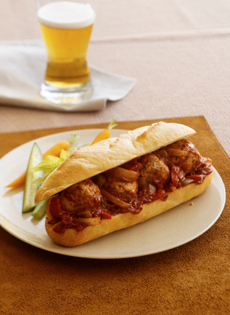 [3] The popular meatball sub (or hoagie) (photo by Jill Chen | IST). |
THE GRINDER? THE HERO? The Grinder: Per Wikipedia, grinder is common term in New England that may have derived from Italian-American slang for a dock worker, among whom the sandwich was popular. Another claim is that it was called a grinder because it took a lot of chewing to eat the hard-crust bread. Wikipedia also claims that in Delaware, New York, Pennsylvania and parts of New England, grinder usually refers to a hot submarine sandwich (meatball or sausage, e.g.), whereas a cold cuts sandwich is called a submarine/sub [source]. The Hero: New York City called its version a hero sandwich, likely owing to its size and substance. The name is sometimes credited to New York Herald Tribune food writer Clementine Paddleford, who wrote (in the 1930s) that “you needed to be a hero to finish the gigantic Italian sandwich.” Depending on the region, the sandwich is also called a po’ boy, torpedo, zeppelin and no doubt, other names. |
|
|
CELEBRATE WITH A GOURMET HOAGIE Build yourself a gourmet hoagie to celebrate National Hoagie Day. Use these upgrades to the classic Italian deli meats, or create your own recipe. |
||

