THE NIBBLE BLOG: Products, Recipes & Trends In Specialty Foods
Also visit our main website, TheNibble.com.
|
November 20, 2007 at 1:58 pm
· Filed under Food Holidays & More
|
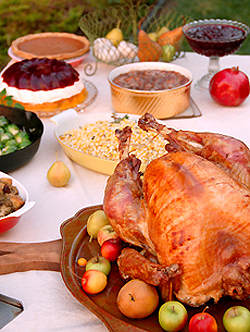
Can you really eat all this without feeling
more stuffed than that turkey?
|
|
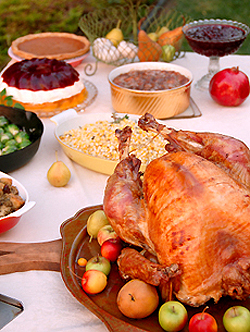
Not that we didn’t have an inkling, but the average person eats 4,500 calories and 229 grams of fat on Thanksgiving, according to the New York Times. Starting with cocktails before dinner—and perhaps some mixed spiced nuts and fat-laden dips—those calories and fats start to pile up. The butter on the Brussels sprouts and the biscuits, the sugar in the cranberries, the carbs in the stuffing…oh sure, be the Grinch Who Ruined Thanksgiving. Here’s our solution:
– No calorie-laden cocktails, just wine spritzers, nicely diluted with club soda.
– Steer clear of the hors d’oeuvres—not just because of the calories, but because they will fill you up and you’ll be in pain before dessert arrives.
– Eat lots of roast turkey—the most low calorie and healthy food on the table—and just take quarter-cup portions of everything else. |
– Forget the biscuits and cornbread—you can have them any day of the year. They’ll just fill you up and cause your buttons to pop. Have two bites if you must; then roll the rest up in a napkin, out of sight. Ask to take a piece home for breakfast. Save your calories for dessert.
– Drink judiciously through dinner. Alternate every glass of wine with a glass of water.
– If you’re too full for dessert, have a bite and ask to take the rest home. Then you won’t feel left out.The key thing to remember is that your family or friends will be happy to send you home with a plate of food. You don’t have to eat it all in one meal: You can enjoy the rest tomorrow. And if you live in the home where the dinner is being served—it will be there for the next two or three days! Follow these tips and you won’t go into a “food coma.” Yes, we have a lot to be thankful for—including the bounty set before us. But we can also be thankful for the will not to eat it all. |
|
|
Permalink
|
|
November 20, 2007 at 1:33 pm
· Filed under Cheese-Yogurt-Dairy, Food Holidays & More
|
| If you’re serving a cheese course on Thanksgiving, we hope it’s American cheese. Some of the greatest cheese artisans in the world work right here in the U.S.A.—and they’ve been earning top awards at world cheese competitions (see details in the Cheese Section of THE NIBBLE online magazine). It would be un-American to bring a Roquefort or a British Cheddar to the table on our day of national thanksgiving. Instead, bring one of the incredible blues from Rogue River Creamery or Point Reyes Farmstead, a great goat cheese from Cypress Grove Chèvre, a Fiscalini Cheddar from California—or any one of a thousand fine American cheeses (there were more than 1,200 at this year’s American Cheese Society competition). If you’d like to send someone a gift basket of American cheeses, MurraysCheese.com has several selections—but call or click over today in time for overnight delivery tomorrow. |
|

The “Pioneer Picks” gift basket from MurraysCheese.com. All-American cheeses and goodies to go with them (honey, nuts and
crackers). |
| As far as that product known as “American Cheese,” we’d like to have the name changed because it defames everything thing that is great about American cheeses; but it has a patent as well as a standard under the U.S. Code of Federal Regulations. Want to know what “American cheese” is? “Pasteurized processed American cheese” (it can be called processed or process cheese) is made of scraps of Cheddar or Colby that otherwise would be unsalable (it can also be made of cheese curd and granular cheese). Processing forms them into new presentable shapes, adding emulsifiers so they will melt smoothly. That’s why American cheese is so popular on hamburgers, grilled cheese sandwiches and cheese omelets—it does not separate or not run off (nor does it provide much flavor). There are other types of processed cheese, including prominent brands like Laughing Cow, which originated in Europe. Processed cheese often contains as little as 51% cheese; Velveeta, which cannot be called cheese but “cheese food,” contains even less. Processed cheese was invented in 1911 by Walter Gerber in Switzerland, but James L. Kraft of Chicago first applied for an American patent for his improved method in 1916. Kraft Foods introduced the first sliced process cheese to stores in 1950. The rest is history. Hmm. |
|
|
Permalink
|
|
November 19, 2007 at 11:12 am
· Filed under Condiments, Kosher Nibbles
|
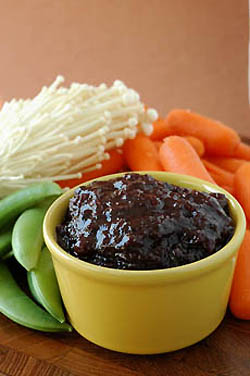
Cousin to a spicy honey mustard, Nip ’n Tang adds the bite of horseradish.
|
|
Perhaps one of the most versatile condiments around, Nip ‘n Tang combines fruit and horseradish for a sweet and spicy profile—sweet fruit and spicy/tangy horseradish. If you like peach and mango salsa and honey mustard, you’ll like Nip ‘n Tang. The flavor combination makes it versatile as a spread, dip, salad dressing and marinade component, meat and poultry glaze and unusual topping (try the sweeter flavors with plain or vanilla yogurt or on vanilla ice cream). The line is all natural, allergen and fat free and certified kosher. We particularly like the Blueberry and the Cranberry Orange, both of which would be terrific on turkey sandwiches this Friday. Read the full review.
Read about more of our favorites in the Condiments Section and the Salsas & Dips Section of online magazine. |
| |
|
|
Permalink
|
© Copyright 2005-2026 Lifestyle Direct, Inc. All rights reserved. All images are copyrighted to their respective owners.