|
We love food garnishing, making each dish or drink special with tasty, edible decor (here’s a basic book to start with).
A lemon or lime wedge, for example, is nothing special. But you can make it so by cutting small grooves, or channels, in the rind.
To do this, you need a small tool call a stripper (a channel knife), which is available by itself or as a combination stripper/zester (and also available in a left-handed version).
For cutting wheels or serving a half-lemon with seafood, first strip the citrus vertically, from top to bottom. For wedges, first, strip the citrus horizontally.
The stripping tool works with any citrus or hard fruit (apples, for example). The peel you strip away can be added to tea, salads, baked goods, and other recipes; or you can wrap it in plastic and save it in the fridge or the freezer to garnish seafood, vegetable dishes, and anything that pairs well with the citrus.
You can use stripped wedges or wheels for everything from drinks to seafood. We’ve already stripped our citrus for this evening’s cocktails.
So we now transition to cocktails:
Have you ever had a Cognac cocktail?
|
|
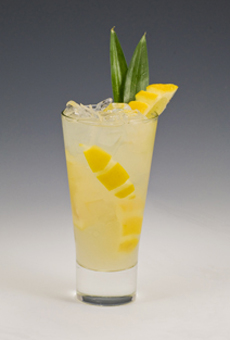
Give your citrus garnishes a glamorous look. Photo courtesy Courvoisier. |
Here’s a refreshing drink from Courvoisier that combines Cognac with apple juice and ginger, and lime wedges for garnish that look so much better when they’ve been “stripped.” Just run the stripper vertically down from the top to the bottom of the citrus.
After you check out the recipe, take a look at the basics of Cognac, below.
RECIPE: COGNAC COOLER
Ingredients Per Drink
2 parts Courvoisier VS Cognac (you can use VSOP, but VS is less expensive and fine for mixed drinks)
2 parts ginger beer
Apple juice to top
2 lime wedges
Cubed ice
Preparation
1. BUILD all ingredients in a highball glass over ice, pouring in the ginger beer last.
2. GARNISH with squeezed lime wedges.
|

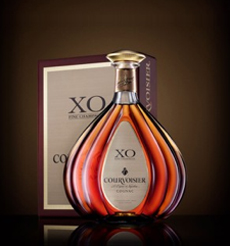
XO Cognac is costly, but worth the
experience. Photo courtesy Courvoisier. |
|
WHAT IS COGNAC
Brandy is a spirit distilled from grapes. Cognac is a type of brandy made only from white grapes; brandy can use white and/or red grapes.
Cognac is named after the town of Cognac in France, and only spirits distilled in the region, following strict rules imposed by the Bureau National Interprofessionnel du Cognac (BNIC), can be called Cognac.
By law, Cognac must be twice distilled in copper pot stills, then aged at least two years (often considerably longer) in French oak barrels from the French forests of Limousin or Tronçais, where it matures in the same way that fine whiskey and wine matures.
The result is: divine!
|
THE DIFFERENT TYPES OF COGNAC
There are official quality grades of Cognac based on age, established by the BNIC. As with all spirits, prices climb along with the length of barrel aging.
However, in the ongoing game of marketing new products, some Cognac producers release their own expressions (for example, C by Courvoisier and Remy Martin Coeur de Cognac, and the more comprehensible Courvoisier 12 and Courvoisier 21), which have no official designation but can really tax a Cognac buyer to figure out what’s in the bottle.
Official designations include:
V.S. or Very Special, a blend in which the youngest Cognac in the blend has been aged for at least two years in cask.
V.S.O.P., or Very Superior Old Pale, is a blend in which the youngest Cognac is stored for at least four years in a cask, although the average age of the blend is much older.
Vieux is a grade between the official grades of VSOP and XO.
Napoleon is another grade between VSOP and XO, equal to XO in terms of minimum age, but it is generally marketed in-between VSOP and XO in terms of price.
XO, Extra Old, is a blend in which the youngest Cognac in the blend is stored for at least six years* but is typically an average of 20 years.
Hors d’Âge, “Beyond Age,” refers to high quality Cognac that does not have an official age scale, but is considered equal to XO.
Vieille Réserve is, like Hors d´Âge, a grade beyond XO that does not have a specific, legal age minimum.
Extra, in which the youngest Cognac in the blend is 6 years of age, this grade is usually older than a Napoleon or an XO.
Why are the names of the different grades in English, rather than French?
Because England was long the primary market for Cognac, and the British importers/merchants named them.
Fine Champagne does not refer to age, but the provenance of the grapes: a blend of Grande and Petite Champagne Cognacs, with at least half coming from Grande Champagne.
WHAT IS FINE CHAMPAGNE COGNAC
More confusion: It has nothing to do with the wine-producing region of Champagne.
There are six different districts (called cru in French) within Cognac. Each has been graded by the government according to the quality of the grapes and Cognac produced there. The best district is Grande Champagne, followed by Petite Champagne, Borderies, Fins Bois, Bons Bois and Bois Ordinaires.
A Cognac bottle labeled “Fine Champagne,” is as good as it gets in its age level.
Time for a drink!
_________________
*In 2016, the minimum age of the youngest Cognac used in an XO blend will be increased to 10 years.
CHECK OUT WHAT’S HAPPENING ON OUR HOME PAGE, THENIBBLE.COM.
|
|