Butternut squash ravioli. Photo courtesy Pom
Wonderful. Here’s the recipe. |
|
When studying culinary history, you learn lots of fun food facts. For example, in the history of pasta, Marco Polo may have brought pasta back from China—but it wasn’t spaghetti or other “long cut” pasta, and it wasn’t “short cut” pasta like farfalle (bowties) or penne.
Credit for the spread of boiled pasta in the West is given to Arabs traders who packed dried spaghetti-type pasta on long journeys over the famed “Silk Road” to China. It was easy to reconstitute into a hot meal along desolate trails. They brought it to Sicily during the Arab invasions of the 8th century and planted the seeds of an Italian culinary breakthrough.
There are records of pasta in Italy before Marco Polo returned from the Far East (he set out in 1271 and returned in 1295). In 1279, in his last will and testament, a Genoan soldier named Ponzio Baestone bequeathed “bariscella peina de macarone,” a small basket of macaroni.
So what part did Marco Polo play? The record is so scant, we’ll never know; but it is conjectured that he brought back “pillow pasta”—boiled dumplings that evolved into agnolotti and ravioli.
|
Polo returned from the Far East at the very end of the 13th century. The earliest mention of ravioli appears in the writings of Francesco di Marco, a merchant of Prato in the 14th century, and other 14th century mentions follow. (Source: Wikipedia)
Here’s a brief history of pasta.
TYPES OF PILLOW PASTA
Pillow pasta is stuffed pasta, but not all stuffed pasta is pillow pasta. The other sub-category includes the large tubes that are stuffed and baked, like manicotti. (Other tube pasta, such as penne, rigatoni and ziti, are too small to be stuffed but are covered with heavier sauces, which are meant to catch in the hollows of the tubes.)
Pillow pasta comprises fresh pasta sheets stuffed with a filling. The filling is placed on the flat sheet of pasta, another sheet is placed on top, the shapes are cut and the edges are sealed.
The pasta can be stuffed with almost any kind of filling, either single or combinations of different meats, cheeses, vegetables, seafood and herbs.
They can be sauced, tossed with butter or olive oil, or added plain to soups.
How many of these pillow pastas have you had?
|
|
Agnolotti: Small stuffed pasta in the shape of a half moon, similar to mezzalune and pierogi. The term is Italian for “priests’ caps.” Photo.
Cannelloni: Rectangular sheets of pasta dough that are filled and rolled into tube shapes. The name is Italian for “large reeds.” They can easily be confused with manicotti, which are pre-formed tubes that are stuffed (the word comes from the Italian word manica, sleeve).
Gnocchi: These oval bites are technically dumplings, and do not have a noodle wrap. But because they’re pillowy bites we want to include them on this list. Gnocchi can be made of semolina or potatoes with cheese or eggs added to the dough. They can be flavored with basil, saffron, spinach or tomato, then boiled, baked or even fried.
Mezzalune: Literally “half moons,” a crescent-shaped stuffed pasta.
Ravioli: The original “pillow pasta” can be oval, rectangular, round, square, sunflower-shaped (called girasole) and triangular (called pansotti). There are also specialty shapes, from fish to hearts. The name is a diminutive of rava, little turnip, which may or may not have been an early stuffing.
Raviolini: Miniature ravioli. They can be served as a pasta dish, hors d’oeuvres or put into soup, like won tons.
Ravioloni: Very large ravioli. They can be as large as three-inch circles and four inch squares or rectangles. In this photo, you can see that the piece at the right is almost as long as the fork.
|
|
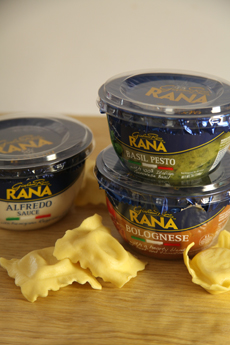
Giovanni Rana’s tasty ravioli and sauces. Photo by Elvira Kalviste | THE NIBBLE.
|
Sacchette: Sacks, or “beggar’s purses.” (More)
Tortellini: Thin strips of raw filled pasta pinched to form a navel-like shape. A popular dish with sauce, it is also served in soups, as in the classic dish, tortellini in brodo. We serve them as cocktail party appetizers with a dip. More.
GIOVANNI RANA PASTA
We recently celebrated March 20th, National Ravioli Day by pigging out on a huge supply of Giovanni Rana pasta, along with another fresh pasta brand.
Hands down, Giovanni Rana was the winner. The venerable Italian artisan producer—who now makes most of the products for the U.S. market here—uses ingredients that are top-knotch; you can taste the difference. We were sent four of the seven varieties ravioli: Artichoke, Cheese “Delicato,” Cheese “Forte” and Spinaci e Ricotta, plus four sauces.
The other flavors including Caprese (basil and mozzarella), Chicken Rosemary and Mushroom. We’ll be seeking them out. (The company also makes tortellini, long cut pasta and gnocchi.)
The ravioli, sold fresh in bags, cook up in two minutes—it takes longer to heat the sauce! The sauces are very dense; a little goes a long way.
Ravioli Vs. Tortellini: A Revelation
After tasting the prosciutto tortellini at the same time as the ravioli, we’ll probably never buy tortellini again.
With all due respect to this popular dish and the quality of Giovanni Rana’s product, we had a revelation: It’s too much pasta and not enough filling. Since one eats pillow pasta for the filling, there’s too little of it in tortellini to deliver on expectations.
Check out all of the delicious pastas at GiovanniRana.com.
If you’re in New York City, head to Chelsea Market, where Giovanni Rana has a restaurant (cucina) and fresh pasta shop (pastificio).
|
|