What Are Stone Fruits & A Stone Fruit Naked Cake Recipe - The Nibble Webzine Of Food Adventures Summer Naked Cake Recipe | The Nibble Webzine Of Food Adventures


THE NIBBLE BLOG: Products, Recipes & Trends In Specialty Foods


Also visit our main website, TheNibble.com.

What Are Stone Fruits & A Stone Fruit Naked Cake Recipe

Updated August 2026

The summer’s selection of stone fruits are begging for a naked cake. June through September is prime stone fruit season in the U.S.

Below:

> What are stone fruits?

> Recipe: naked cake with stone fruits.

> Recipe: berry fruit purée (a sauce for the cake).

> The year’s 14 stone fruit holidays.

Elsewhere on The Nibble:

> What’s naked cake?

> The history of apricots.

> The history of cherries.

> The history of peaches.

> The history of mangoes.

> 20 ways to enjoy apricots.

> The year’s 80 fruit holidays.
 
Assorted Stone Fruits
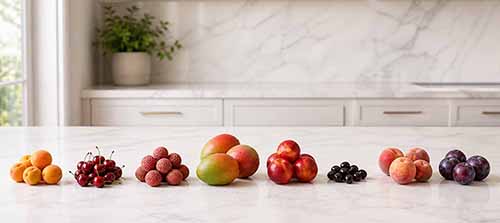
[5] Stone fruits from left to right: apricots, cherries, lychees, mangoes, nectarines, olives, peaches, and plums.
 
 
1. WHAT ARE STONE FRUITS?

Stone fruits are members of the Prunus genus. Most stone fruits are native to warmer climates. That’s why in the U.S., much of the local supply comes in July and August. They include:

  • Apricots
  • Cherries
  • Lychees
  • Mangoes
  • Nectarines
  • Olives
  • Peaches
  • Plums
  • Cross-breeds such as apriums, plumcots and pluots
  •  
    Among botanists, a stone fruit is also called a drupe: a category of fruit with a large, hard stone (pit) inside fleshy, edible fruit, and thin skin.

    The stone (pit) is often thought of as the the seed, but the seed is actually inside the stone.

    Not all drupes are stone fruits. Here are more members of the family:

  • Nuts such as almonds, pecans and walnuts are examples of the seeds inside the stones. They’re also drupes, but a type in which we eat the seed inside the pit instead of the surrounding fruit.
  • Coconut.
  • Bramble fruits such as blackberries and raspberries.
  •  
    Not all drupes have single large stones.

  • Raspberries are a good example. To see their stones, the fruit has to be carefully broken open. Then, the tiny stones can be seen inside (that’s why raspberry “seeds,” or drupelets, are so crunchy). They are called stones because botanically, the seeds keep their covering (called an endocarp)— not because the seeds are large and hard.
  •  
    Not every fruit with a large stone is a drupe.

  • Avocado is actually a berry, not a stone fruit (more). Berries are a different genus in the same botanical family as drupes.
  • Drupe cousins: Drupes are members of the Rosaceae family—the rose family—which includes shrubs as well as other prominent fruits in non-drupe genera, such as apples, loquats, pears, quinces and strawberries.
  •  
    BONUS: You’ve just read through a lot of botany. You deserve this song from Ray Charles.

      Stone Fruit Stack Cake
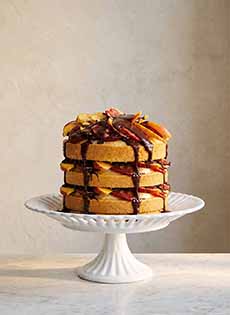
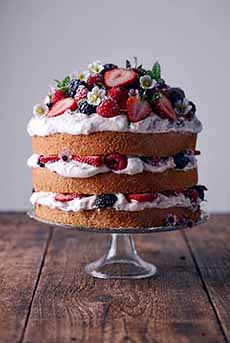
    [1] It’s pretty easy to slice a pound cake, fill the layers with stabilized whipped cream, and add sliced fruits and more whipped cream or fruit purée are a light, luscious summer dessert (photo Wife Mama Foodie | Facebook).

    Naked Cake Fresh Figs
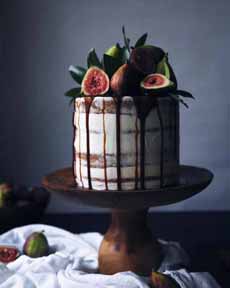
    [2] Does a light swath of icing make this a semi-naked cake? This recipe, from Wife Mama Foodie, is a spice cake topped with fresh figs. Figs aren’t stone fruit, but they’re a luscious summer fruit.

    Mixed Berry Stack Cake
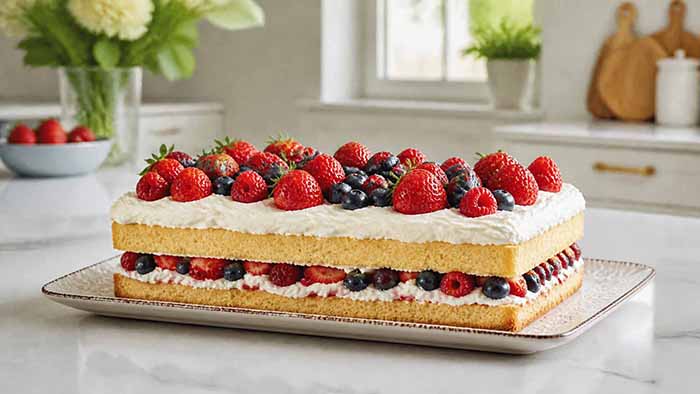
    [3] We actually prefer mixed berries to all strawberries. This naked cake is calling our name (photo Wife Mama Foodie | Facebook).

    Better Crocker Pound Cake Mix
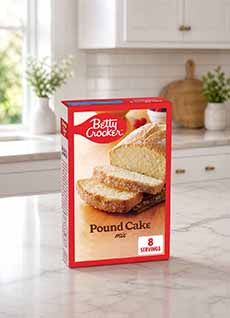
    [4] If you don’t like to measure, use a box mix. But The Kitchn proves it’s not a time saver (photo © The Nibble).

     
    Berry Shortcake
    [6] Hack: Buy a pound cake (photo © The Baker Chick).
     
     
    2. RECIPE: NAKED CAKE WITH MIXED STONE FRUITS

    Naked Cake is just the thing for summer. It requires no frosting on the sides, although some bakers like to use a thin swath of it.

    Here’s more about naked cake, with plenty of photos of different presentations.

    You can make any layer cake, but we prefer our homemade pound cake recipe (it’s more buttery). And guess what: box mixes don’t save time. The Kitchn did side-by-side tests; here are the results.

    What you do save is a wee bit of clean-up, although we just stick the measuring spoons and cups in the dishwasher.

    It’s different with whipped cream. Home-beaten cream is so luxurious, but does take 10 minutes. If you’re time-strapped, grab a couple of cans of Reddi-Wip.

    Round cake layers are more elegant to present, but loaf cakes are easier to slice. To use a loaf cake, cut two slices and put the filling and fruit on the bottom; add the top layer and the sauce.
     
    Ingredients

  • Pound cake or yellow butter cake (from scratch or a mix)
  • Sliced stone fruits (an assortment is the way to go)
  • Filling: lemon or other curd, custard, instant vanilla pudding, homemade whipped cream
  • Topping: fruit purée* While photo #1 uses chocolate sauce, we think summer is too heavy for the cream-based chocolate/butterscotch/caramel group, and suggest a raspberry purée
  •  
     
    3. RECIPE: BERRY FRUIT PUREÉ (SAUCE)

    This recipe is especially good with blackberries, boysenberries and raspberries. You can use fresh or frozen berries. Frozen is less expensive, and once you mix the purée with sugar and lemon juice, you can’t tell the difference.
     
    Ingredients For About 1 Cup

  • 12 ounces (approximately 1-1/2 cups fresh or defrosted frozen berries†
  • 1/4 cup granulated sugar, less or more to taste
  • 2 tablespoons freshly-squeezed lemon juice
  •  
    Preparation

    1. SORT and wash the berries (or thaw if frozen). Drain, cap and de-stem unsweetened berries.

    2. COMBINE the berries, sugar, and lemon juice in a food processor fitted with the metal blade; process to a smooth purée, about 30 seconds. NOTE: Puréeing may be done in a blender or a food processor. If using a blender, make sure that any seeds are not ground so finely that they will pass through the sieve.

    3. POUR the mixture into a fine sieve set over a bowl. Use a rubber spatula to stir and press the purée through the sieve. Discard the solids. Taste and add more sugar if necessary. (Editor’s note: Less is more when it comes to sugar.)

    4. REFRIGERATE in a non-reactive container for up to 3 days, or freeze for up to 2 months.
     
     
    4. THE YEAR’S 14 STONE FRUIT HOLIDAYS
     
    Apricots

  • January 9: National Apricot Day
  •  
    Cherries

  • February 22: National Cherry Pie Day
  • March 25: National Pecan and Cherry Day
  • April 23: National Cherry Cheesecake Day
  • June 14: National Cherry Tart Day
  • July 11: National Rainier Cherry Day
  • July 15: National Cherries Jubilee Day
  • September 1: National Cherry Popover Day
  •  
    Mangoes

  • July 22: National Mango Day
  •  
    Olives

  • June 1: National Olive Day
  • June 19: National Martini Day
  • September 30: National Extra Virgin Olive Oil Day (EVOO Day)
  •  
    Peaches

  • August: National Peach Month
  • August 24: National Peach Pie Day
  • ________________

    *While photo #1 uses chocolate sauce, we think summer is too heavy for the cream-based dessert sauces (chocolate, butterscotch, caramel). A berry purée is just right.

    †When making purée from frozen fruit, let the berries thaw in a colander over a bowl. Once the berries have thawed, pat them dry before blending. By draining the berries first, you get a thicker purée.


    CHECK OUT WHAT’S HAPPENING ON OUR HOME PAGE, THENIBBLE.COM.


    Comments are closed.


    © Copyright 2005-2026 Lifestyle Direct, Inc. All rights reserved. All images are copyrighted to their respective owners.