RECIPE: Apple Streusel Bundt Cake & The History Of The Bundt
|
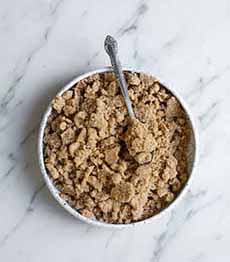
Updated August 2026 Celebrate fall’s apple harvest with this apple Bundt recipe from Zulka, a family-owned business that makes premium sugar. National Bundt Cake Day is celebrated on November 15th. The day was established by Nordic Ware, the company that trademarked the Bundt pan, to celebrate the 60th anniversary of the pan’s creation. Below: > Apple Streusel Bundt recipe. > The history of the Bundt cake and the namer “Bundt.” > What exactly is the design called? Elsewhere on The Nibble: > The year’s 19 apple holidays. > The year’s 55 cake holidays. > The history of cake and the different types of cake: a photo glossary. Ingredients For The Cake 1. MAKE the apple streusel. Combine 1½ cups brown sugar, cinnamon, nutmeg, 2 tablespoons flour and 6 tablespoons butter in a medium bowl, and stir until the butter is evenly mixed in (photo #5). Add the apples and pecans and stir well. Keep chilled until ready to use. 2. PREHEAT the oven to 325°F. Butter a 12-cup Bundt pan and coat with flour, tapping the sides to shake out excess flour. 3. MAKE the cake. Whisk the eggs in a medium bowl, then add the yogurt, apple sauce and 1½ teaspoons vanilla. Mix well and set aside. 4. COMBINE the remaining 3 cups flour, 2 cups brown sugar, baking powder, baking soda and salt in a large bowl. Mix on low speed until just combined. 5. ADD 2 sticks of butter one tablespoon at a time, and mix on low until well combined. Add half of the egg mixture and beat on low. Add the remaining mixture and raise speed to medium and mix for 30 seconds. 6. POUR half of the batter into the Bundt pan, spreading evenly. Spoon the apple streusel filling in the middle of the batter, making sure none reaches the edge of the pan; gently press into the batter. Top with the remaining batter and carefully spread so that no streusel is showing. 7. BAKE for 40-55 minutes or until a toothpick comes out clean. Let cool in the pan for 10 minutes, then flip onto a cake plate or serving platter and carefully remove the Bundt pan. Let cool completely before icing. 8. MAKE the icing: Combine the cream cheese, 2 tablespoons butter, 1½ cups powdered sugar, lemon juice and 1 teaspoon vanilla extract. Mix well with an electric mixer. Drizzle or pour over the top of the cake. |
|
|
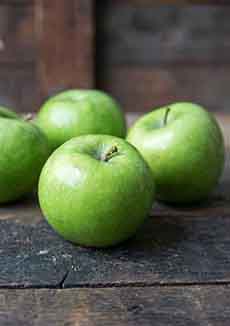
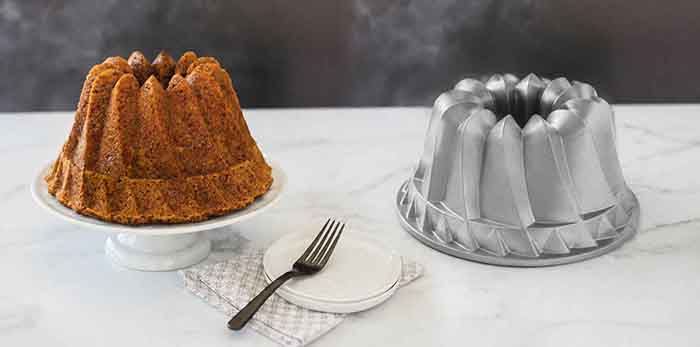
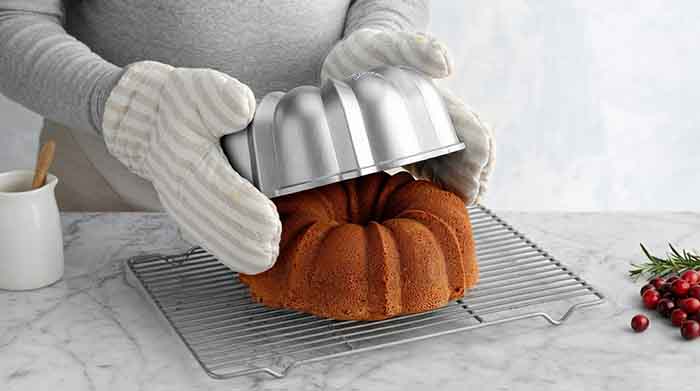 [6] The classic Bundt: scallops and flutes create a design that requires no frosting, and is easy to slice (photo © Taste Of Home). 2. THE HISTORY OF THE BUNDT CAKE The Bundt pan was created in 1950 by H. David Dalquist, founder of Minneapolis-based Nordic Ware, a manufacturer of kitchenware products. He did so at the request of Rose Joshua and Fannie Schanfield, members of the Minneapolis chapter of Hadassah, a Jewish women’s service organization. According to an article in the Fall 2005 issue of Generations, the newsletter of the Jewish Historical Society of the Upper Midwest, Fannie remembers a Hadassah luncheon when Rose lamented the quality of light and fluffy American-style cakes, and longed for the rich, dense cakes of her European childhood. These, however, required a special type of of pan—one with a hole in the center that allowed heat to penetrate heavy cake batter from all sides. With this type of form, a heavier batter could be baked without leaving under-baked dough in the center. Fannie’s husband arranged a meeting with Dalquist, and Rose joined her to show Rose’s mother’s ceramic kugelhopf cake pan. This became the prototype for the Bundt pan. Members of the Hadassah had asked Dalquist to reproduce a traditional heavy ceramic or cast-iron mold in a lighter material. He refined the Old World fluted form of the Kugelhopf/Gugelhupf into a tapered ring with a more elegant/conical center tube, and created distinctive, architectural pattern of alternating broad scallops and narrower flutes (photo #6). The sculptural pattern decorated the cake without frosting and creates natural divisions for slicing (photo #1). He used cast aluminum to create a lightweight pan. He named and marketed it as the Bundt pan (see the next section). Some months later, a dozen Nordic Ware factory “seconds” were delivered to Hadassah member Mary Juster’s home, and Hadassah sold the pans to members for $4.00 each. The way the story is told, the name Bundt comes from the German word bund, which means “community” or “a gathering of people”; and that Dalquist just added the letter “t” to the end and trademarked the word. However, there is a citation for a “Bundt form” as early as the 1903 edition of the famous Milwaukee Settlement Cookbook†, 63 years before Dalquist filed for his trademark on March 24, 1966. One can surmise that the Jewish women of Milwaukee had the cookbook and asked for a Bundt pan. Still, Dalquist was granted the patent. In 1960, the Good Housekeeping Cookbook showed a pound cake baked in a Bundt pan; that feature turned the Bundt into the number-one selling cake pan in America. But it was the 1966 Pillsbury Bake-Off, where the Tunnel of Fudge Cake recipe baked in a Bundt won second place, that launched the Bundt trend. What do you call a center-tubed ring mold with an sculptural rhythm that alternates broad scallops and narrow flutes? We asked A.I. if there was a name for the style of flutes and scallops. Here’s the response, which we include here rather than losing it for all Nibble posterity: In concise culinary descriptions or glossary entries, the Bundt is often summarized as “a ring-shaped, center-tubed cake characterized by alternating alternating broad scallops and narrow flutes that create a decorative, sculpted crown.” The ring-shaped, fluted silhouette has distinct architectural and functional features. *The best apples for this recipe: Granny Smith, Honeycrisp, Mutsu, or Pink Lady. †In the 1903 Milwaukee Settlement Cookbook, “Bundt form” is found on page 319 in the following text (under BUNDT KUCHEN, No. 2): “Grease Bundt form (a heavy round fluted pan with tube in center) well, and flour lightly. Cream butter and sugar well, add beaten yolks and beat, then the raised mixture and the rest of the flour, and lastly the beaten whites. Pour in pan, let rise until very light, and bake until well done and brown in a moderately hot oven, about forty-five minutes.” (Read details of the Settlement Cookbook source material). The Settlement Cookbook, first published in 1901 in Milwaukee to raise funds for the Settlement House for immigrants, is considered to be the most successful fund-raising cookbook in American history. It is still in print; the 1976 edition was named to the James Beard Cookbook Hall of Fame. ‡Streusel is a crumb topping made from butter, flour, and sugar (photo #5). It can also contain chopped nuts or rolled oats. It’s used on cakes and pies alike. Pronounced SHTROY-zul, the word derives from the German “streuen,” meaning to sprinkle or scatter. The American mispronunciation “STROO sul?” Fuggedaboudit. ‡‡We learned a new word: A toroid is a three-dimensional ring-shaped form resembling a doughnut or an inner tube. Mathematically, a standard torus is created by rotating a circle around an axis outside the circle. A Bundt cake is approximately toroidal, but it is not a perfect mathematical toroid because it has a flat base, tapered sides, and decorative fluting. For us non-mathematicians, “ring-shaped” or “circular with a hollow center” makes it clear. CHECK OUT WHAT’S HAPPENING ON OUR HOME PAGE, THENIBBLE.COM. |
||