|
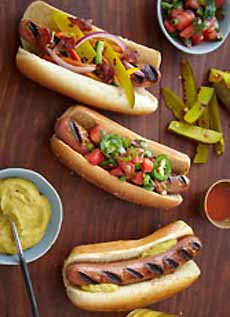
We often come across a debate about if a hot dog (or burger) is a sandwich. Now that it’s National Hot Dog Month, let’s settle it.
Yes, the hot dog is a sandwich, as is the burger, taco, and burrito.
A sandwich is defined as bread with filling. It can be any type of bread, most often sliced bread, rolls, or flatbread (e.g. tortillas).
And by the way, the correct term is roll, not bun. Will someone please relay that information to everyone who sells “buns” for sandwich bread.
Below:
> The 10 sandwich categories (types).
> The difference between buns and rolls.
> The year’s 20+ bread holidays.
Elsewhere on The Nibble:
> The different types of sandwiches: a photo glossary.
> The year’s 25+ sandwich holidays.
> The years 20+ bread holidays are below.
> The history of the sandwich.
THE 10 SANDWICH CATEGORIES
While there’s no universally agreed-upon taxonomy, culinary professionals and food historians have come to group sandwiches based on structure, assembly, and serving style.
Here are the 10 major sandwich categories, based on their form and preparation, in alphabetical order.
Note that sandwiches can occupy more than one category. For example an open-faced hot roast beef sandwich with gravy belongs to both the Open-Faced and Hot categories. In photo #4, the open-faced finger sandwich (photo #11) also belongs in the Delicate category. In photo #7, the Grilled-Pressed-Hot Sandwich can also be a closed sandwich—and probably should be a subset of Closed Sandwich, except that Hot Sandwich can also be Open-Face.
It takes a true keeper of the flame to want to sort these things out and contribute them to the vast world of food knowledge.
Breakfast Sandwich
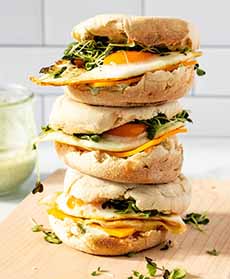
Definition: Sandwich with egg as a primary component (photo #2). Typically served hot and eaten by hand.
Examples: Egg and cheese biscuit, Egg McMuffin, croissant scrambled egg sandwich.
Closed Sandwich
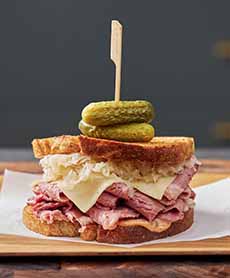
Definition: Two slices of bread with a filling in between. The most common category (photo #3).
Examples: PB&J, ham and cheese, turkey club.
The melt is a sub-category, in which the filled is topped with cheese and broiled (e.g., tuna melt).
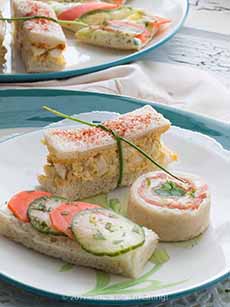
Another sub category is the Delicate Sandwich (photo #4), providing just a bite or two and often made with finer ingredients (photo #11).
Definition: Small size, elegant presentation, and traditional at afternoon tea or as canapés.
Examples: Appetizer sandwich, finger sandwich*, party sandwich (e.g. pinwheels), tea sandwich*.
Dessert Sandwich
Definition: Sweet fillings between layers of bread or cookie-like components (photo #5).
Examples: Ice cream sandwich, Nutella-stuffed brioche, cookie sandwich.
Folded or Pocket Sandwich
Definition: Bread that wraps or folds around the filling (photo #6).
Examples: Tacos, gyros, pita with falafel or other fillings, bao buns.
Bread structure holds contents without a top slice.
Grilled-Pressed-Hot Sandwich
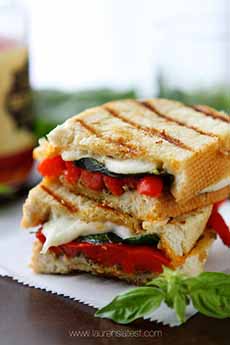
Definition: Bread and filling cooked together via grilling or pressing (photo #7).
Examples: Grilled cheese, panini, Cuban sandwich, Croque Monsieur.
Often includes melty cheese and crispy bread.
Hero-Sub-Hoagie-Baguette Sandwich
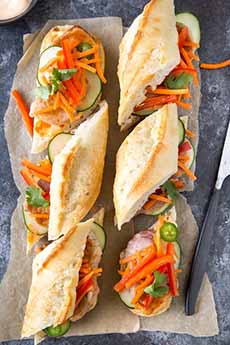
Definition: Long roll or split baguette, filled with hearty fillings (photo #8).
Examples: Italian sub, cheesesteak, po’ boy, bành mì (and a plug for our favorite, Brie, prosciutto, and fig jam on baguette)).
Layered-Stacked Sandwich
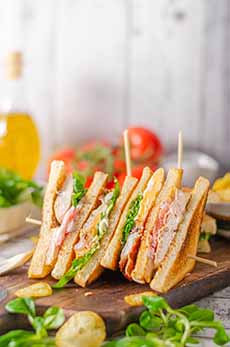
Definition: Tall with multiple ingredients separated by layers of bread, often held together with toothpicks/skewers (photo #8).
Examples: Club sandwich (often 3 slices of bread), Dagwood sandwich, triple decker sandwich.
Open-Faced Sandwich
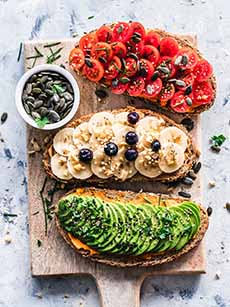
Definition: Single slice of bread topped with ingredients (photo #9).
Examples: Avocado toast, Welsh rarebit, smørrebrød (Denmark), crostini.
Often eaten with a knife and fork rather than by hand.
Tartine, a French open-face sandwich, typically has an artistic presentation.
Rolled or Wrapped Sandwich
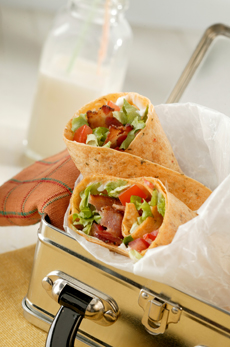
Definition: Filling is wrapped inside a flatbread or rolled bread, making it compact and portable (photo #10).
Examples: Burritos, wraps, lavash roll-ups, pinwheel sandwiches.
Stuffed or Filled Bread
Definition: Bread that is hollowed to enclose the filling.
Examples: Panini pockets, runzas, pita stuffed with falafel, meat buns.
BUNS, ROLLS AND BISCUITS: THE DIFFERENCE
Americans typically use the word “bun” instead of “roll” to denote the bread that holds hot dogs and burgers.
But we should be calling them rolls, not buns.
There is no official difference: Both are single-serve breads, and the FDA only stipulates that buns and rolls weigh less than one-half pound (as opposed to loaves of bread, which must weigh one pound or more).
Why do Americans ask for a burger bun and a whole wheat bun, yet a ciabatta roll and a Kaiser roll? Cinnamon roll yet sticky bun?
Manufacturers and retailers use whichever term they want.
But there is order to be had in the bread universe!
The American Institute of Baking uses this distinction:
Rolls is the term generally used for individual breads that hold a filling—either pre-filled like cinnamon rolls or sandwich bread like Kaiser rolls. The notable exception is hot cross buns, which are filled with currants or raisins and thus should be hot cross rolls. However, the first recorded use of the term “hot cross bun” appears in 1733, when there was no distinction.
Buns typically do not contain a filling, but can be eaten plain, with a spread (butter, jam), or used as a sop, i.e., to wipe up a liquid food: gravy, sauce, soup, stews.
Bunne was the word used in Middle English. The use of roll to describe a small bread came much later. The oldest reference we could find is to Parker House rolls, in 1873.
Biscuits use a different leavening. Biscuits use baking powder to rise; buns and rolls use yeast.
Texture: Rolls can be hard (crusty) or soft, buns are soft, and biscuits are pillowy soft (from the baking powder).
We wish everyone who is a stickler for accuracy good luck getting people to change the words they use!
|
THE YEAR’S 20+ BREAD HOLIDAYS
|
|
|
January
January: Bread Machine Baking Month
January: National Wheat Bread Month
February
February Second Last Saturday to Last Sunday: Real Bread Week
February, Last Thursday: National Toast Day
March
March 20: World Flour Day
March 21: National French Bread Day
March 29: National Pita Day
April
April 1: National Sourdough Bread Day
April 23: National English Muffin Day
May
May 13: National Crouton Day
May 14: National Buttermilk Biscuit Day
May 18: World Baking Day
June
Nothing yet!
|
July
Nothing yet!
August
Nothing yet!
September
September: National Biscuit Month
September: Sourdough September
September, 2nd Week: National Biscuits & Gravy Week
September 16: National Cinnamon Raisin Bread Day
September 23: National Baker Day
September 25: German Butterbrot Day
October
October 31: National Breadstick Day
November
November: National Raisin Bread Month
November: National Stuffing Month
November 13: National Bread Pudding Day
November 17: National Homemade Bread Day
November 21: National Stuffing Day
December
December 22: National Date Nut Bread Day
Bonus
The Year’s 9 Biscuit Holidays
|
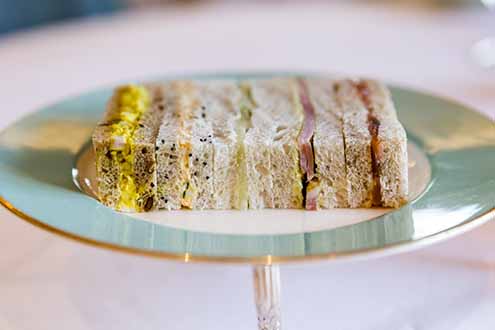
[11] Five finger sandwiches filled with curried egg salad, smoked salmon, cucumber, ham, and artisan peanut butter and jelly (photo © Fortnum & Mason).
|
|

[1] A hot dog is most definitely a sandwich (photo © Vermont Smoke & Cure).
[2] The Egg McMuffin introduced America to the breakfast sandwich (see †footnote) Here’s the recipe for this better-for-you version (photo © Aero Farms).
[3] Closed sandwich, the most common category. Here’s the recipe for this yummy Reuben sandwich (photo © Marion’s Kitchen).
[4] A finger sandwich, an open-faced finger sandwich, and a pinwheel. Here’s the recipe (photo © Pinch Me I’m Eating).
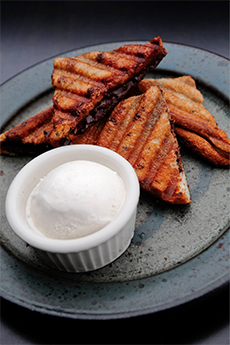
[5] This dessert sandwich grills chopped quality chocolate bars on brioche (and almonds, cinnamonn, whatever), with a side of vanilla ice cream (photo © Parma 8200).
[6] In the Folded Sandwich we present some food fusion: Chicken Caesar Salad [U.S.] in pita [Greece] (photo © Leanna Myers | Unsplash).
[7] In the Grilled / Hot category, here’s one of our favorites: mozzarella, fresh basil, and roasted red peppers. Here’s the recipe (photo © Lauren’s Latest).
[8] In the Hero-Sub-Hoagie-Baguette category, the bành mì sandwich, a Vietnamese-French fusion of Vietnamese ingredients on a baguette. Here’s the recipe (photo © Simple Healthy Kitchen)..
[9] The Club is the classic stacked sandwich: a BLT with turkey or chicken. We like to add avocado and arugula or watercress (photo © Peteer | SmartPix).
[9] Open-Faced Sandwiches (tartines in French) can be as plain or fancy as you wish. This trio equals a sandwich-and-a-half (photo © Ella Olsson | Unsplash).
[10] Wrap sandwiches are easily portable, and a thin flatbread wrap is a nicer alternative to risen bread (photo © National Pork Board).
|
________________
*The difference between finger sandwiches and tea sandwiches: These are similar and may share fillings, but not the same, largely due to shape. Finger sandwiches are a subset of tea sandwiches, made in finger-like rectangles. Tea sandwiches can have any shape.
> Both are created for afternoon tea, bridal showers, lunch buffets, hors d’oeuvre, and even kids’ meals, since the small shapes appeal to children (check out these PB&J piano keys finger sandwiches).
> The fillings for both are often sophisticated. They can be more elegant variations of everyday fare, e.g. Brie with fig jam, curried egg salad, goat cheese with roasted red peppers or arugula, pimento cheese, smoked salmon with capers.
> Finger sandwiches are made on thinly-sliced, crustless bread, 3–4 inches long by 1-inch wide (finger-sized, but coincidentally, finger food). Over time, the term has been adopted by other types of small sandwiches, but the rectangular “finger” is the proper form.
> Tea sandwiches are also made on thinly-sliced, crustless bread, and often sophisticated fillings. Initially created for afternoon tea, they consist of buttered bread with sliced cucumber, deviled ham, egg salad, watercress, or other delicate filling. They are most often cut into triangles but also rectangles; rounds, ovals, and specialty shapes (using cookie cutters); and squares.
†The first McDonald’s Egg McMuffin was introduced in 1971 in Santa Barbara, California, as a handheld breakfast option. It was invented by franchisee Herb Peterson, who was inspired by Eggs Benedict. It became a part of the national McDonald’s menu in 1977.
CHECK OUT WHAT’S HAPPENING ON OUR HOME PAGE, THENIBBLE.COM.
|