Monte Cristo Sandwich Recipe For National Monte Cristo Day
|
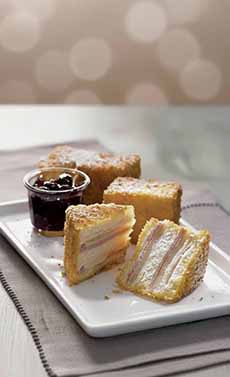
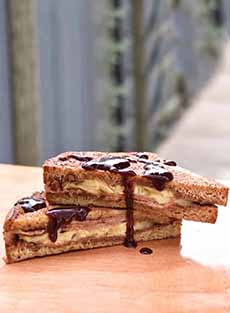
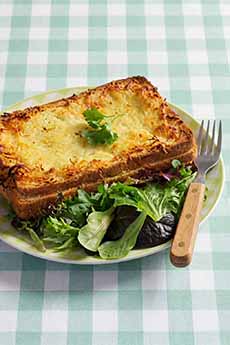
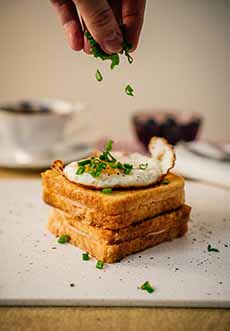
September 17th is National Monte Cristo Day, celebrating a sandwich that some people consider to be a fancy grilled ham and cheese sandwich on French toast. More accurately, it is an American relative of the croque monsieur, the classic French grilled or baked ham-and-cheese sandwich. Below: > Monte Cristo, Croque Monsieur and Croque Madame: the difference. > The history of the Monte Cristo sandwich. Elsewhere on The Nibble: > The history of the sandwich. > The different types of sandwiches: a photo glossary. > The different types of bread: a photo glossary. > The year’s 27+ sandwich holidays.
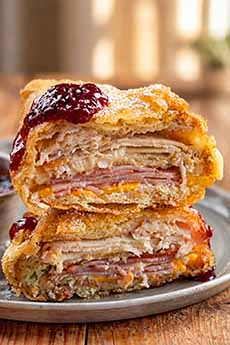
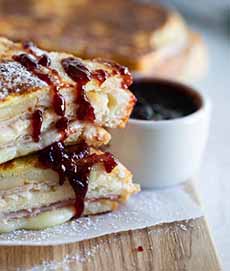
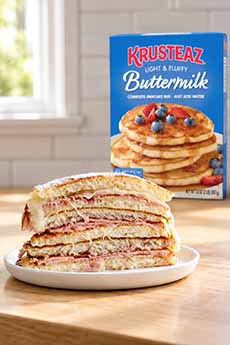
The sandwich is served with a side of jelly for dipping, and often garnished with powdered sugar. We’re not a fan of the latter. It just gets over everything (table and clothes). And who needs sugar on a ham and cheese? While we prefer Gruyère cheese, as is used in the Croque Monsieur and Croque Madame, you can substitute Emmental, or America’s approximation of Emmental, a.k.a. Swiss cheese—or whatever you like. We’ve seen everything from Gouda to Provolone. TIP: You can hold the sandwich layers with toothpicks. Add them before battering and frying. Ingredients For 4 Triple-Decker Sandwiches
1. WHISK the eggs and milk in a shallow pan. Melt the butter in a large skillet. 2. LAYER a slice of bread, cheese, ham, another slice of bread spread with mayonnaise, turkey, cheese, and then another slice of bread. Cut or fold the meats and cheese so they are contained within the borders of the bread. Press down so that the layers stick together, and use toothpicks to hold them. 3. MELT the butter in the skillet. Dip each sandwich in the milk and egg mixture, then transfer to the skillet. Cook until the bread is toasted on both sides and the cheese is melted. 4. CUT in half. Dust with powdered sugar if desired, and serve with the jelly/jam in a ramekin on the side.
That’s a lot of croque for you to consider. You may like to create your own. We often make one with truffle cheese and chicken. The origin of the Croque Monsieur is not known with certainty, but it is believed to have originated in French bistros and cafés as a quick snack. The name means, roughly, “a bite for a man,” from French words croque (bite) and monsieur (“mister”). One of the first known written references is on a Parisian menu from 1910. It is cited in volume 2, Within a Budding Grove (published 1918), of Marcel Proust’s epic novel, In Search of Lost Time [source]. When there is no certainty, there are always apocryphal stories.
In recent years, different chefs and restaurants have put their own spins on the original Croque Monsieur recipe. See them below. Decades Later Came The Monte Cristo Sandwich According to old newspaper records cited in Wikipedia, the first documented reference to a “Monte Cristo Sandwich” was in an American restaurant industry publication in 1923. There’s a common claim that it was developed in the 1960s in Southern California, but this is likely the belief that the sandwich was invented for Disneyland in Anaheim, which served a version of the original at the Blue Bayou Restaurant beginning in 1966, and at the Cafe Orleans in New Orleans Square [source]. But it existed long before then. No one knows exactly who created it and named it, but it happened somewhere in California.
|
|
|
|
The Recipe Evolves The original Monte Cristo sandwich is made from deli ham and Swiss cheese. The entire sandwich is then lightly dipped in the egg batter used for French Toast, and grilled or deep fried. Who added the powdered sugar and jam? The 1924 Los Angeles Times recipe describes bread, cheese, ham, egg, and butter—but no sugar or jam. Over the next decades, someone added turkey, and someone transformed the Monte Cristo into the equivalent of turkey, ham and cheese French toast, garnished with a dusting of powdered sugar and a side of jam, jelly, or preserves (per our mother, “Only in America!”). The Delicious Disneyland cookbook notes the sandwich was served at New Orleans Square, and that it was the sandwich was on the commissary menu at The Walt Disney Studios in 1940. By at least 1966, Disneyland was serving the sandwich battered, deep-fried, dusted with powdered sugar, and accompanied by fruit preserves, helping to popularize this sweet-and-savory combination among park visitors. Did someone at Disney invent this version? We can only guess. The Count Of Monte Cristo? Many of us have read the French novel, The Count of Monte Christo by Alexandre Dumas. No historical person was titled the Count of Monte Cristo. He is a fictional character, Edmond Dantès, the protagonist of the novel. In the story, Dantès takes the title after acquiring immense treasure hidden on the small Italian island of Montecristo—literally “Mount of Christ.” While the count is fiction, the island is real, a beautiful spot in the Tuscan Archipelago (west of Tuscany, Italy in the Tyrrhenian Sea, which flows into the Mediterranean. Following the success of the novel, Alexandre Dumas built the Chateau de Monte-Cristo in Port-Marly, outside of Paris. It’s now a museum (photo #9). And there’s the luxury Hôtel Monte Cristo in Paris, also inspired by the famous novel. The sandwich’s name is likely a literary allusion. In addition to numerous “talkies,” four silent-film adaptations predated the first one in 1934 (a smash hit starring Robert Donat). One, “Monte Cristo,” starring John Gilbert as Edmond Dantès, appeared in 1922—the year before the recipe was first published. A tribute to a popular film? We can only conjecture. *Auvergnat is a dialect of Occitan spoken in the region of Auvergne in Central France. †Although there are numerous references to the sandwiches, we (and A.I.) can’t find a reference for Gagnet. If a surname, it may have been that of the chef or the restaurant, lost to history. In French, the verb gagner means to win, earn, gain, or save. †Although there are numerous references to the sandwich, we (and A.I.) can’t find a confirmed origin for Gagnet. It is a French surname, and may have been that of the chef or restaurant, lost to history. In French, the verb gagner means to win, earn, gain, or save. ‡Tartiflette is a dish from Savoy in the French Alps and from the Aosta Valley. It is made with potatoes, Reblochon cheese, lardons and onions. CHECK OUT WHAT’S HAPPENING ON OUR HOME PAGE, THENIBBLE.COM. |
||