|
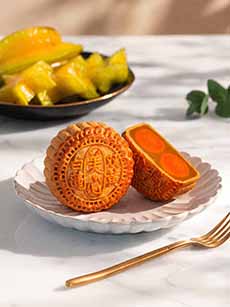
[1] A plate of red bean mooncakes (photo © Omnivore’s Cookbook).

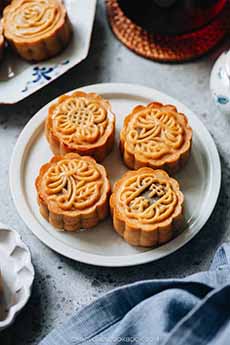
[2] Traditional mooncakes with a pot of Chinese tea (photo © In Pursuit Of Tea).
[3] A stack of mooncakes with both traditional and modern designs (stack adapted from Vogue).
[4] A traditional mooncake—lotus seed paste and duck egg yolk—from Hong Kong’s most famous mooncake brand, Mei Xim, pronounced MAY-shin (photo © Yami).
|
|
The Moon Festival, also known as the Mid-Autumn Festival and Mooncake Festival, is one of China’s most traditional holidays.
It occurs on the 15th day of the 8th month of the Chinese lunisolar calendar, a time-tracking system that matches both the monthly phases of the moon and the yearly seasonal cycle of the sun.
This year, the festival falls on September 25th in the Gregorian calendar*.
Much like Thanksgiving in the U.S., it’s a time for family reunions, giving thanks for the autumn harvest, and gathering to admire the bright full moon.
Below:
> What are mooncakes?
> Mooncake gift-giving.
> The world of mooncake flavors.
> Have a mooncake tea party.
> Where to buy mooncakes.
> Mooncake recipes.
> The history of mooncakes.
Elsewhere on The Nibble:
> The year’s 15 Chinese food holidays.
1. WHAT ARE MOONCAKES?
Mooncakes are a traditional Chinese pastry eaten during the Mid-Autumn Festival. As you can see from the photos:
- Shape: Traditional mooncakes can be round or square. The thin, soft crust is baked to a golden brown.
- Made in special molds, the top has raised designs: the Chinese characters for good luck, flower shapes, patterns, etc.
- Fillings: Traditional fillings are lotus seed paste, red bean paste, or black sesame paste. A counterpoint to the sweet paste, a salted duck egg yolk is often placed in the middle to look like a full moon. Mixed nuts, seeds, or even pork can be added.
- Contemporary versions fill mooncakes with chocolate, fruit jellies, or ice cream, and pastry chefs show off their skills in the design.
- Size: Traditional mooncakes are rich and heavy: dense, sweet, and oily. The standard size measures approximately 4 inches (10 cm) across and 1¼ to 1½ inches (3–4 cm) thick. Mini or bite-sized versions typically measure 1.75 to 2 inches (4.5 to 5 cm) in diameter.
- That means they’re high in calories and fact. But this is a once-a-year celebration: Enjoy it.
How To Eat Mooncakes
- Traditionally they’re paired with hot green tea to balance the intense sweetness.
- Tradition dictates cutting the cake into small wedges—often quarters or eighths—to share with family and friends.
- Mini sizes are now made so that you simply cut them in half and share (or not).
2. GIVING MOONCAKES AS GIFTS
Giving someone a mooncake means wishing them health, happiness, completeness, and a happy family reunion.
You can begin giving mooncakes two to four weeks before the Mid-Autumn Festival. A typical schedule:
- 2 to 4 weeks before: Give mooncakes to business clients, bosses, and extended family members.
- 1 to 2 weeks before: Give mooncakes to close friends and immediate family, so they can eat them during the actual celebration.
- You can still gift them for up to a week after the festival.
Traditional baked mooncakes may keep for several weeks, depending on their packaging and ingredients. The newer style, fresh snowskin mooncakes, spoil quickly and require refrigeration.
Give perishable types closer to the actual holiday date.
|
[5] For gifting, fine pastry chefs and chocolatiers create beautiful packaging, as well as contemporary flavors. These snowskin mooncakes from Lady Wong are made in hazelnut praline, matcha pistachio, mountain raspberry, mandarin peel, pandan, and yuzu (photo © Lady Wong).
[6] A platter of traditional red bean mooncakes. Here’s the recipe for these and other flavors (photo © Omnivores Cookbook).
3. MOONCAKE FLAVORS
The classic Cantonese-style mooncake usually has a thin, golden-brown baked crust, decorative mold pattern, and a dense sweet filling. Each region has its favorites. Traditional fillings include:
- Black sesame: Used alone or combined with fillings such as glutinous rice (mochi) or salted duck egg yolk.
- Five-kernel/five-nut filling (wǔrén): A textured mix of nuts and seeds, commonly including walnuts, sesame, pumpkin seeds, watermelon seeds, peanuts, or almonds. Recipes differ by region.
- Jujube-date paste: Dark, fruity, and lightly tangy.
- Lotus-seed paste: Often considered the most luxurious classic filling, particularly white lotus paste.
- Mung-bean paste: Smooth, mild, and sweet.
- Red bean paste: Earthier and more bean-forward than lotus paste.
- Salted duck egg yolk: Typically set inside lotus or bean paste; its round golden form represents the full moon. One or two yolks are common, and some elaborate versions use more.
- Savory fillings: Particularly in regional styles: minced pork, ham, dried shrimp, mushrooms, and other savory ingredients.
What’s with the egg yolks?
The yolk tempers the sweetness and gives the pastry a sweet-salty contrast. The best-known Cantonese combination is white lotus paste with salted egg yolk.
Regional Variations
Long before modern bakers put a 21st-century spin on them, mooncakes varied greatly across China. Beyond lotus paste and egg yolks, even the “classic” mooncake flavors have varied, with bean-based, floral, fruit-adjacent, nutty, and savory styles. Examples:
- Cantonese: Lotus paste, red bean, egg yolk, five-kernel, mixed savory-sweet fillings.
- Suzhou: Flaky, layered pastry with sweet fillings but also savory minced pork and ham versions.
- Teochew: Often flaky; taro/yam, mung bean, and salted egg yolk are common.
- Yunnan: Can feature rose, nuts, or local ingredients.
- Fujian: Often larger and more rustic, with nuts, sesame, jujube, candied winter melon, and lard-rich pastry.
- Shanghai/Jiangnan: Savory fresh-pork mooncakes are a major seasonal specialty.
[7] Purple sweet potato is one of the more contemporary flavors. Here it’s filled with blueberry ice cream (photo © Suncore Foods).
The Modern Flavor Diaspora
As mooncake traditions moved beyond China, they evolved in Hong Kong, Taiwan, Southeast Asia, and overseas Chinese communities. Bakers used familiar local ingredients to appeal to younger generations and customers outside of the community.
First came tropical and other Asian-influenced flavors:
- Durian: A major Southeast Asian adaptation, especially popular in Malaysia and Singapore.
- Fruit pastes: Lychee, melon, mango, and other translucent fruit pastes turned up in contemporary chilled styles.
- Pandan: The “vanilla of Southeast Asia” is, not surprisingly common in Southeast Asian mooncakes. Grassy and vanilla-like, pandan is often paired with lotus, mung bean, coconut, or egg yolk.
- Pineapple: Especially linked to Taiwanese baking traditions, including the popular Taiwanese pineapple cake. In a mooncake, it provides tartness that cuts through the richness; it can be paired with salted egg yolk.
- Taro/yam: Now widespread, if not purely “new.”
[8] Matcha snowskin mooncakes filled with red bean paste. Here’s the recipe (photo © Cooking Therapy).
The Creation Of Snowskin Mooncakes
The biggest leap forward was the emergence of snowskin mooncakes in Hong Kong in the 20th century.
Unlike the traditional baked wheat pastry, snowskin mooncakes are not baked. They cover the filling with a soft, chewy glutinous-rice exterior (like mochi) and are served chilled.
These lighter, contemporary pastries were especially well-suited to flavors that would feel unusual in an old-style lotus-paste cake:
- Chocolate
- Coffee
- Cream cheese
- Custard
- Ice cream
- Lychee
- Mango
- Matcha
- Molten lava
- Passionfruit
- Strawberry
The lighter style also begat colorful skins: pale pink, green, yellow, purple, blue, and other shades, made with natural ingredients or food colorings. (Matcha, for example, can tint a skin green, while fruit and vegetable ingredients can create pink, purple, or yellow tones.)
Are you ready to have a Mid-Autumn Festival tea party? (We just created the idea; it’s not a thing in Asian communities.)
[9] A tray of mooncake molds with different designs (photo © Constellation Inspiration).
4. HAVE A MOONCAKE TEA PARTY
Get different flavors of mooncakes—including traditional and modern varieties. Put on the tea kettle, pop the bubbly. And decorate.
- String colorful paper lanterns. In many Mid-Autumn Festival celebrations, lanterns brighten the night and symbolize the moon’s glow..
- Eat mooncakes. Sharing round pastries symbolizes wholeness and family unity.
- Gaze at the moon. Gather outdoors to admire the beauty of the full moon, sip tea, and share festive foods.
If weather obscures the sky and prevents moon-gazing, the celebration simply shifts indoors. The cultural essence of the holiday remains unchanged.
Beverages
Because traditional mooncakes are rich, dense, and sweet, the best drinks will have acidity, herbal lightness, or crisp effervescence to cleanse the palate.
Non-Alcoholic Drinks
- Apple Cider with Ginger: Warm or chilled spiced apple cider lightly infused with fresh ginger.
- Green tea or tisane (herbal tea): hot definitely; iced optional.
- Sparkling yuzu or pomelo/grapefruit soda.
Alcoholic Options
- Dry Gewürztraminer, such as an Alsatian: floral and lychee-scented.
- Sparkling wine.
Party Soundtrack
The playlist should balance gentle, reflective evening tones with warm, celebratory energy.
Popular Selections
- “Dancing in the Moonlight,” King Harvest
- “Fly Me to the Moon,” Frank Sinatra
- “Harvest Moon,” Neil Young
- “Moondance,” Van Morrison
- “Moon Song,” Phoebe Bridgers
- “Pink Moon,” Nick Drake
- “The Whole of the Moon,” The Waterboys
Classical Selections
- “Clair de Lune,” Claude Debussy
- “Moonlight Sonata (Piano Sonata No. 14),” Ludwig van Beethoven
- “Pierrot Lunaire, Op. 21,” Arnold Schoenberg
- “Song to the Moon” (aria from “Rusalka”), Antonín Dvořák
- “Vaga luna, che inargenti (Lovely moon, who sheds silver light, arietta),” Vincenzo Bellini
[10] These mooncakes from Lady M bridge the traditional and the contemporary, in pistachio, yuzu cheesecake and red bean (photo © Lady M).
5. WHERE TO BUY MOONCAKES
A starter list:
- Ăn Xôi: traditional mooncakes with Vietnamese-influenced flavors.
- Kee Wah Bakery: lotus seed/egg yolk, red bean, date paste, mixed nuts with ham.
- Lady Wong, elegant packaging.
- Mariebelle: lotus seed and pineapple flavors in contemporary designs.
- Lady M.: Traditional shapes with modern flavors (photo #10, above).
- Weee: This online grocer specializing in Asian foods, has a broad selection.
- Also check at Costco and Walmart.
[11] A Vietnamese-style mooncake with festive accoutrements (photo © Mooncakes by Ăn Xôi).
6. MOONCAKE RECIPES
Prefer to bake rather than buy? Mooncakes are not very difficult to make, but the process has many steps and takes patience.
7. THE HISTORY OF MOONCAKES
A mooncake—yuèbǐng—literally “moon cake” or “moon pastry”—is a traditional food of the Mid-Autumn Festival.
The connection between round cakes, moon worship, and the autumn harvest is ancient, but the precise origin of the modern mooncake is difficult to pin to one date or dynasty. What we do know:
- Early roots: Autumn moon offerings were part of longstanding Chinese ritual. Round cakes became associated with the Mid-Autumn Festival and its themes of harvest and reunion.
- Tang dynasty (618–907): Many accounts place recognizable festival mooncakes in this period, although origin stories vary and should be treated as tradition rather than a fully documented single invention.
- Yuan-to-Ming transition (1368): A popular legend says rebels hid messages inside mooncakes to coordinate an uprising against the Mongol-led Yuan dynasty. It’s an enduring story, but historians generally treat it as folklore rather than settled fact.
- Regional development: Over centuries, different regions developed distinct pastries—especially the glossy, molded Cantonese mooncake; the flaky Suzhou mooncake; and varieties from Beijing, Yunnan, Chaoshan/Teochew, Fujian, and elsewhere.
- Modern gift culture: In the 20th century, mooncakes increasingly became premium seasonal gifts. Their packaging, branded collections, and creative flavors have become almost as significant commercially as the cakes themselves.
The Mid-Autumn Festival spread through Chinese communities across East and Southeast Asia, so mooncakes developed local identities in Hong Kong, Taiwan, Vietnam, Malaysia, Singapore, Japan, and beyond. Asian Inspirations gives a useful overview of that broader regional evolution.
For the origin story—the legend of the moon goddess and the rabbit—see “The Romantic Myth of Moon Fest.”
[12] Taiwanese mooncakes and a pot of tea (photo © The Foundry Bakery).
*The 15th day of the 8th month of the Chinese lunisolar calendar falls between September 7th and October 8th in the Gregorian calendar.
CHECK OUT WHAT’S HAPPENING ON OUR HOME PAGE, THENIBBLE.COM.
|