TIP OF THE DAY: 20+ Ways To Enjoy Dried Apricots
|
|
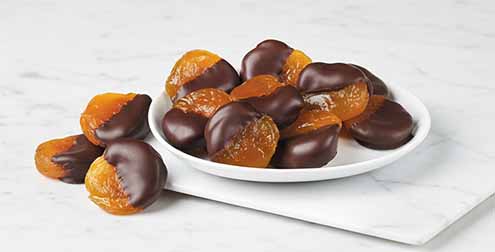
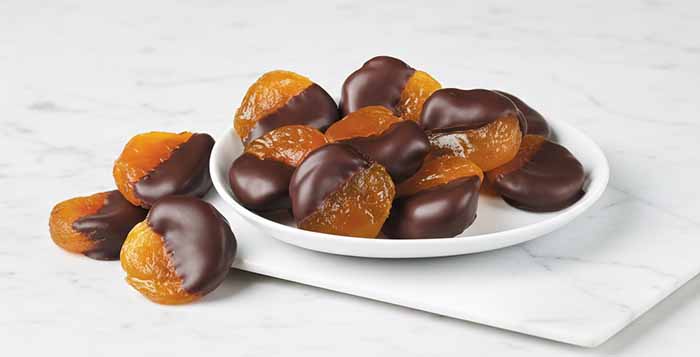
January 9th is National Apricot Day. Because fresh apricots aren’t in season until summer, we recommended making these couldn’t-be-easier chocolate-dipped dried apricots. They’re delicious with coffee and tea, as part of a petit fours plate for dessert, as a garnish for ice cream, or to satisfy a sweet tooth.
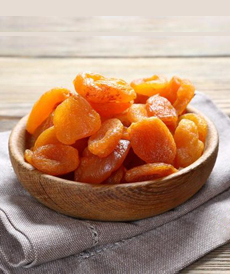
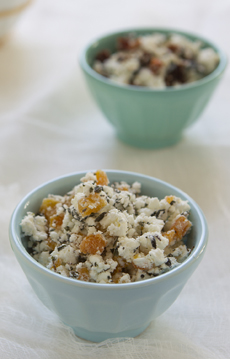
Since we purchased more apricots than chocolate, we got to thinking: What else can we do with dried apricots? > Check out the 20+ ways to enjoy them below. below. > Also below, the history of apricots. > The year’s 80 fruit holidays. > The history of apricots is below. > There’s a second recipe below, for plain glazed dried apricots. > The year’s 4 apricot holidays. Appetizers: Try a half apricot on an appetizer skewer with cubed chicken and pineapple; in a prosciutto roll (photo #3); as a diced garnish on canapés. Bagels. You’ll have a one-up on a raisin bagel when you sprinkle diced apricots atop the cream cheese on a plain bagel. Breads & Muffins: Quick breads, scones…all bread products taste great with some diced dried apricots. Try this recipe. Cakes, Cookies, Energy Bars: Add chopped apricots to layer cake fillings and garnishes, substitute for raisins and other dried fruits in cookies and bars. Check out these Apricot Newtons and Apricot Cheesecake Bars. Candy: Chocolate-dipped apricots, our favorite chocolate-covered fruit (photo #6, below). Here’s a recipe. Cheese Plate: Serve apricot halves with cheese and whole wheat crackers; dice them and add to a grilled cheese sandwich with brie, blue cheese or goat cheese. Chocolate Fondue: Add apricots to the dippers (here’s a list of dessert dippers). Cottage Cheese & Yogurt: Dice the apricots and blend them in. Dip: Purée your choice of crumbled blue cheese, cream cheese, yogurt, dates, dried apricots, and pecans. Serve dip with crudites, pretzels or other crunchy options; spread it on a sandwich or on bagels. Fruit Compote: Here’s a timely recipe for Winter Fruit Compote. Fruit Salad. Mix dried apricots with fresh seasonal fruits for a fruit salad (you can also add dried blueberries, cherries, cranberries and raisins). Add them to a Waldorf Salad* or Ambrosia Salad. Gift: For a favorite food friend, make these Dried Apricots In Cardamom Syrup. Grab & Go: Add some variety to your apple or banana snack; or add some nuts to an apricot snack bag for extra protein. Green Salads: Crown a green salad with an apricot half. Hot Cereal: Oatmeal and other hot cereals are tastier with a garnish of diced dried apricots. (You can also make a dried fruit medley with dates, dried cranberries, raisins, etc.) Also add to Overnight Oats. Ice Cream & Sorbet: Use a dried apricot half as a crown, to garnish the top of the scoop. Raisin Substitute: From Ants On A Log to oatmeal cookies and rice pudding, diced apricots are just as yummy, and a more colorful replacement. Rice and Grains: Add diced apricots as a garnish, or mix them in. For a fruited Grain Pilaf, toss the grain with dried cranberries, diced dried apricots, raisins, sautéed garlic and slivered almonds. Salad Topper: Toss or mix chopped dried apricots into your favorite chicken, seafood, or pasta salad. Snacks: Garnish a bowl of popcorn with apricot halves or diced apricots, dip apricot halves into chocolate (recipe) for a most delicious confection. Stuffing: Chicken, lamb and pork love a stuffing with dried apricots. Trail Mix: Combine dried apricots and other dried fruits with your favorite nuts. Chocolate chunks (larger than chocolate chips) optional. (article continues) |
|
|
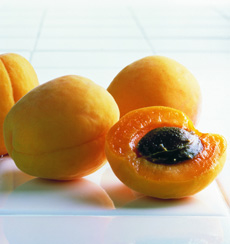
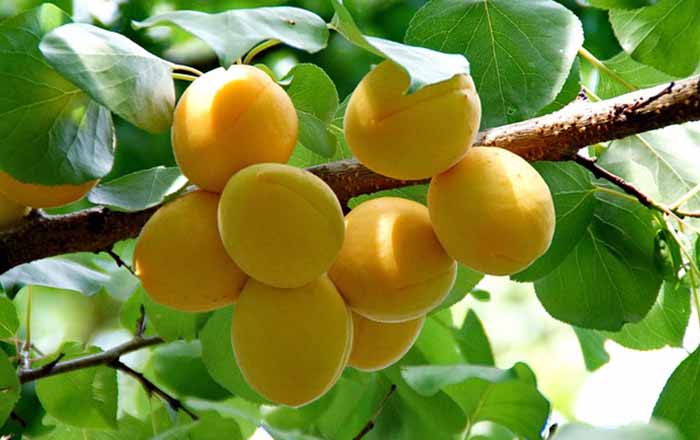
APRICOT HISTORY Apricots are a stone fruit in the genus Prunus (stone fruit genus), family Rosaceae (rose family) and order Rosales (flowering plants order). Other genus members include almonds, cherries, peaches and plums. The stone fruits are so named because there’s a large, hard pit [stone] in the center (photo #1). (article continues) The apricot tree, Prunus armeniaca, got its name because it was long thought to have originated in Armenia. It had become extensively cultivated there by the time Roman traders encountered it. Archaeologists have discovered apricot seeds in Armenian sites that date to the Chalcolithic-era (Copper Age)—roughly 3500 B.C.E. to 2300 B.C.E. Armenia’s climate was ideal for apricot cultivation—the fruit became so integral to Armenian agriculture and cuisine that it remains a national symbol today (the apricot color is one of the stripes in the Armenian flag and the country cultivates some 50 varieties of apricots). However, there are other claimants, and the plant’s scientific name, Prunus armeniaca, reflects a historical misconception. Other archeo-botanists point to the Chinese region as the likely site of domestication, and others point to India, about 3000 B.C.E. For medicinal uses, the oil from the kernels inside the pits has been part of Chinese and Ayurvedic medicines for millennia. Apricots have been cultivated in Persia (modern Iran) since antiquity; the dried fruits were an important commodity on Persian trade routes. Alexander The Great brought rootstock from Persia to Greece. The Romans introduced apricots to the Mediterranean region around the first century B.C.E., and they flourished in the warm, temperate climate. During the medieval period, Arab traders and the expansion of Islamic empires further spread apricot cultivation throughout the Middle East and into Spain. The Moors, who occupied parts of the Iberian Peninsula from the 8th to 15th centuries, established apricot orchards that would influence Spanish and subsequently New World agriculture. The fruit was prized not only for its flavor but also for its ability to be preserved through drying, making it valuable for long journeys and winter sustenance. By the 17th century, apricot kernel oil was used homeopathically in England to fight tumors, swelling and ulcers. Spanish missionaries and conquistadors brought apricots to the Americas in the 18th century. Franciscan friars planted apricot trees at their California missions, where the Mediterranean-like climate provided perfect growing conditions. California would eventually become one of the world’s leading apricot producers, with commercial cultivation expanding dramatically during the 19th and 20th centuries. Most of our modern American apricots groves come from seedlings carried to the West Coast by Spanish missionaries. Fresh apricots are highly perishable, which historically limited their distribution, but advances in refrigeration and transportation have made fresh apricots available far from growing regions. As mentioned earlier, apricots today are grown commercially on every continent except Antarctica. Turkey leads global production, followed by Iran, Uzbekistan, Italy, and Algeria [source]. The U.S., particularly California, remains a major producer, though production has declined somewhat in recent decades due to urban development and water scarcity issues. There is some in Washington and Utah [source]. Modern cultivation has produced numerous cultivar varieties, each selected for specific characteristics such as size, sweetness, color, or resistance to disease. Because the growing season is short and the fruit is perishable, dried apricots remain popular worldwide, year-round. Beyond serving as food, apricot kernel oil has multiple applications in cosmetics and skincare, homeopathy The wood of the tree is prized for musical instruments and decorative items for the home; and the bark makes dye. Discarded apricots and by-products from processing can be used as livestock feed for pigs and cattle. _______________ *The Waldorf Salad, which originated at the Waldorf Astoria Hotel, consists of apples, walnuts, grapes and mayonnaise on a bed of lettuce. CHECK OUT WHAT’S HAPPENING ON OUR HOME PAGE, THENIBBLE.COM. |
||