RECIPE: Cherry Tart Or Summer Fruit Tart With Lemon Mascarpone Filling
|
Skip the cherry pie for George Washington’s Birthday (February 22nd). Make this delicious cherry tart instead. The recipe, sent to us by Vermont Creamery via the New England Open House Cookbook, actually works with any fruit. When berry season arrives, make it with blackberries, blueberries, raspberries or strawberries; or call in the stone fruits—apricots, cherries, nectarines, peaches, plums. Fig lovers: Use fresh figs. Your fruit of choice—rest atop a filling of lemon-mascarpone cream. Is your mouth watering yet? The cherry tart can be frozen or canned cherries, or fresh cherries in season. June 18th is National Cherry Tart Day. > All of the year’s cherry holidays are below. > So are the year’s tart holidays. > The history of tarts is also below. > The history of cherries. > The year’s pastry holidays. While cherries are a summer fruit and we love eating the sweet ones—Bing, Queen Anne [a.k.a. Royal), Rainier—the cherries that are best for baking and cooking are the sour/tart cherries. They are rarely sold fresh: Most taste too tart to eat without sweetening and cooking. But they are superior to sweet varieties when when cooked or baked, and are the type used for making jams and preserves. Sour cherries like the Montmorency (which accounts for more than 95% of the U.S. sour cherry market) are pitted and then canned in water or syrup, or frozen. The frozen cherries generally have a better texture and taste than the canned options. Here’s more on the different types of cherries. Serve the tart the same day it is made, preferably within a few hours of making it. If that’s too much to do with other cooking needs, save this recipe for when you’re invited to dinner and can bring it as dessert. Ingredients For A 9-Inch Crust 1. PLACE a rack in the center of the oven and preheat the oven to 350°F. This recipe makes enough dough for two nine-inch tarts. Half the pastry can be stored in the freezer, where it is easily thawed for the next tart. 2. PLACE the flour, sugar, pinch of salt, and butter in a food processor and pulse the machine until the mixture resembles coarse crumbs. With the machine running, drizzle in enough ice water to make the dough begin to form into a ball. |
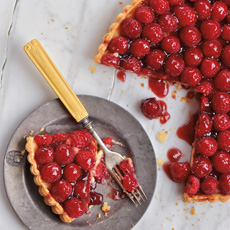 [1] Hungry yet? Get ready to make this cherry tart (photo courtesy New England Open House Cookbook).
|
|
|
3. DIVIDE the pastry dough in half and, working on a lightly floured work surface, shape each half into a flat disk. Wrap each pastry disk in plastic wrap and refrigerate the disks for at least 45 minutes and up to 24 hours or freeze them for up to 3 months. 4. FLOUR the work surface lightly. Roll out 1 pastry disk to form an approximately 11-inch circle. Ease the pastry into a 9-inch tart pan with a removable bottom. Crimp the edge decoratively, trimming away any excess dough. Refrigerate the tart crust for about 30 minutes before baking it. 5. LINE the chilled tart crust with aluminum foil or parchment paper and fill it with ceramic pie weights or dried beans. Bake the tart crust until the edges begin to brown, about 15 minutes. Remove the weights and liner and continue baking until the bottom is a light golden brown, 12 to 15 minutes. When finished, transfer the tart crust to a wire rack and reduce the oven temperature to 325°F. As the crust bakes… 6. MAKE the filling. Combine the eggs, lemon juice, lemon zest, mascarpone, cream, sugar and salt in a mixing bowl. Beat with a hand-held electric mixer at medium speed until smooth and creamy. Pour the filling into the baked tart crust. 7. BAKE the tart until the filling is set, 20 to 25 minutes. Let the tart cool completely on the wire rack. 8. ARRANGE the fruit in a tight, attractive concentric circles on the top of the tart. Place the jelly and cassis in a small saucepan, stir to combine, and heat over medium-low heat until melted and smooth. 9. BRUSH the warm jelly mixture gently over the fruit with a pastry brush. Refrigerate the tart until ready to serve. Medieval Europe: The tart evolved in the 13th and 14th centuries from early medieval pies, which were often savory and enclosed in thick, salty crusts. (The crusts were very purely functional and not edible, created before the wide availability of ceramic and later metal cooking vessels.) Tarts in medieval England were often filled with meat, fish, or cheese and later, sweet versions (fruits, custards) sweetened with honey, produced locally by beekeepers*. (Sugar was rare at the time. Imported from Southeast Asia, it was available only to the wealthy (the history of sugar). Unlike pies, early tarts were open-faced with the filling exposed—both practical and decorative. Cooks used doughs enriched with butter and eggs and designed elaborate fruit arrangements to top fillings of almond cream (frangipane) and custard. While home cooks could bake simple tarts, the pastry was a way for noble households to display wealth. They showed off tarts made with costly ingredients like sugar and exotic fruits and nuts. France chefs elevated the tart as a distinct form different from pies. Their tartes aux fruits (fresh fruit tarts glazed with apricot jam) and tarte au citron, lemon tart filled with citrus curd, became patisserie classics. The term tart is dervices from the French tarte, which was used for both tarts and pies. In fact, our English word tart comes from the Old French tarte, used from medieval times to describe both tarts and pies. Written records of tarte are recorded as early as the 12th century. It likely derived from the Medieval Latin tarta, which is related to the Late Latin word torta, which meant “a small bread.” Tarts spread throughout Europe and beyond. As with any food, each area developed its own types based on local flavors and ingredients. Barley malt syrup was sometimes used in cooking or medicinal recipes, but not as a widespread sweetener, owing to its malty, grainy taste. CHECK OUT WHAT’S HAPPENING ON OUR HOME PAGE, THENIBBLE.COM. |
||