THE NIBBLE BLOG: Products, Recipes & Trends In Specialty Foods
Also visit our main website, TheNibble.com.
|
April 21, 2008 at 10:40 am
· Filed under Wine
|
Air travel restrictions have changed wine drinkers’ buying and travel practices, according to results from a poll released by BottleWise, a manufacturer of airline-friendly wine travel bags. BottleWise asked attendees at last month’s Food and Wine Expo in Washington, D.C., what impact, if any, TSA carry-on restrictions have had on their wine buying habits when flying home from wine country or other destinations. U.S. Transportation Security Administration (TSA) began restricted liquids carry-ons to three-ounce or smaller containers. A bottle of wine is 750ml or 25.4 ounces.
· 24.4%, said they no longer buy bottles of wine when traveling by air
· 41.2% wrap bottles in clothing or bubble wrap and place it in their checked luggage
· 18.1% ask the winery to ship the wine directly to them
· 10.4% reported no impact because they never travel with wine |
|

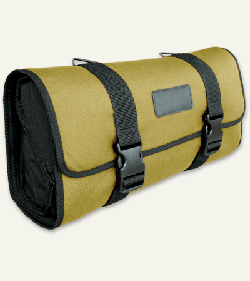
Pack wine in luggage safely with a wine tote like BottleWise. |
| Airlines do not provide compensation for damage to luggage contents created from spills or leaks. Passengers must take the necessary precautions to protect wine bottles, olive oil, perfume and other glass purchases packed away in their checked bags. While bubble wrap is a good start, and the luggage compartments on modern aircraft are pressurized (there is no risk to bottles popping an unopened cap or cork, but transporting opened bottles is not recommended), people with fine clothing may want to take an extra step and use a device like BottleWise, which has liquid-tight pouches. At $48.95 to $58.95 for a carrier that holds just two bottles, it may seem like a luxury; but rolled into the cost of the vacation, it’s just rounding error. Learn more at BottleWise.com. Learn more about wine in the Wine Section of THE NIBBLE online magazine. |
|
|
Permalink
|
|
April 20, 2008 at 11:37 am
· Filed under Beer & Hard Cider, Food Holidays & More
|

THE 2008 champion Best Large Brewery In The World. Blue Moon, based in Golden, Colorado, is owned by Coors. |
|
Beers in 91 style categories took honors yesterday at the 2008 World Beer Cup championships, held in San Diego. Every two years, a highly-qualified panel of beer professionals selects winners in what has been called “the Olympics of beer competitions,” because it awards a gold, silver and bronze in each category. A World Beer Cup gold medal allows a brewery to say that its winning beer represents the best example of that beer style in the world. Craft beer has grown enormously over the past decade. In 1996, at the first World Beer Cup, held in Vail, Colorado, 250 breweries in 20 countries entered 600 beers. This year, 644 breweries from 58 countries and 45 U.S. states vied for awards, with 2,864 beers entered. While brewers from all major continents earned awards, the U.S. won 185 of the 268 style category awards and four of the five Champion Brewery/Brewer awards. |
Judges from 21 countries worked in teams to conduct blind tasting evaluations of the beers. Of the 129 judges, professional brewers and brewing industry experts, 64% came from outside the U.S. Where is America’s award-winning craft beer coming from? California (35 medals), Colorado (22), Oregon (16), Illinois (9), New York (8) and Washington (8). Entries were received from 45 of the 50 U.S. states and Puerto Rico—everwhere except Alabama, New Hampshire, South Dakota, North Dakota and West Virginia.
Here are some of the top beers to look out for: The Lost Abbey beers, made by Port Brewing Company in San Marcos, California, is the 2008 Champion Brewery in the Small Brewing Category. The MidSize Brewing Company Champion is Privatbrauerei Hoepfner GmbH of Germany, maker of Hopefner Pilsner. And the Large Brewing Company champion is Blue Moon Brewing Company of Golden, Colorado, which is actually owned by Coors. A detailed analysis of the entries and awards can be found at WorldBeerCup.org. |
|
|
Permalink
|
|
April 20, 2008 at 7:59 am
· Filed under Beverages
|
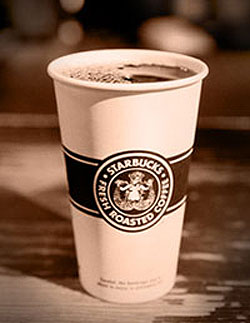
| If you live in a major city, you’ve probably seen the ads for Starbucks new Pike Place Roast coffee…and perhaps you got a taste of the free coffee given out on April 10, the launch day. The name honors the location of the first Starbucks coffee emporium (way back in 1971) in Seattle’s Pike Place Market. The goal was to provide Starbucks customers with a signature, “every day” coffee. Starbucks offered different daily choices of its 25+ different blends and single origin coffees. But research showed that many patrons wanted the same taste every day.
Now, Pike Place Roast will be brewed from freshly-ground beans, every half hour. It’s an excellent blend: robust enough for serious coffee drinkers and moderate enough for moderates. After a week of enjoying a daily cup, we conclude that the company has done a great job of appeasing both camps. |
|
A blend to appeal to everyone…and to pair perfectly with coffee cake, cookies and chocolate-based foods. |
| Everyone will note that there’s a smoother finish and softer acidity in this arabica blend. Coffee geeks or super palates (take your position on the podium of your choice) will note nuances of cocoa and toasted nuts. While it’s a universal cup, the flavor notes pair well with foods that have chocolate, cinnamon or nuts (coffee cake, chocolate chip and other cookies, almond toffee, chocolates and chocolate desserts).
Equally as important as the flavor, IOHO, is that Pike Place Roast is the first of Starbucks’ coffees to bear a new mark symbolizing the company’s ongoing commitment to environmental sustainability, through an expanded relationship with Conservation International, an organization that works in 40 countries to protect plant and animal diversity. Coffee bearing the new mark is purchased from C.A.F.E. Practices-verified suppliers. In 2003, Conservation International and Starbucks joined forces again to design Coffee and Farmer Equity (C.A.F.E.) Practices, a set of environmentally-, socially- and economically-responsible coffee buying guidelines to support conservation and make a positive difference in the lives of farmers and their communities—similar to the goal of Fair Trade Certified practices (Fair Trade Certified is a trademark of Fairtrade Labeling Organizations (FLO), an international monitoring organization whose U.S. auditor is TransFair USA).
Free tastes are still being given out over the next two weeks across the country. Find an event near you at Starbucks.com. See more of our favorite javas in the Coffee Section of THE NIBBLE online magazine. |
|
|
Permalink
|
© Copyright 2005-2026 Lifestyle Direct, Inc. All rights reserved. All images are copyrighted to their respective owners.