TIP OF THE DAY: Mix Spaghetti With Zucchini Noodles (Zoodles)
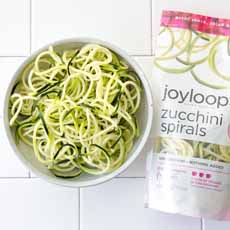
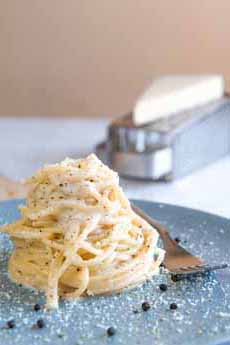
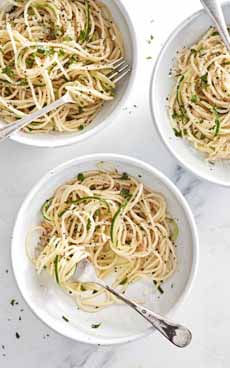 [1] Cacio e Pepe, “cut” with zucchini noodles (photos #1 and #2 © Good Eggs).
|
Two years ago, when zucchini noodles became the rage, many of us ran out to buy spiralizers—simple gadgets that turned a zucchini into ribbons of vegetable “pasta.” You can now buy spiralized zucchini in bags. A big bowl of pasta with Bolognese sauce and lots of grated cheese can be lightened, both texturally and calorically, and is an attractive substitute. We’ve previously written about Cacio e Peppe (KAH-chee-oh ay PEP-pay, cheese and pepper), an ancient pasta dish (in fact, one of the most ancient dishes in Italian cuisine). The classic recipe is a quick one Grated cheese—cacio in Roman dialect, referring to a sheep’s milk cheese like pecorino romano—becomes a creamy, cheesy sauce when mixed with a a few spoons of the hot water used to cook the pasta. The result: creamy sauce, obtained by combining the best quality Pecorino Romano and a few spoons of the water used to cook the spaghetti. The starch that leaches from the spaghetti into the cooking water combines with the grated cheese in just the right way. But Good Eggs has taken it one step further in the name of lowering the carbs: They mixed conventional wheat pasta noodles with zucchini noodles. The recipe is below, but first: > November 14 is National Cacio e Pepe Day. > August 8 is National Zucchini Day. > November is National Pepper Month, celebrating both black peppercorns (Piper nigrum, family Piperaceae) and chili peppers (Capsicum annuum, family Solanaceae), which are not related‡. > The year’s 20 pasta holidays. > The history of pecorino romano cheese. The history of cacio e pepe follows, and below you’ll find the history of zucchini noodles. Cacio e Pepe, a Roman dish, was an easy comfort food. The ingredients were very portable and did not spoil. Roman shepherds and travelers needed only water and a fire to create a stick-to-your-ribs meal. The classic recipe has no butter or cream, ingredients which are used to make creamy Alfredo sauce. There’s just pasta, salted water to cook it, cheese, and ground black pepper. Some modern recipes use a bit of olive oil to bind the ingredients. All the ingredients are ancient foods: You can use all pasta, all zucchini, or a mix to lower the carbs. Ingredients For 2 Main Course Servings |
|
|
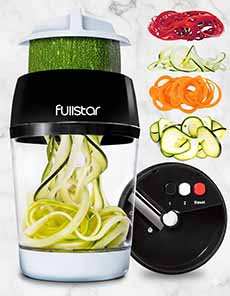
Preparation 1. BRING a large pot of salted water to a boil. While it heats, place the zucchini in a saucepan over medium heat and sauté for about 2 minutes, until al dente. Turn the heat off and cover the zucchini to keep it warm. 2. COOK the spaghetti according to package directions; then drain it, holding back a few tablespoons of pasta water. Add the pasta and half the pasta water to the zucchini pan, and toss together. 3. REMOVE from the heat and toss with the cheese and pepper to taste (Italians go heavy on the pepper). The heat of the pasta and the pasta water should help melt the cheese into a smooth, creamy sauce. Add more hot pasta water as needed to achieve the consistency you desire. If the water has become tepid, microwave it for 30 seconds. 4. GARNISH with parsley and serve. It isn’t part of the official recipe, but we like the crunch of toasted bread crumbs or croutons as a garnish. Zucchini was bred from other squash varieties in Milan, in the late 19th century. But the trend of spiralizing or julienning it and other vegetables into noodle-like ribbons is a more recent culinary development. According to Mirriam-Webster, the word “zoodle” is relatively new, with the first known use dating back to the 1990s. The original Spiralizer vegetable slicer was patented by Japanese inventor Kazunori Hamada of Benriner Co Ltd. in 1993. Here’s what the gadget looked like—a style still made today, although more modern styles have been introduced. A zoodle is defined as a long, thin strip of zucchini that resembles a narrow ribbon of pasta. In the U.K., where zucchini is known by its French name, courgette, zucchini noodles are called courgetti. The U.S. took the Italian name for the vegetable, zucchini, from Italian immigrants who came to America between 1880 and 1920 [source]. Ribbons of zucchini named zoodles were launched in 2014 by restaurateur Danny Antin of Danny’s Chinese Kitchen in Bellmore, New York, on the south shore of Long Island [source]. He had customers with gluten sensitivities and wanted to offer a gluten-free option on his menu. He used a spiralizer to turn zucchini into the approximate shape of wheat-based lo mein noodles (soy sauce also contains gluten but gluten-free tamari, a fermented soybean condiment made without wheat, can be substituted). Noodles & Company, a national restaurant chain with a location not far from Danny’s, added Zoodles to their menu in 2018. Multiple people are credited with inventing zoodles, or zucchini noodles, including Danny from Danny’s Chinese Kitchen and Noodles and Company: Driven by the rise of low-carb and gluten-free diet, in 2018, Noodles and Company began selling zoodles as a lower-carb, lower-calorie alternative to pasta. Zoodles led to the practice of spiralizing apples, beets, broccoli stems, butternut squash, cabbage, onions, and other produce [source: Claude.ai November 14, 2024). ________________ *Humans can’t live without some sodium. It’s needed to transmit nerve impulses, contract and relax muscle fibers (including the heart muscle and blood vessels), and maintain a proper fluid balance. Here’s more about it from Harvard Medical School. †Long, thin spaghetti has different names in different regions of Italy; for example, capellini, fedelini, spaghetti alla chitarra and tonnarelli. Spaghetti alla chitarra, also known as maccheroni alla chitarra, is a variety of egg pasta typical of the Abruzzo region in Italy, with a square cross-section about 2–3 mm thick. Tonnarelli is a similar pasta from the Lazio region. In the U.S., you’re most likely to find spaghetti, spaghettini, and vermicelli (angel hair, capelli d’angelo, is too thin for this rich sauce). The widths of all of these strands vary, but not in a significant way to impact the recipe. ‡The New World fruits were first called pepper by Christopher Columbus when he tasted one for the first time on the island of Hispaniola. Because of their heat and spiciness, he thought they were the fruits (they are fruits, not vegetables) from which the Indians (of India) made pepper. The Nahuatl (Aztec) word is chīlli, which the Spanish explorers spelled “chile.” CHECK OUT WHAT’S HAPPENING ON OUR HOME PAGE, THENIBBLE.COM.
|
||