Valentine’s Day is right around the corner. Our first fun recommendation is the priciest: Caviar Cake! It’s not cake, but a luxurious first course that’s perfection with a glass of Champagne.
Consider the heart-shape for anniversaries and engagements as well as Valentine’s Day.
You don’t have to make it heart-shaped; round, square, or any shape will do.
Ready to make it? The recipe follows along with a list of affordable caviar.
Elsewhere on The Nibble:
> The different types of caviar, a photo glossary.
> The history of caviar.
RECIPE: CAVIAR “CAKE”
Editor’s note: The original recipe was made with an omelet as the base. The firmness makes it a cake. Our mashed potatoes version is less firm. If you prefer an omelet, go for it!
Ingredients
Mashed potatoes with snipped chives (see instructions below)
Caviar of choice (see below)
Garnish: baby greens (in photo arugula, chard, red-veined sorrel)
Lemon juice-EVOO vinaigrette or flavored EVOO for dressing
Plus:
Heart-shaped mold or cookie cutter
EVOO or cooking spray (truffle- or chive-infused EVOO is great!)
Preparation For The Mashed Potatoes
1. WIPE the inside of the mold with butter or EVOO.
2. PREPARE the stiffed mashed potatoes (see below).
3. PLACE the mold on the serving plate and fill with the stiffened mashed potatoes. Smooth the top, and gently lift the cutter.
4. COVER the top with a layer off caviar.
5. DRESS the greens ever-so-lightly. There should be no dressing dripping off them.
6. REMOVE the mold, sprinkle a few leaves around the heart, and serve with Champagne.
How To Stiffen Mashed Potatoes
Potatoes: Use starchy potatoes: Yukon Gold or Russets are best. Then, you need to remove moisture from the mashed potatoes.
Option 1: Add Dehydrated Potato Flakes. Stirring in a small amount of instant potato flakes is the professional secret for thickening mash without changing the flavor. They absorb excess moisture instantly.
Option 2: Stovetop. Put the mashed potatoes back in a pot over low heat. Stir constantly for 5–10 minutes to cook off the steam and excess moisture.
Option 3: Egg Yolk. Stirring in 2-3 egg yolks per pound of potatoes (while the potatoes are warm but not boiling) acts as a binder. As the potatoes cool slightly, the yolk helps them set.
Option 4: Create A Crust. Shape the heart potatoes on a baking sheet and place the sheet under the broiler for 2-3 minutes. A light golden crust to lock the shape in place.
16 TYPES OF AFFORDABLE CAVIAR
Sturgeon caviar prices vary widely depending on the type and quality, and the most affordable ones are still too expensive to make a Caviar Cake. Don’t worry, though: We have more affordable options below.
To take the price pulse of sturgeon caviar today:
White sturgeon caviar costs around $80 per ounce.
Siberian sturgeon caviar ranges from $50 to $70 per ounce.
Kaluga caviar is about $80 per ounce.
Osetra caviar typically ranges from $80 to $200.
Beluga caviar, an endangered species, is not sold in the U.S. anymore.
Once upon a time, not too long ago, only sturgeon roe was called “caviar.” But today, any fish roe fits the bill. So take a look at these:
Avruga, Spanish herring roe. It looks like large, glossy black caviar pearls, but it isn’t caviar at all! Avruga is a roe-free caviar substitute made by a Spanish company, Pescaviar, from herring in Spanish waters. It comprises 40% local Spanish herring plus squid ink, salt, corn starch, lemon juice, citric acid and stabilizers (about $15/$20/ounce; (more).
Bottarga is cured, dried fish roe: no longer in the form of caviar, but pressed into a block that can be sliced or grated (and is sold as the whole roe (about $7-$13/ounce) or a grated in a jar (about $8-$32/ounce). It is typically made from the roe of the grey mullet, and is very popular in Italy, for grating over pasta, rice, salads and other dishes (more). Also see mullet.
Bowfin caviar comes from a fish in the southern U.S. that is not related to the sturgeon. Its eggs visually resemble sturgeon roe, but taste entirely different (muddy, some call it, and it lives on mud river bottoms). That’s why it’s also called mudfish, swampfish, cypress trout, and by the Cajun name “choupique.” It was considered a trash fish, the flesh used to make fish cakes, until the ban of imported Caspian caviar led to a search for alternatives ($7-$15/ounce; more).
Capelin roe or smelt roe, called masago at sushi bars (more), about $4-$15/ounce.
Herruga caviar (another brand name is stromluga) is a version of avruga, a product made from herring meat to look like caviar. The herring comes from the North Atlantic and Baltic seas. The color of the beads ranges from dark gray to black, and they have a light smokey character ($6 and up/ounce).
Kazunoko comes from the golden herring, and is available during the holiday season, eaten for the Japanese new year by those hoping for children (gold color symbolizes fertility). Its bright roe sac (the ovary) contains thousands of tiny eggs, which crunch like tobiko. While the roe is not particularly flavorful, it is marinated in a dashi-soy seasoning. its golden beauty makes it a popular New Year’s dish in Japan. The name is made up: kazu means number and ko means child. Here’s more (about $2-$3/ounce).
Lumpfish roe from the North Atlantic lumpfish. If your family used Romanoff caviar as as garnish back in the day, you’ve had it. The pale, crunchy eggs are dyed black, red or golden, but the food coloring runs. It is used mostly as a garnish on hors d’oeuvre (about $7/ounce; more).
Mentaiko and tarako are roe of the Alaskan cod or pollock. Mentaiko is spiced with powdered red pepper, which makes it pink to dark red in color. Tarako is not spiced, but is salted instead ($8-$9/ounce).
Mullet roe (karasumi in Japanese) is the Japanese equivalent of Italian bottarga. The the roe sac of the mullet is cured and vacuum packed. The whole roe sac is sold, to be sliced for hors d’oeuvre served with saké, sliced on top of rice, or grated as a garnish. It’s considered a delicacy ($25-$45/ounce).
Pollock roe, called tarako in Japanese. Not widely available in the U.S., we couldn’t even find it on Amazon except in a fermented Korean condiment.
Salmon caviar, called ikura at sushi bars, is popular in the U.S. as a colorful, tasty garnish. As with any product, prices and quality vary (and start at about $10/ounce). The imported roe from the keta salmon of Russia has larger eggs, which are considered more desirable.
Smelt roe, called masago in Japanese, looks like the pricer, higher-quality flying fish roe (tobiko); but is crunchy rather than flavorful like tobiko. California rolls are often coated with a splash of masago; while the gunkan maki are filled with tobiko. You can use a few beads of garnish to add color to canapés (about $2/ounce).
(list continues below)
|
|
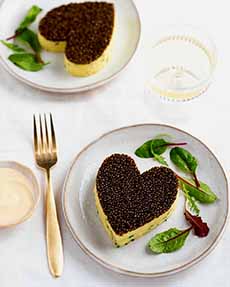
[1] Yes, we will be your valentine. Can we get seconds? (photo © Petrossian).
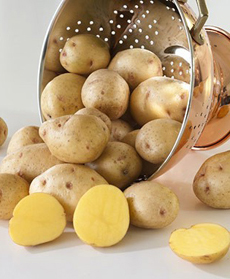
[2] Yukon Gold potatoes make the creamiest mashed potatoes (photo © Bonnie Plants).
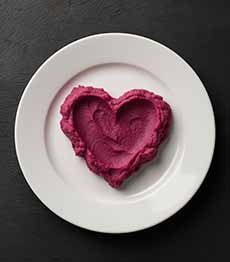
[3] While Purple Peruvian potatoes and purple Japanese sweet potatoes (Okinawan purple sweet potato a.k.a. Beni Imo, or Murasaki) mash up silky and smooth in a ricer, they’re more dense and firm than creamy. It’s a trade-off for visual effect (Abacus Photo ).
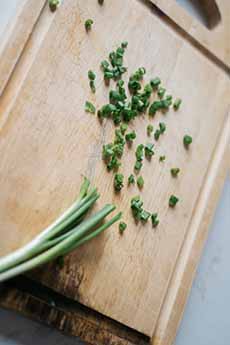
[4] A bit of minced chives complements both the potatoes and the caviar (photo © Anna Tarazevich | Pexels).
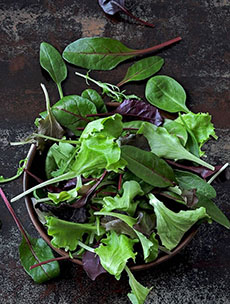
[5] Not too long ago, baby greens were the precious of fine cuisine. Now they’re a staple at supermarkets. Here’s more about baby greens (photo © The Vegan Atlas).
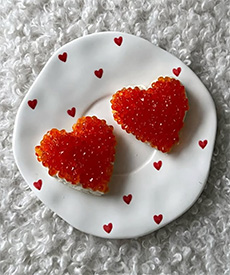
[6] Salmon caviar hearts. See the *footnote for other red roe varieties (photo © Icra Rosie | Moldova).
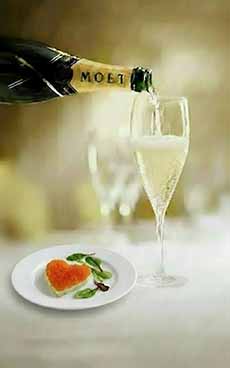
[7] Don’t forget the Champagne (Abacus Photo).
|
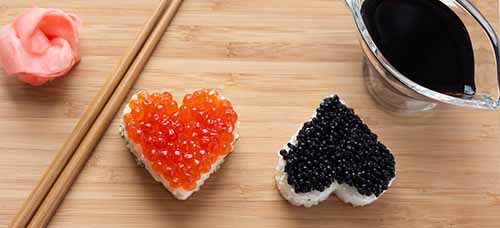
[8] The same concept works with sushi (photo © Savvy Tokyo).
Tarama, the tiny roe of carp, cod or mullet (more). Pale orange in color, they are most often found blended into taramosalata but also available in their original form from Krinos (an 8-ounce jar is about $7-$13, elsewhere $1.35-$3+/ounce). Tarama means fish roe in Greek and Turkish.
Tobiko, roe from the Icelandic flying fish (a superior product to the similar-looking masago—more). It is typically dyed orange, but can be found in red, green (with wasabi flavor) and black (about $6-$15/ounce).
Trout roe, pale yellow in color, has become a popular garnish, especially when colored red-orange to resemble the pricier salmon roe, which it resembles (about $9-$15+/ounce).
Whitefish roe, also pale, has been colored and flavored into delights such as beet (red), ginger (yellow), mango (orange), truffle (brown), wasabi (green), even black (about $8-$13.50/ounce).
________________
*In addition to salmon roe (ikura) and tobiko (flying fish roe), other red or red-orange fish roe include:
> Lumpfish Caviar: A budget-friendly option that is naturally gray, but is usually dyed red or black for use as a garnish. It has negligible flavor.
> Masago (capelin roe): Naturally a light orange or yellow, masago is frequently dyed with red with beet juice or food coloring for sushi, where it is used as a smaller, less crunchy alternative to tobiko.
> Mentaiko (pollock/cod roe): Alaska pollock roe that is cured and often spiced with red pepper, resulting in a pink to dark red color. It is not appropriate for this recipe, since it is shaped in one long piece like shad roe, rather than separate eggs.
> Trout Roe (trout caviar): Visually it looks like salmon roe, but smaller and with a different, mild, flavor. The color ranges from golden-orange to vibrant red-orange color.
> Whitefish Caviar: While naturally golden, with tiny eggs and mild flavor, it is often colored and infused with gourmet flavors (e.g. brown/truffle, green/wasabi, orange/bacon, red/beet or saffron, yellow/lemongrass).
CHECK OUT WHAT’S HAPPENING ON OUR HOME PAGE, THENIBBLE.COM.
|

