America’s Top 10 Sandwiches & Grilled Cheese History
|
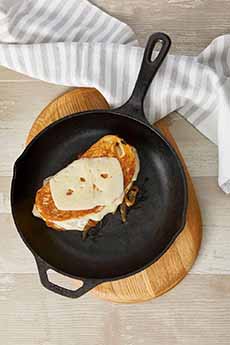
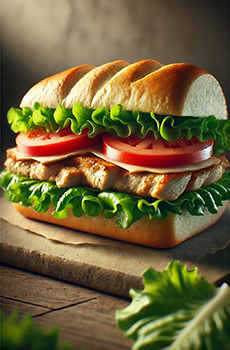
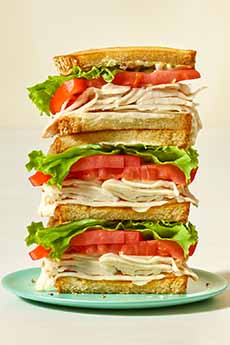
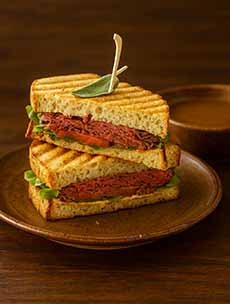
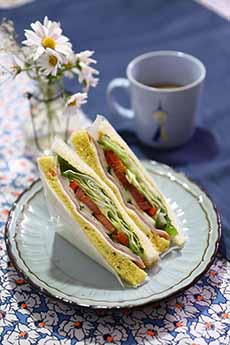
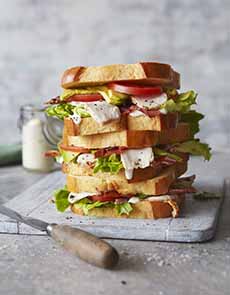
We’re celebrating National BLT Day today, July 22nd, with the Cheddar, bacon, and tomato for lunch and a luxury version, a lobster BLT with Gruyère, for dinner. Which got us to thinking: Is the BLT our favorite sandwich? Actually, its big brother, the club sandwich, topped with turkey or chicken—has an edge. So we decided to see what the rest of the country prefers. The Top 10 sandwiches in America follow. But first: > The different types of sandwiches: a photo glossary. > The year’s 25+ sandwich holidays. > The history of the sandwich. > The history of the grilled cheese sandwich is below. We looked at several surveys, which, as is common varied somewhat. Here’s one compiled by 24/7 Wall St. Note that the BLT, Club, and Bacon sandwiches have close kinship: While we may have our own definitions, by the textbook a BLT is a simple sandwich, usually consisting of just bacon, lettuce, and tomato with mayo between two slices of bread. The club sandwich adds a layer of turkey or chicken on toasted bread. It can be a single or “triple decker.” The Top 10 Sandwiches 1. Grilled Cheese (photo #1) 2. Grilled Chicken (photo #2) 3. Turkey (photo #3) 4. Roast Beef 5. Ham 6. BLT 7. Club 8. Bacon Sandwich 9. Peanut Butter & Jelly 10. Pulled Pork The bread. The earliest form of bread was flatbread made from wild grains and tubers ground into flour, mixed with water, and baked on hot stones. The eastern evidence is ca. 12,400 B.C.E. (predating agriculture!) in what is now Jordan. There was widespread flatbread use from 7000 to 6000 B.C.E. By 2000 B.C.E., flatbread became common across Near East as well. The first leavened (risen) bread likely emerged around 3,000 B.C.E. in ancient Egypt, via contact between the flatbread dough and wild yeast. By the Roman era, 100 B.C.E.–400 C.E., wheat bread was a staple. > The history of bread to modern times. Cheese appears, ca. 7000–6000 B.C.E. The earliest evidence has been found in Neolithic pottery in Poland. The process of cheese making, involving fermenting milk to separate curds and whey, was possibly discovered accidentally when milk was stored in animal stomachs (animal stomachs and bladders were employed as containers in ancient times). Stomachs contain the rennet enzymes necessary to create the curds that are pressed into cheese. While archaeologists have yet to find the smoking gun (or smoking pottery, as it were), around 6000–5000 B.C.E., in Mesopotamia or the Fertile Crescent, people could plausibly have eaten cheese with flatbreads or early forms of grain cakes. Sumerians (ca. 3000 B.C.E) and Egyptians (ca. 2000 B.C.E.) both produced cheese. By the time of the Greeks and Romans, cheese was widely made and even aged for texture and flavor. In ancient Rome, bread and cheese were a common soldier’s ration. > The history of cheese. The concept of combining bread and cheese dates back thousands of years. Ancient Romans reportedly enjoyed bread grilled with cheese, though not in sandwich form. Welsh rarebit (rabbit) originated in Britain, possibly as far back as the 14th century (the earliest printed record dates to 1725). Melted cheese was poured over a slice of toasted (presumably stale) bread. The sandwich was invented on the fly in 1762, to make it convenient to eat while at the gambling table (the history of the sandwich). Sometime in 18th-century Switzerland, the practice of dipping bread in melted cheese—fondue—appeared. It is believed to have been created as a way to use stale bread. The Swiss also created raclette, melted cheese served with boiled potatoes, crusty bread, cornichons, and usually a variety of proteins and vegetables. Needless to say, where ever there was bread and cheese, they were eaten together in some form or other. Take a look at: You have to cross the ocean for modern grilled cheese—melted cheese between two slices of bread—which was created in the U.S. in the 1920s. 1920s: It was made possible thanks to two key inventions, beginning in the 1920s: 1940s: During World War II, mess halls served “American cheese filling sandwiches,” usually toasted, to U.S. soldiers. The name “cheese dream” was sometimes used, especially when the sandwich was topped with extras like bacon or tomato and served hot and open-faced. |
|
|
|
1950s: The now-familiar two-slice grilled cheese, made with with buttered bread and American cheese toasted in a skillet, was common in American households. Schools added it to lunch fare as an inexpensive, child-/teen-friendly meal, often paired with tomato soup (which counted as a serving of vegetables). Cookbooks and advertisements promoted the grilled cheese sandwich as quick, wholesome, and ideal for busy mothers and picky eaters. 1960s: By the 1960s, the term “grilled cheese sandwich” became more common, replacing older terms like “toasted cheese.” The switch to grilling in a pan with butter (rather than baking or broiling) helped define the form we recognize today: two slices of bread, buttered on the outside, filled with cheese, and griddled until golden and melty. Grilled cheese sandwiches became a staple in American households and school lunchrooms. Paired with tomato soup, grilled cheese became a nostalgic comfort food—partly due to school cafeterias, partly due to marketing campaigns by soup companies like Campbell’s. 2000s: Today grilled cheese has evolved from American cheese on white or whole wheat, into a gourmet item, including add-ons beyond the traditional toppings of bacon, tomato, and deli-style pickles. CHECK OUT WHAT’S HAPPENING ON OUR HOME PAGE, THENIBBLE.COM. |
||