Haggis, The National Dish Of Scotland, For Haggis Day & Burns Night
|
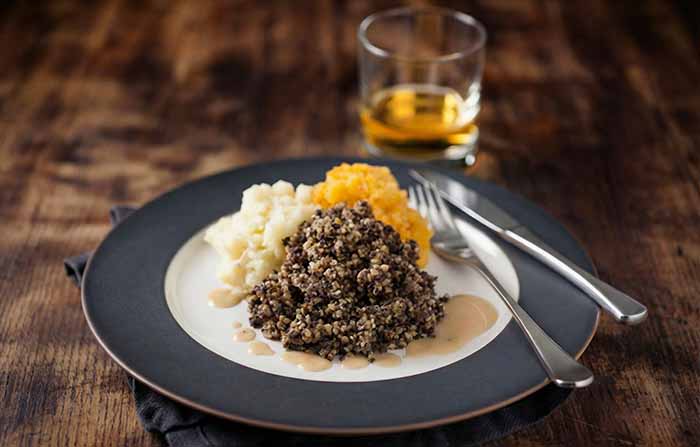
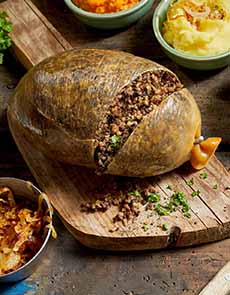
January 25th is a celebration day in Scotland. It’s the birthday of Robert Burns, Scotland’s national poet, and it’s also National Haggis Day, celebrating Scotland’s national dish. And it’s celebrated in the U.S., too. The poet’s celebration is called Burns Night, an evening for dinner parties and festivities that celebrate Scottish food, drink, and verse—particularly the reading of Burns’ “Address to a Haggis.” In addition to being a great poet, Burns (1759-1796) was a noted raconteur and the first Burns Supper was organized by his friends in 1801 to celebrate him after his death in 1796. Burns (photo #9) was known familiarly as Rabbie Burns, not Robbie. The tradition became an annual event in Scotland, taking on any form from a formal affair to a relaxed family gathering to a party of friends. Going back millennia, dishes like haggis made efficient use of organ meats that were more perishable than muscle meat. You’ll see more in the history below. Scotland’s mountainous terrain, poor-quality soil, and harsh, wet climate made it ideal for hardy sheep breeds, which can thrive on sparse vegetation where crops and other livestock fail. With roughly 70% of the land unsuitable for arable farming, sheep became the primary livestock, enjoying life in the rugged, high-altitude pastures. Haggis became deeply embedded in Scottish culture, especially after Robert Burns, Scotland’s national poet, wrote “Address to a Haggis” in 1786, elevating it to an iconic national dish. Here’s the poem, but unless you understand Scottish, it may be difficult to understand. And, in eight stanzas, it only mentions “haggis” twice! > The menu for a Burns Night dinner party. > Sing along to Burns’ most famous poem, “Auld Lang Syne.” If you’re invited to a Burns Night supper and want to bring something, we suggest Scottish whiskey or shortbread. > If you want to have fun with it, here’s how to turn gingerbread men into Scotsmen (or Burns bros). > How to plan a Scotch tasting. > For something more easy to manage, how about a Scotch and chocolate tasting? While solid chocolate wasn’t invented in Burns’ lifetime, he was a bon vivant and we’re sure he’d approve. > The year’s 75 meat holidays. > The history of haggis follows this photo of a perfect plate of haggis with a glass of Scotch. While haggis (HAG-us) is the national dish of Scotland, its exact origins are debated. The concept of cooking meat in animal stomachs dates back to ancient times. The practice likely arose in prehistory from the practical necessity of using every part of an animal. Nothing went to waste, and the stomach of a sheep created a convenient cooking vessel. When writing appeared, we can trace the dish through: The etymology of “haggis” is not certain, but: Haggis is made with sheep’s heart, liver, and lungs (known collectively as the “pluck” of the sheep) are mixed with oatmeal, minced onions, suet, and spices, all chopped together, sewn into a sheep’s stomach, and boiled (although modern versions often use synthetic casings). It’s essentially, a sausage: minced ingredients stuffed into a casing. The cooked insides are removed from the stomach* *(photos #2 and #3) and served with neeps and tatties (Scottish for rutabaga and potatoes—photo #9). In fact, traditional Scottish haggis containing sheep’s lung is not allowed to be sold or imported into the U.S.; the USDA banned sheep lungs, heart, and liver for human consumption in 1971 (here’s why). The ban has led to creative adaptations of haggis in the U.S. that replace the forbidden ingredients while still aiming to capture its essence, including the offal of other meats, such as beef, lamb, pork, and venison. Lung-free, versions using alternative ingredients (like lamb heart) are legal and available in the U.S. right now, made with ox bung (cow’s intestine) or artificial casings instead of sheep stomach. There are even vegan/vegetarian versions:, haggis, made with mushrooms, onions, other fresh vegetables, pulses, oats, and seeds. Vegan casings are made from beans, lentils, nuts, and various vegetables instead of meat. And if it’s a good recipe, meat-eaters will enjoy it, too. After beginning to petition the Obama administration in 2014, the Biden Administration lifted the 1971 ban in December 2021. It didn’t mean the immediate import of haggis—you know, paperwork and more paperwork (continues below). |
 [1] Haggis and tatties (mashed potatoes). Here’s the recipe (photo © 196 Flavors).
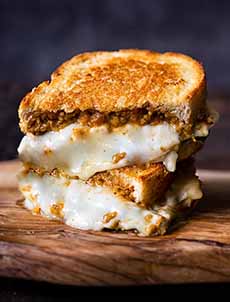
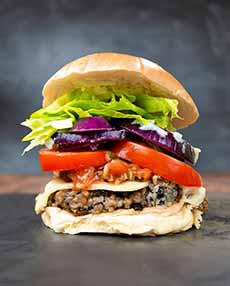
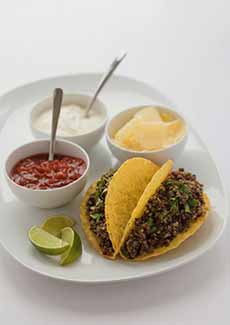
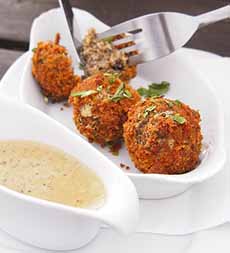
Modern Ways To Serve Haggis
|
|
 [10] Portrait of Burns by Alexander Nasmyth, 1787. It hangs in the Scottish National Portrait Gallery (Public Domain). Scottish producers are currently developing compliant, lung-free recipes aimed at potentially entering the U.S. market in time for Haggis Day/Burns Night 2027. Scotland’s largest haggis producer, Macsween of Edinburgh, is currently testing a compliant recipe. There are some 30 million U.S. citizens who claim Scottish heritage, and others who developed an appreciation for the dish while visiting Scotland. Not to mention curious foodies who have no connection with Bonnie Scotland. So all of you: Mark your calendar for January 25, 2027 and plan ahead to celebrate National Haggis Day and Burns Night. Don’t forget to toast haggis the with some Scottish whisky: It’s part of the tradition. Or have it for breakfast with eggs and toast. You can include the neeps and tatties, too. Neeps. Some articles/recipes refer to neeps as turnips. They are rutabaga, also known as swedes or yellow turnips. They are technically a hybrid species (Brassica napus) and not true white turnips (Brassica rapa). They are the orange-fleshed root vegetable served mashed alongside haggis and tatties. Tatties. Tatties is the Scots term for potatoes in general, but in culinary contexts like “neeps and tatties,” it refers specifically to mashed potatoes. As with the American recipe, they are boiled, mashed with butter and milk, and seasoned with salt and pepper. ________________ The main course, haggis, begins with the Parade of the Haggis. Guests welcome the haggis: standing, they clap their hands, accompanied by the sound of the bagpipes (a recording will do). The haggis and chef (or host in a small gathering) approach the top table, and the Burns’ Address to the Haggis is recited. At the end, “His knife, see rustic labour dicht / An’ cut ye up wi’ ready slight.” The haggis is then cut open and served. The evening often includes speeches in praise of Burns, as well as a traditional “Toast to the Lassies” from a male guest with a response from a female guest. CHECK OUT WHAT’S HAPPENING ON OUR HOME PAGE, THENIBBLE.COM. |
||