Bakewell Tart Recipe For National Bakewell Tart Day
|
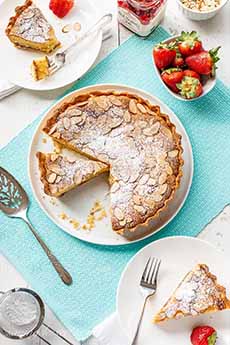
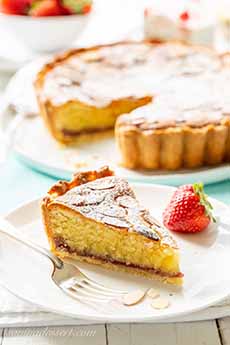
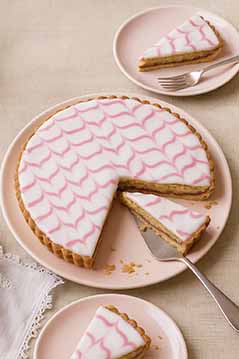
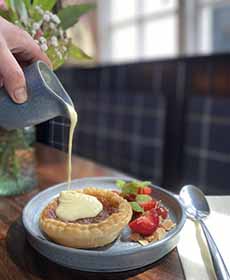
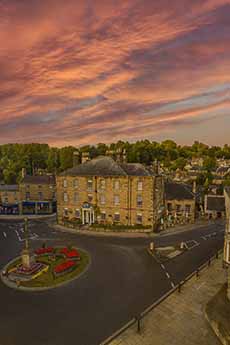
August 11th is National Bakewell Tart Day, a fact which may lead most Americans to say, “What’s A Bakewell Tart?” It’s a traditional British pastry that originated in the town of Bakewell in Derbyshire, England. A layer of jam covers a shortbread crust, topped in turn by of almond custard (frangipane) and sliced almonds. It isn’t overly sweet, making it perfect for afternoon tea or even as a breakfast pastry. We think it’s pure comforting food. The jam can be virtually any flavor. In the newspaper reporting of the original “accident” (see the history, below the flavor wasn’t specified. The cook would have used whatever was on hand. Today’s Bakewell Tart typically uses cherry, raspberry, or strawberry jam. Use whatever you like. > The history of the Bakewell Tart is below. > The year’s 3 tart holidays are below. However… > The difference between a pie and a tart. > The different types of pies and pastries: a photo glossary. Prep time is 45 minutes and bake time is 45 minutes. While many recipes like a garnish of confectioners’ sugar, we leave it off—we don’t like it “dusting all over the place.” See the commentary in the *footnote about substituting marzipan for frangipane. For The Shortbread Crust 2. LIGHTLY BEAT the egg yolks with the almond extract and stir them into the flour mixture. Continue to mix while adding just enough water to form a sticky dough. 3. ROLL out the dough on a lightly floured surface to 1/4-inch thickness. Transfer the dough to the tart pan, pressing along the sides and trimming any excess dough. Refrigerate for at least 30 minutes. 4. PREHEAT the oven to 400°F. Place a circle of parchment paper on top of the dough and fill it with pie weights or dried beans and bake for 10 minutes. (This is called blind baking, to briefly pre-cook the shell before adding the filling, to ensure a crisp, fully cooked crust). Then… 5. REMOVE then the pie weights and parchment paper and bake for an additional 5 minutes until just barely golden. Reduce the oven temperature to 375°F and set the crust aside to cool. 6. MAKE the frangipane. Cream together the butter and sugar with an electric mixer on medium speed until light and fluffy, about 1 minute. Add the eggs, one at a time, beating well after each addition. Add the almond extract and beat for an additional 30 seconds. Spoon in the almond meal and all-purpose flour while the mixer is running and combine well. 7. SPREAD 1 cup of jam evenly along the shortbread crust. Top with the frangipane, spreading to cover the entire surface of the tart. Smooth the top and bake at 375°F for 20 minutes. 8. REMOVE the tart from the oven and scatter the sliced almonds across the top. Return to the oven and bake an additional 5-10 minutes, until golden brown and a tester inserted into the center of the tart comes out clean. 9. DUST with additional confectioners’ sugar if desire and serve slightly warm or at room temperature with optional custard sauce or whipped cream. If not serving that day… 10. TIGHTLY WRAP the tart or place it in an airtight container. If will keep on the counter for three days, or a few days longer in the fridge (allow to come to room temperature before serving). You can freeze a Bakewell tart for three months. Allow it to thaw in the fridge instead of on the counter. Before serving, take it out of the fridge and let it come to room temperature. The history off the Bakewell Tart begins with the creation of its predecessor, Bakewell Pudding (photos #1, #6, and #7). An origin story claims it was invented around 1820 by accident at the White Horse Inn (now the Rutland Arms Hotel) in Bakewell, Derbyshire (photo #8). What we do know is that a recipe for Bakewell Pudding appears in The Magazine of Domestic Economy, published in London in 1836. Another recipe is found in Eliza Acton’a 1845 book, Modern Cookery for Private Families. But there is a conflicting account from a contemporary bakery café in Bakewell. As The Old Original Bakewell Pudding Shop tells it, around 1860 a Mrs. Wilson became aware of the creation that at The White Horse Inn (which seems a bit late given the aforementioned recipes). The website also adds to the origin story, that a visiting noblemen had ordered a strawberry tart at The White Horse Inn, but instead of stirring the egg mixture into the pastry, the cook spread it on top of a layer of jam. The story goes on to say that Mrs. Wilson acquired the original recipe and started a business of her own. Oh, and some trivia: The name Bakewell doesn’t refer to a town where there are talented bakers. Rather, it’s derived from its Old English name, “Baedeca’s wella,” meaning Baedeca’s Springs. Likely, a Saxon named Baedeca or Beadeca first settled by the warm springs in the area. The name of the town is mentioned in a historical record dating back to 924 C.E. The evolution to the modern Bakewell Tart with frangipane instead of custard filling occurred in the early 20th century, probably between 1900 and 1920. To our knowledge, no one has yet dug through early 20th-century British cookbooks and bakery records to find a printed record (although as with all recipes, it can have emerged long before it first appears in print). The transition was likely been gradual rather than a single moment of invention. It likely occurred because: †The date is in dispute; some sources say June 17th, some say the 18th. |
|
|
|
CHECK OUT WHAT’S HAPPENING ON OUR HOME PAGE, THENIBBLE.COM. |
||