Chicken Parm “Lasagna” For National Chicken Parmesan Day
|
|
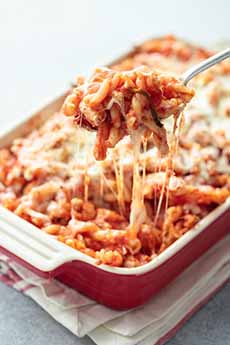
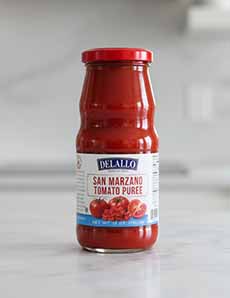
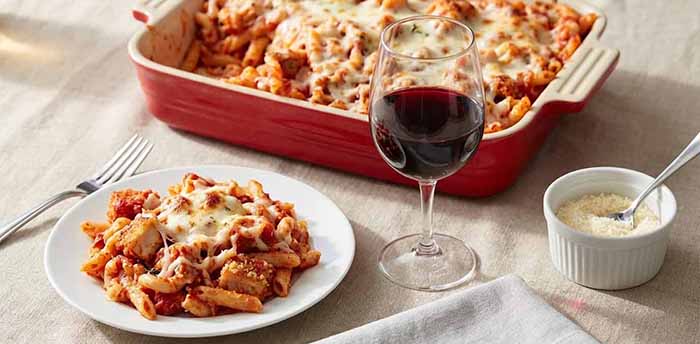
We count ourselves among the lasagna lovers who eagerly order it at restaurants but don’t have the energy to make it at home. We found a great hacks in Ravioli Lasagna, where sheets of ravioli are layered in between the cheese. (Since it’s the first day of fall, here are recipes for Pumpkin Lasagna and Pumpkin Ravioli Lasagna.) Today’s hack is simply a pasta bake with tomato sauce, mozzarella, and parmesan: the ingredients of lasagna in an easy-to-throw-together dish. No wrangling of lasagna noodles is involved. Instead, you can use any “short cut” of pasta, from: This recipe, which was contributed to the DeLallo recipe archive by Love & Olive Oil, adds chicken breasts as protein. If you don’t want the chicken, adapt the recipe to pasta only. But chicken turns it into a different hommage recipe: Chicken Parmesan. Americans say their favorite Italian food is Chicken Parm, and March 11th is National Chicken Parm Day. Below: > The recipe for Chicken Parmesan Lasagna. > The history of Chicken Parmesan. Elsewhere on The Nibble: > The history of baked pasta (pasta al forno). > The history of chicken and the different types of chicken: a photo glossary. > The different types of pasta: a photo glossary. > The year’s 20 pasta holidays. > The year’s 40 chicken holidays. > The year’s 58 Italian food holidays. Ingredients For 8 Servings |
|
|
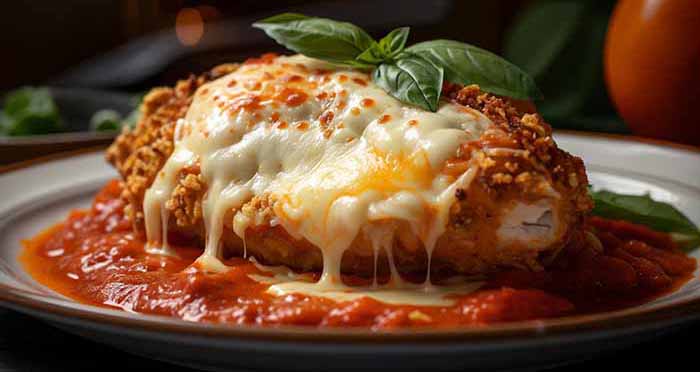
Preparation 1. PREHEAT the oven to 350°F. Lightly spray a 3-quart casserole dish with cooking spray. 2. BRING a large pot of salted water to a boil. Meanwhile… 3. HEAT the olive oil in a large skillet over medium-high heat. Add the onion and garlic and sauté for 6 to 8 minutes, or until the onion is softened and fragrant. 4. ADD the tomato purée and bring the mixture to a simmer. Add the chicken and simmer for about 10 minutes or until the sauce is thickened slightly and the chicken is just cooked through. Stir in the fresh basil and season generously with salt and pepper. Meanwhile… 5. COOK the pasta in boiling water until it is not quite al dente (subtract 2-3 minutes from the cooking time listed on the package). Reserve a cup of the pasta water before draining the pasta. 7. TRANSFER half of the pasta to the prepared casserole dish, spreading it into an even layer. Sprinkle with half of the mozzarella and half of the parmesan cheese. Top with the remaining pasta, followed by the rest of the cheese. 8. SPRINKLE with the breadcrumbs and Italian herb seasoning. Bake for 20 to 30 minutes or until the cheese is melted and bubbly and the pasta is heated through*. If desired, broil for 2 to 3 minutes at the very end until the cheese is browned in spots. Let cool for 5 minutes before serving. If you ask for “Pollo alla Parmigiana” in Italy, you will likely get a confused look. If it exists at all, it’s usually in tourist-heavy areas catering to Americans. In Italy, “Parmigiana” almost exclusively refers to the eggplant dish. Chicken Parmesan (or Chicken Parmigiana) is a classic Italian-American creation. While it has deep Italian roots, the dish as we know it—a breaded chicken cutlet smothered in marinara sauce and melted mozzarella—is a product of the immigrant experience in the United States. The true Italian parmigiana is Eggplant Parmesan (Melanzane alla Parmigiana), which hails from Southern Italy (the regions of Campania and Sicily). As with the American version, it’s a layered dish of fried eggplant slices, tomato sauce, and cheese. In Italy, it’s often served at room temperature as a side or a starter. It is rarely breaded and never served over spaghetti. When Italian immigrants arrived in the U.S. in the late 19th and early 20th centuries, they found that meat was significantly cheaper and more available than it had been in the Old Country. They began substituting the humble eggplant with veal (Veal Parmigiana) and eventually chicken, which was even more affordable. And yes, Eggplant Parmesan still had a place on the Italian-American table. But the Italian-American versions became much more robust than the Italian eggplant dish. By the 1960s, it was a staple of “red sauce” Itallian restaurants and eventually became widely available as a frozen dinner. *If your pasta was cool or cold when you put it in the oven—for example, if you made the pasta ahead of time and refrigerated it overnight—it will likely need more time. CHECK OUT WHAT’S HAPPENING ON OUR HOME PAGE, THENIBBLE.COM. |
||