Build Up Your Pastrami Sandwich With These Pastrami Sandwich Variations
|
|
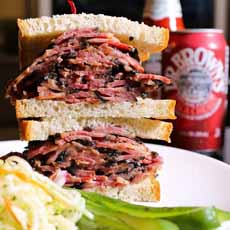
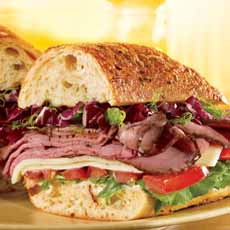
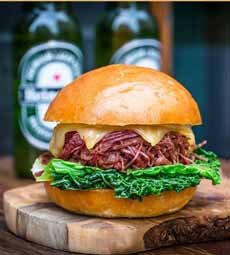
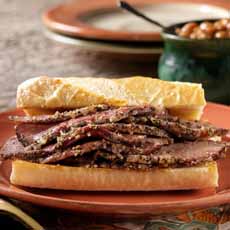
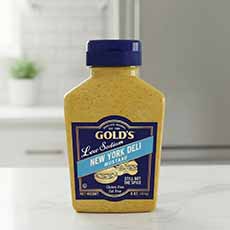
January 14th is National Hot Pastrami Sandwich Day. The classic Jewish deli pastrami sandwich came to New York City with Romanian-Jewish immigrants in the latter half of the 19th century. Below you’ll find: > Trending pastrami sandwich variations. Elsewhere on The Nibble: > The year’s 27+ sandwich holidays. > The year’s 25+ beef holidays. > The different types of sandwiches: a photo glossary. > The different cuts of beef: a photo glossary. > The Reuben sandwich and its variations. Pastrami is spicy cured brisket of beef. The brisket is salt-brined, seasoned with herbs and spices, and hot smoked. The typical pastrami spice-and-seasoning blend includes coriander seeds, dark brown sugar, granulated garlic, ground black pepper, ground cloves, kosher salt, smoked paprika and yellow mustard seeds. The spiced, smoked pastrami is then chilled and steamed (it is often kept warm on a steam table). In New York, it is thinly sliced (sometimes medium, but never thick) and served warm on caraway-seeded rye bread with a pot of brown deli mustard, accompanied by dill pickles and coleslaw. Deli mustard (photo #7), by the way, is an American name for a variety of coarsely ground mustard, i.e., a whole grain mustard. Some recipes add a hint of horseradish (yes!). The combination is the perfect accent to fatty pastrami and corned beef—and is delicious on ham, roast beef, turkey and everything else. In New York, the drink of choice is a can of Dr. Brown’s Black Cherry, Cel-Ray or Cream Soda, regular or diet (we wouldn’t turn down a good beer). That’s a New York pastrami experience. The name pastrami comes from Romanian pastramă, a derivation of a word that means to conserve food. Pastrami came to the U.S. with a wave of Jewish immigration from Bessarabia and Romania, in the second half of the 19th century. The word modification “pastrami” likely occurred then. In the Old Country, Jewish Romanians commonly used goose breasts were to make into pastrami; they were inexpensive. But in the U.S., beef navel was cheaper than goose, so the Romanian Jewish immigrants adapted their recipe and began to make beef pastrami. New York’s Sussman Volk is generally credited with creating the first pastrami sandwich, in 1887. Volk, a kosher butcher and immigrant from Lithuania, claimed he got the recipe from a Romanian friend in exchange for storing the friend’s luggage. According to his descendant, Patricia Volk, he sold the pastrami on sandwiches at his butcher shop. The sandwich was so popular that Volk converted the butcher shop into a restaurant to sell pastrami sandwiches [source]. As pastrami traveled to different cities, it was “adapted”—to the horror of a New York deli purist—to include Italian rolls, soft rolls giardiniera, even (gasp!) marinara sauce and mayonnaise. The Kansas-style brisket with barbecue sauce was added to the list. These versions are what Jewish New Yorkers call goyishem, meaning “in the manner or style of a non-Jewish person.” For the sake of our mother, grandmother, and every other cook in our line, we offer some modern yiddishe enhancements, “in the manner or style of Jewish foodies.” You can get creative with a pastrami sandwich without violating any Geneva Food Convention. You can add or substitute without abusing the New York pastrami tradition. We mean, you can modernize it. We’re not talking wasabi mustard, pickled jalapeños, or pesto, just some logical extensions, some borrowed from the Reuben sandwich. Our favorite: pastrami on rye or pumpernickel with melted Gruyère and caramelized onions. Plus the deli mustard and sides of pickles and coleslaw. Alas, our taste buds can’t go so far as pastrami on a baguette or any crunchy or flavored roll. Not even brioche. Although some day soon, we’ll try it in a pita pocket. |
|
|
________________ *Russian Dressing vs. Thousand Island Dressing: The main difference between the two is that Thousand Island dressing has pickle relish (the “thousand islands”), giving it more sweetness and texture. It is made with mayonnaise and ketchup. Russian Dressing is made from mayonnaise and chili sauce, and is more piquant. Some people add a bit of prepared horseradish for more spice. CHECK OUT WHAT’S HAPPENING ON OUR HOME PAGE, THENIBBLE.COM. |
||