THE NIBBLE BLOG: Products, Recipes & Trends In Specialty Foods


Also visit our main website, TheNibble.com.

TIP OF TODAY: Stop Potatoes From Sprouting

September is National Potato Month (August 19th is National Potato Day). While we’ll share recipes later in the month, today we have a safety message.

You’ve probably never heard of getting glycoalkaloid toxicity from potatoes.

The effects are mostly gastrointestinal. They are often delayed 8 to 10 hours after consuming a bad potato.

The poisonous ingredient is solanine*, which is very toxic even in small amounts (here’s more information).

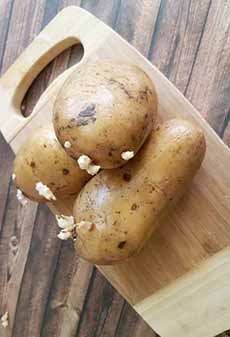
The compound mostly resides in the stem and leaves, as well as in green potatoes and new sprouts (eyes, or buds).

You can avoid it by only buying potatoes as you need them, storing them in a cool and dry place—not in the refrigerator.

Potatoes will naturally sprout around 120-150 days after harvesting. To keep them fresh for as long as possible:

  • Store them in a cool place (not cold), well ventilated and dark. The ideal temperature range is 42° 55°F. Some humidity is helpful.
  • Don’t store potatoes in a plastic bag without holes. Harvested potatoes continue to breath and any trapped moisture will make the potatoes age more quickly.
  • Don’t leave potatoes on the countertop. They will turn green from the light.
  • >Don’t store potatoes in the fridge. The cold will convert the potato starch to sugar, which causes problems when cooking. Fried potatoes will fry up with dark flesh, and baked or mashed potatoes will taste sweet.


    DO YOU HAVE TO THROW OUT POTATOES THAT HAVE SPROUTED?

    According to Dr. David Douches, director of the Potato Breeding and Genetics Program at Michigan State University, you can still eat them.

    However, the sprouts must be removed and discarded because they aren’t edible.

  • When a potato begins to sprout, the starch inside the potato converts to sugar, enabling the sprout to grow.
  • If the potato is still firm to the touch, it’s fine to cook it. Just remove the sprouts, and any soft spots. The potato will still have most of its nutrients.
  • But if the potato is wrinkled and shrunken and the sprouts are long, throw it out.
  • Never eat potatoes that are green below the skin or otherwise spoiled.
  • Remember the well-worn food adage: When in doubt, throw it out.
  •  
    To prepare a sprouted potato for cooking:

  • Snap off the eyes. Peel or scrub off the rest of the eye under cold running water.
  • Use a paring knife or vegetable peeler to remove any remainder.
  •  
     
    TIPS


    Sprouted Potatoes
    [1] If the potato is still firm, cut away the eyes with a paring knife (photo © Best Food Facts).

    Sprouted Potatoes
    [2] Remove the eyes under running water (photo © National Capital Poison Center).

    Assorted Potatoes
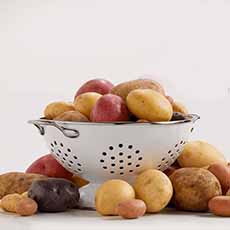
    [3] Just buy what you need. You don’t know how long ago the potatoes were harvested; after 120 days they can begin to sprout (photo © Potatoes USA).

  • Don’t Freeze Potatoes. While you can store potatoes in a garage or other cool place, don’t let them freeze. You’ll have to toss them.
  • Plant The Eyes. Like avocado pits, you can plant the eyes—or the entire sprouted potato. You’ll get at least a plant, if not a potato. However…
  • Serious Growing. If you want to grow a crop of potatoes, use certified potato seeds from nurseries.
  •  
     
    POTATO HISTORY

    Potatoes are native to the Andes Mountains of Peru. Here’s the history of our beloved spuds and the different types of potatoes.

    _______________
    *Solanine is found in species of the Nightshade family (Solanaceae), within the genus Solanum. This includes the potato (Solanum tuberosum), the tomato (Solanum lycopersicum), and the eggplant (Solanum melongena). Bell and chile peppers are a different genus in the Nightshade family. However, solanine is limited to the potato.

    Solanine can occur naturally in any part of the plant, including the leaves, fruit and tubers. It has pesticidal properties, and it is one of the plant’s natural defenses.


    Comments off

    TIP OF THE DAY: A Rainbow Of Vegetables In Unusual Colors

    Colored Carrots & Beets

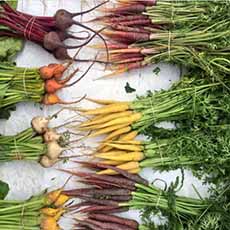
    [1] Different colors of beets and carrots (photo © The Chef’s Garden).

    Purple Brussels Sprouts

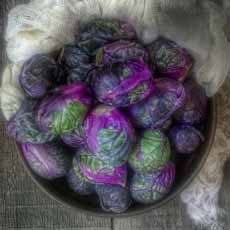
    [2] Purple brussels sprouts (photo © Frieda’s Specialty Produce).

    Multicolored Cauliflower
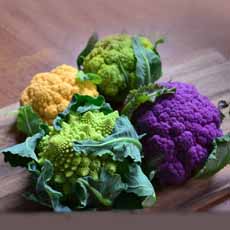
    [3] Cauliflower in the conventional white, plus orange and purple. In the front is romanesco, a variation of cauliflower that has spikes (photo © Nourish The Roots).

    Multicolored Green Beans
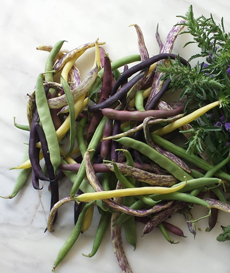
    [4] Green beans don’t have to be green photo © The Pines Restaurant | Brooklyn).

    Red Leaf Lettuce
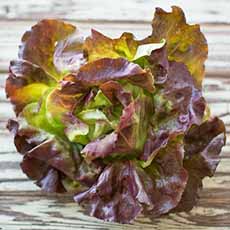
    [5] Red butterhead lettuce is just one of several red leaf lettuces (photo © Good Eggs).

    Colored Radishes
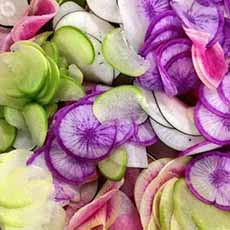
    [6] Colored radishes (photo © The Chef’s Garden)


    September is National Fruits & Vegetables Month. You know that fruits come in a rainbow of colors, but how about veggies?

    Sure, you can find multicolored baby carrots, bell peppers, chiles and heirloom tomatoes.

    But there’s much more to look for.

    So today’s tip is: Keep an eye out and treat yourself to whatever is new and different.

    Grocers know that customers want new options, so even if there’s no farmers market near you, keep looking.

    It’s not just about fun; there are nutritional benefits as well. Colored foods tend to be more antioxidant rich than pale and white foods.

    For example, orange cauliflower contains high levels of beta-carotene; purple cauliflower contains anthocyanin, an antioxidant that gives purple color to a variety of foods, including red cabbage and red onions. Green cauliflower just happens to have more protein than the other colors.

    Some of the veggies below are natural mutations (as was red grapefruit and many other foods); some are cross-bred. None are GMO.

  • Asparagus: Look for purple and white in addition to green.
  • Beets: Beyond red beets, look for orange, yellow and white (photo #1). Chioggia beets have red skin, but a surprise interior of concentric red and white circles.
  • Bell Peppers: Beyond the familiar green and red are black (purplish), orange, yellow and white bell peppers (photo). They all start out green, and ripen into the different colors.
  • Brussels Sprouts: Look for the pretty purple variety (photo #2).
  • Cabbage: You may use green and red/purple cabbages, but have you tried the beautiful Savoy cabbage with its crinkled leaves? It’s green, as are bok choy and Chinese cabbage, but don’t don’t overlook them when you’re looking for variety.
  • Cauliflower: White cauliflower is now joined by orange, purple and pale green (photo #3).
  • Chiles: A nice accent for those who like heat, different varieties are available beyond the familiar red and green, to brown, orange, purple and yellow.
  • Carrots: The original carrot was white, like a turnip. The other colors—orange, purple, red, yellow—were mutants (photo #1). Here’s the story.
  • Cauliflower: The familiar white cauliflower is joined by heads of green, orange and purple, all natural mutants of white cauliflower (which itself was bred to be whiter). Green cauliflower, also called broccoflower, has a lighter green cousin.
  • Endive: Pale green endive has a variety with purplish-red-tipped leaves. It’s the color of radicchio, which is a cousin of endive.
  • Eggplant: Beyond the familiar dark purple, also grows green (Thai eggplant), lavender, orange (Ethiopian, scarlet or Turkish eggplant), pink, and striped purple and white (graffiti eggplant) and white eggplant. The lighter colored eggplants tend to be less bitterness than the dark purple.
  • Green Beans: These are a mutation where the skin of a regular green bean grows violet (photo #4). Alas, they are only purple when raw; cooking engenders the familiar green skin. But they sure are impressive crudités! (Photo and more information.) And don’t forget the yellow wax beans. A mix of green and yellow is interesting, and much more available.
  • Lettuce: Look for red lettuces, including red butter lettuce (photo #5), red oak leaf lettuce and red romaine.
  • Kale: Kale leaves are largely green, but look for Red Russian Kale, with some reddish leaf tinge and a purple spine.
  • Microgreens: These tiny sprouts are often green, but some varieties—beet and daikon, for example—are red. In any color, they’re a delightful accent to foods.
  • Onions: Red onions and shallots are familiar vegetables, but remember to use them for color accents.
  • Radishes: Most of us know the red skin with white flesh, but look for black radishes (black or brown skin, white flesh), candy stripe radishes (red skin, red and white striped flesh), Easter radishes (orange, pink, purple or white or white skin, white flesh), green radishes (skin and flesh), purple radishes (purple skin, purple and white center), watermelon radishes (green flesh, green flesh with a rosy center)(photo #6).
  • Red leaf lettuce: There are quite a few varieties of red lettuce. Two of our favorites for “prettiest” are red fire lettuce (scroll past the green lettuce) and the beautifully spotted freckles lettuce.
  • Romanesco: Also called Romanesque cauliflower, Romanesco broccoli and Romanesque cabbage, there’s a reason for the different names. Professional plant taxonomists can’t decide precisely where this exotic beauty belongs. A natural vegetable first discovered in Italy, it is one of the most beautiful vegetables imaginable (photo #3, plus a closer look here).
  • Sweet Potatoes: The skin of sweet potatoes can be brown, purple, red, white, or yellow; and the flesh can be orange, purple, white or yellow.
  • Sweet Red Corn: Look for it during the summer corn season. (Photo.)
  • Swiss Chard: Long familiar in green with red accents, check farmers markets to find it in vivid orange, pink, purple, yellow and white. (Photo.)
  • Tomatoes: Anyone who has visited a farmers market has seen the lush colors beyond red: brown, green, orange, purple, striped, yellow, white. While they’re summer produce, you can find mixed color cherry tomatoes year-round.
  •  
    Isn’t nature grand?


    Comments off

    TIP OF THE DAY: Smoking Cocktails & More Uses For A Smoke Gun

    A couple of years ago, we began to notice smoking cocktails on the menus of some fine restaurants we patronize.

    These are not the dry-ice-generated smoke of Halloween, but flavored smoke made with wood chips or other agent that provide heavenly aroma.

    You don’t want the bouquet to dissipate. It’s like the alluring scent of a burning log added to a great drink.

    When the smoking cocktail is brought to the table (photo #1) and the waiter removes the dome that’s keeping the smoke inside (photo #2), the whole table gets to enjoy the aroma.

    The smoke not only excites the nose, but it adds a delightful depth of flavor.

    We couldn’t head to the restaurants every time we wanted a smoked cocktail, so we asked the mixologists at Wall Street Grill, a sophisticated restaurant in Manhattan’s Wall Street area, to help us.

    Their recipe for a Smoking Rosemary Fizz is below. The restaurant happens to be kosher, but its fine food can be enjoyed by everyone.

    You can make it at home by investing in a smoke gun (photo #3 and #4, for as little as $20) and a glass dome, which has other uses for baked goods, cheese, etc. Just head to Amazon.
     
     
    WHAT TO DO WITH A SMOKE GUN (A.K.A. SMOKE INFUSER OR SMOKING GUN)

    While a smoke gun is a great addition to the kitchen, first note that a smoke gun doesn’t smoke food in the manner of a backyard smoker, over many hours of cooking.

    Rather, it gives a 30-second infusion of smoke flavor to cooked food or a drink, or to ingredients you’ll use to make a recipe.

    Like a kitchen torch (and of a similar size), a smoke gun is a small tool that delivers big flavor. You add wood chips or other flavor agent (there’s a list below), and the gun converts the chips, cinnamon, herbs, etc. to smoke.

    The gun blows the smoke into your food or drink, infusing it with smoke flavor.

    Far from being exotic, it is easy to use with your everyday foods. You can:

  • Smoke cocktails or straight spirits. How about a smoky Bloody Mary or Margarita?
  • Smoke and freeze water into ice cubes for extra smoke.
  • Smoke coarse sea salt and dried spices.
  • Smoke butter and condiments: mayonnaise, oil, pesto, vinaigrettes.
  • Smoke ingredients to make smoked ice cream, pasta and more.
  •  
    And of course, you can add smoke to cooked meats and fish. See the video on this page, showing all the different things you can smoke.

    Here are more videos specific to cocktails.

  • Dome: Smoking with a dome.
  • Decanter: You can use a decanter instead of a dome, but it doesn’t allow for a rising-smoke presentation (see this video).
  • Hose: Instead of a dome, you can use the hose of the smoke gun to blow smoke directly into the cocktail. This is also how you infuse smoke onto cooked food.
  •  
    A smoking gun can cost as little as $20, like this ChefHut model, which gets five stars on Amazon. There are units for $80 and more.
     
     
    OTHER FLAVORS TO INFUSE

  • Cinnamon sticks: Provides a lighter smoke flavor with subtle sweetness.
  • Citrus peels: Use as a garnish to deliver some smoky flavor.
  • Herbs and spices: Experiment with your favorites, including tea leaves and saffron.
  • Oak chips: These accentuate the charred wood notes from barrel aging.
  • Pecan chips: These provide a nutty flavor.
  • Other wood chips: Experiment with whatever you like: apple, hickory, maple, mesquite, orange, etc.
  • Rosemary sprigs: herbaceous flavor
  • Vanilla beans: light, sweet smoke
  •  
     
    RECIPE: SMOKING ROSEMARY FIZZ


    Smoking Cocktail
    [1] Smoke infusing the cocktail under the dome (photo © Wall Street Grill).

    Smoking Cocktail
    [2] The big reveal at the table (photo © Wall Street Grill).

    Infusing Food With Smoke
    [3] Infusing chicken breasts with smoke, using a $20 Chefhut infuser (photo © Chefhut).

    Infusing Ribs With Smoke
    [4] Spraying smoke atop ribs with the hose of the Breville smoke gun (photo © Breville).

    Smoked Cocktail
    [5] A smoked Manhattan cocktail at Ocean Prime (photo © Ocean Prime).

     
    You may also need a glass dome, a smoke gun, a smoking agent (e.g. wood chips), and ideally, a jumbo ice cube (it works better than regular cubes).

    Ingredients Per Cocktail

  • 2 ounces Makers Mark bourbon (or substitute)
  • 2 ounces Grapefruits Juice
  • 1 ounce made rosemary simple syrup
  • 2 dashes orange bitters
  • Ice
  • Garnish: rosemary sprig
  •  
    For The Rosemary Simple Syrup

    You can also use this syrup in iced tea, hot tea or lemonade, on fruit salad, as pound cake glaze and sorbet topping, and of course, to flavor sophisticated snow-cones.

  • 1 cup water
  • 1 cup sugar
  • 4 fresh rosemary sprigs
  •  
    Simple Syrup Preparation

    1. MAKE the simple syrup. Combine the water and sugar in a small saucepan. Bring to a boil over medium-high, whisking occasionally until the sugar dissolves. Then simmer for a few more minutes until liquid is completely clear. Remove the saucepan from the heat.

    2. ADD the rosemary and let it infuse in the simple syrup for 30 to 60 minutes, until the mixture is thick and syrupy.

    3. REMOVE the rosemary from the pan and pour the syrup into a glass jar. Refrigerate, tightly capped. It will keep for at two weeks (twice as long for unflavored simple syrup).
     
    Cocktail Preparation

    1. SHAKE all the ingredients with ice and strain into a rocks glass with a jumbo ice cube. Garnish with rosemary.

    2. SMOKE with hickory wood with a smoke gun under a glass dome.

    3. BRING to the table still covered. Remove the dome in front of the guest (or yourself) so everyone can enjoy the aroma.


    Comments off


    © Copyright 2005-2026 Lifestyle Direct, Inc. All rights reserved. All images are copyrighted to their respective owners.