THE NIBBLE BLOG: Products, Recipes & Trends In Specialty Foods
Also visit our main website, TheNibble.com.
|
November 25, 2007 at 10:58 am
· Filed under Food Holidays & More, NutriNibbles-Organic-Health, Rice-Beans-Grains-Seeds
|
| McCormick came out with black food coloring this fall (it did not previously exist at the consumer level, so now you can ice chic [or goth] cupcakes to your heart’s content). Based on a food trend reported by Florida’s Sun Sentinel, McCormick may be an American trendsetter. Ebony-colored foods are red-hot in Japan and other parts of Asia, and the trend may be headed west. Black foods have been eaten for hundreds of years in Japan for their rich taste (deeper-colored foods generally have more profound flavors). But now, people are buying them for their nutritional value. |
|

Black rice, also known as “forbidden” rice (see our Rice Glossary for more information).
|
The black-food fervor in Japan began a few years ago with a cocoa drink spiked with black soybeans. Next, a black-soybean tea was granted FOSHU status (foods for specified health use), the Japanese equivalent of an FDA-approved health claim. Black vinegar drinks are promoted as tonics to lower blood pressure and cholesterol levels. Black soybean coffee and black soy milk have become popular. On the food side, there are black rice, black sesame biscuits and cereal, and black soybean coffee. If you want to jump the trend, the Sun Sentinel suggests:
– Black Beans. The familiar black bean contains more antioxidants (including anthocyanins) than any other bean. Add them to chili, soups and salads. Read more in our Bean Glossary.
– Black Rice. This whole-grain rice contains more fiber and nutrients compared to white rice. Some varieties look purple when cooked (see the photo above). We love making Thai rice pudding with black rice and coconut milk. Read more in our Rice Glossary.
– Black Soybeans. High in protein, fiber and anthocyanins, black soybeans may be better at lowering cholesterol levels than yellow soybeans, according to Japanese researchers.
– Black Vinegar. A dark vinegar typically made from brown rice, it’s an Asian version of balsamic, aged to give it a woodsy and smoky flavor. Find it Asian markets. Read more in our Vinegar Glossary.
– Blackberries. The purplish-black berries have among the highest antioxidants of any fruit.
– Nigella Seeds. Also called black onion seeds, these tiny jet-black seeds are staples in Indian and Middle Eastern cuisine. They have a nutty, peppery flavor and are used as a seasoning for vegetables, beans and bread (including naan). Find them in ethnic markets.
– Black Mushrooms. Aromatic and rich in flavor, black mushrooms include shiitake, wood ear and black trumpet. Dried versions are easily found in Asian markets. Read more in our Mushroom Glossary.
Perhaps you’ll be inspired to whip up a New Year’s Eve dinner with black foods in every course, to celebrate a healthy new year. |
|
|
Permalink
|
|
November 24, 2007 at 10:32 am
· Filed under Food Holidays & More
|
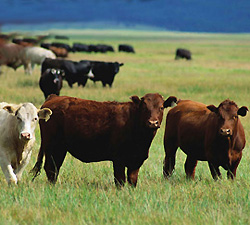
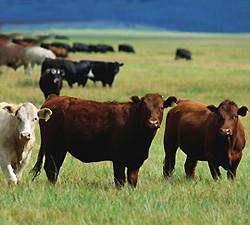
Save the planet, order the bean burrito instead! |
|
According to the Vegetarian Research Group, about 3% of American adults are true vegetarians who say they never eat meat, fish or poultry. But at least 10% of adults consider themselves vegetarians, even though they eat fish or chicken occasionally. These are “flexitarians,” people who seek out vegetarian meals but will eat fish and/or chicken. More formally, flexitarianism describes the practice of eating mainly vegetarian food, but making occasional exceptions for social, pragmatic, cultural or nutritional reasons. Flexitarians may occasionally eat meat and/or other animal products. |
| Eating vegetarian doesn’t automatically translate to a healthier diet—there are plenty of high-fat, high-calorie choices, including pasta, bread, fried foods, sauces, cookies, cake and candy. However, the main point is that advocates consider it humane not to kill animals unnecessarily, for food. Equally (if not more) important these days is the looming global warming crisis and the desire of many people to live more “green” lives. Animal agriculture has a huge impact on global warming. While most people are aware of the effect of carbon dioxide on climate change, the most significant non-CO2 greenhouse gas is methane. Methane, produced by decomposing animal manure, is responsible for nearly as much global warming as all other non-CO2 greenhouse gases combined. Animal agriculture produces more than 100 million tons of methane a year; global meat consumption has increased fivefold in the past 50 years and continues to grow. You can do your part by choosing a bean burrito or Margherita pizza instead of the beef burrito or the pepperoni pizza, whenever possible. |
|
|
Permalink
|
|
November 24, 2007 at 10:24 am
· Filed under Food Holidays & More, Recipes
|
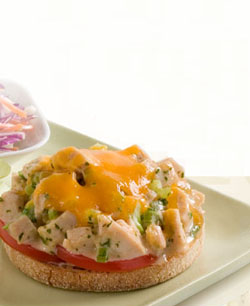
Got leftovers? If you’re still looking at turkey, here’s an easy way to use it up and start Monday with a clean slate: A turkey melt. This recipe for a gourmet turkey melt is courtesy of Butterball. This recipe makes 8 servings.
Ingredients
– 2 cups cubed cooked turkey
– 1/3 cup finely-chopped celery (or make it
more exciting with fennel instead)
– 3 minced green onions
– 1/4 cup chutney
– 1/2 cup light or regular mayonnaise
– 4 split, toasted whole wheat English muffins
(see our review of Wolferman’s)
– 1 cup (4 ounces) shredded sharp Cheddar or Swiss cheese
– Optional: 2 tablespoons chopped fresh
cilantro
– Optional: Sliced tomatoes |
|
Make a turkey melt with that leftover turkey. |
Preparation
1. Combine turkey, celery, green onions and chutney. Stir in mayonnaise to bind. Cover with plastic wrap. Refrigerate until ready to use.
2. Preheat broiler.
3. Arrange English muffin halves on a baking sheet. Top with tomato, then add turkey mixture and top with cheese.
4. Broil a few inches from source of heat for 3 to 4 minutes until hot and bubbling. Serve with coleslaw. |
|
|
Permalink
|
© Copyright 2005-2026 Lifestyle Direct, Inc. All rights reserved. All images are copyrighted to their respective owners.