A Golden Accident: The Story Of Blonde Chocolate
|
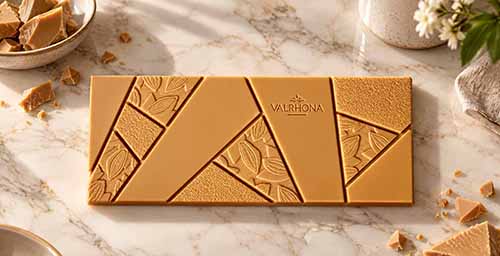
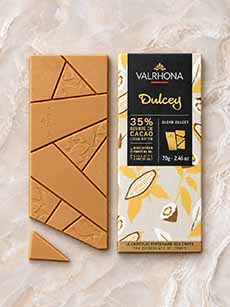
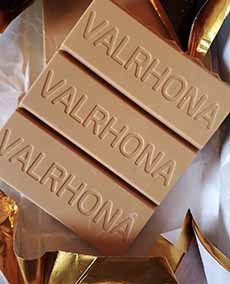
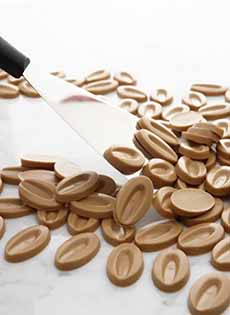
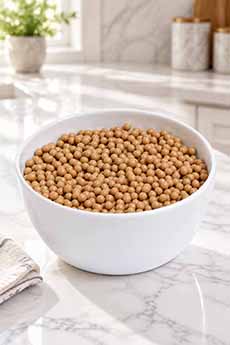
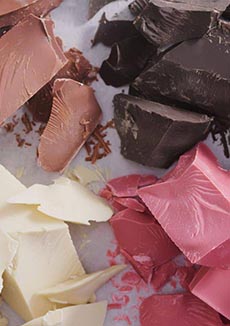
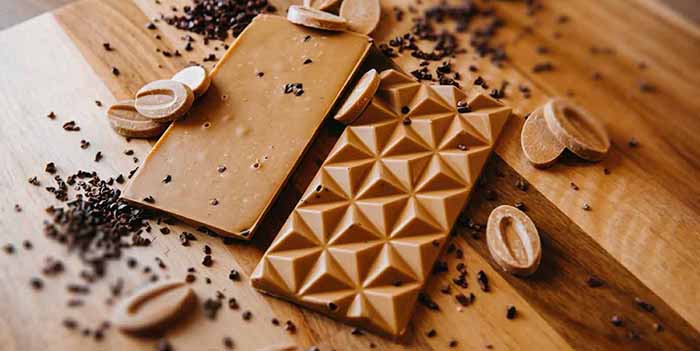
For more than 80 years, you could purchase only three types of chocolate bars: dark chocolate (launched in 1847), milk chocolate (debuted in 1875), and white chocolate (arrived in 1930). Few people realize that in 2012, a fourth chocolate joined the group. Valrhona introduced blonde chocolate (which it trademarked under the name Dulcey®), discovered in a kitchen accident. And just five years later, in 2017, Barry Callebaut unveiled the fifth type, ruby chocolate (photo #6), made from specially selected and processed ruby cacao beans. The first major consumer product using it—a ruby KitKat—followed in 2018. Blonde and ruby are not “flavored” chocolates. They are distinct formulations, just as milk was added to dark chocolate to create milk chocolate, and the cacao solids were left out of the blend to create white chocolate. We’ve previously extolled the virtues of ruby chocolate. In celebration of International Chocolate Day, September 13th, we introduce you to our favorite blonde. Below: > Why haven’t you heard of it? > The history of blonde chocolate. > The science of blonde chocolate. Elsewhere on The Nibble: > The different types of chocolate: a photo glossary. > The world’s top chocolate houses. > The year’s 69 chocolate holidays. Blonde chocolate, called Dulcey by its creator Valrhona, is caramelized white chocolate. Blonde/blond and gold are generic names. Unlike standard white chocolate, which is a blend of cocoa butter, milk solids, and sugar, blonde chocolate undergoes the Maillard* reaction to develop its caramel notes—the same process that turns cream into caramel candy. Under gentle, prolonged heat, the natural milk proteins and sugars react to produce a rich blonde-tan hue. The reaction fundamentally transforms the flavor into a profile similar to that of dulce de leche (itself a Maillard reaction). A blonde chocolate bar is creamy and melt-in-your-mouth smooth: a velvety texture, a warm golden hue, and a symphony of flavors. The melt-in-your-mouth feature is the result of 35% cocoa butter—not to be confused with 35% cacao‡ of many milk chocolate bars. Like white chocolate, it contains cocoa butter but no cocoa solids; its distinctive blond color and toasted, caramelized flavor come from the processing of its milk and sugar components. The initial notes are buttery and toasty, evoking butterscotch and caramel and the essence of freshly baked shortbread. Valrhona uses its trademark Dulcey®, but other producers call their products blonde/blond chocolate, caramelized white chocolate, and sometimes, gold chocolate. Barry Callebaut has trademarked Caramel Aura®. Valrhona also makes a second type of blonde chocolate called Orelys®† for the professional market. Blonde chocolate has had a significant impact—but primarily in professional pastry, not as a mass-market candy. It has not become a consumer category in the way milk, dark, white, or even ruby chocolate (briefly) have. Yet, Dulcey became Valrhona’s most successful chocolate launch and one of its five leading sellers (note that the bulk of Valrhona sales are to professionals—pastry chefs and chocolatiers). Why is that? It originated as a professional couverture ingredient. Valrhona marketed Dulcey to pastry chefs: for creams, ganache, glazes, ice creams, mousses, and molded pieces—not as a grab-and-go candy bar. So far, its influence can be found in restaurant desserts, bakeries, and luxury confections. Some artisan chocolatiers use it, and you can find blonde/Dulcey chocolate bars. It does not look dramatically new. Blonde/Dulcey chocolate is pale gold or tan. On a shelf, it can be mistaken for white chocolate, caramel chocolate, butterscotch, or a milk-chocolate variant. Ruby chocolate had an immediate advantage: Its naturally bright pink color is visually striking and easy to communicate on a package or in a photograph. Its flavor is familiar, but its identity is confusing. The flavor—caramelized milk, which delivers notes of dulce de leche and shortbread—is appealing. But consumers can easily interpret it as salted caramel or toffee, rather than recognize a distinct chocolate type. It has no clear mass-market flagship product. Most consumers learn a chocolate type through an inexpensive, widely distributed, strongly branded item: a Hershey bar, a KitKat, an M&M’s product, and so on. Ruby received that kind of attention through Nestlé’s ruby KitKat launch. Dulcey has been sold in bars and baking pieces (discs/feves), but its principal home has remained specialty retail and pastry. Even Valrhona’s U.S. store presents it chiefly as a premium chocolate and baking ingredient. It competes with a crowded caramel universe. Caramel, salted caramel, dulce de leche, toffee, brown butter, cookie butter, and butterscotch already give shoppers choices in essentially the same flavor territory. Blonde chocolate is technically more useful to pastry chefs than liquid caramel or caramel fillings, but that functional advantage matters far more in the kitchen than in the candy aisle. The same survey found caramel to have the broadest appeal among added flavors. In other words, consumers may like what blonde/Dulcey tastes like while choosing it under the familiar word caramel. In fact, some companies market it to consumers as caramel white chocolate or caramelized white chocolate. (The history of blonde chocolate follows after the photo.) |
|
|
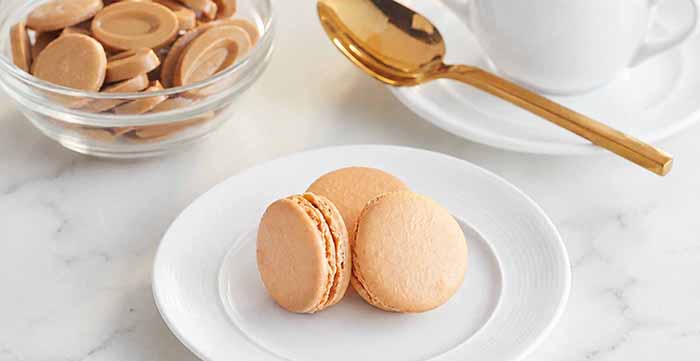 [9] Macarons made with Dulcey chocolate (photo © Valrhona). 3. THE HISTORY OF BLONDE CHOCOLATE Blonde chocolate was a happy kitchen accident at one of the world’s most prestigious chocolate houses. It was discovered in 2004 by Frédéric Bau, the renowned pastry chef and creative director of the French luxury chocolatier Valrhona. While leading a demonstration at l’École Valrhona—the company’s professional pastry school in Tain-l’Hermitage, the Rhône Valley headquarters of the chocolate company—Bau inadvertently left white chocolate in a hot bain-marie for longer than intended. Instead of burning or curdling, the chocolate slowly caramelized over approximately ten hours, turning a soft golden hue and releasing warm aromas of toasted shortbread and roasted milk. Recognizing that this mishap had culinary brilliance, Bau spent eight years perfecting the formulation, texture, and industrialization of the process until Valrhona officially introduced the product to pastry professionals and consumers in 2012 under the trade name Dulcey. Unlike standard white chocolate, which relies on a simple blend of cocoa butter, milk solids, and sugar, blonde chocolate undergoes caramelization via the Maillard reaction*.
Before the introduction of blonde chocolate, confectioners and pastry chefs faced a noticeable flavor gap between sweet, dairy-forward white chocolate and deeper cacao-bean chocolates. Standard white chocolate is frequently criticized for being flat, excessively sugary, and lacking complexity (but check out our favorite white chocolate bars, which are not). Caramel and dulce de leche can be tricky to work into delicate pastry mediums because of moisture, stickiness, or instability at room temperature. Blonde chocolate solved these culinary challenges by bringing three essential qualities to the table:
Today, blonde chocolate has expanded far beyond Valrhona’s original couverture to become a recognized chocolate style across artisan chocolatiers worldwide, offering dessert lovers a sophisticated alternative that is warm, savory-sweet, and thoroughly distinctive. Get a bar! Here are a few places for starters. If you’re going to try blonde chocolate, start at the top. Less expensive bars won’t give you the best experience (with the exception of Trader Joe’s). In alphabetical order:
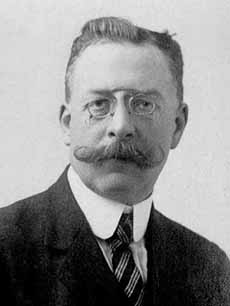
*The Maillard Reaction: The chemical phenomenon known as the Maillard (my-YARD) reaction is named for the French physician and chemist Louis Camille Maillard (photo #7), who identified it. It’s a form of non-enzymatic browning that requires heat to effect a reaction between the sugars and amino acids in the particular food. This reaction is what creates the tan or brown color of caramel candy, caramelized onions, toasted bread and nuts; barbecued, roasted and seared meats; and roasted coffee (and many others). †Valrhona Dulcey® vs. Valrhona Orelys®. Valrhona describes Dulcey as buttery and caramelized (think toasted shortbread, warm milk caramel, and a very smooth creamy finish), while Orelys’s muscovado-driven sweetness yields a molasses-like depth, deeper color and muscovado’s characteristic light licorice notes. For pastry, Dulcey pairs with fruits, nuts, vanilla, and straightforward caramel desserts; while Orelys’ darker sugar profile was created to stand out with coffee, warm spices, banana, citrus, or berry flavors. See the different types of sugar. ‡The better milk and dark chocolate bars state their percentages of cacao. A top milk chocolate bar can be 45% or higher; dark chocolate can range up to 100% (no sugar is added). Connoisseur-quality bars are typically 70% cacao, the percentage which shows the finest bars to their best advantage. Here’s more about the percentage of cacao. CHECK OUT WHAT’S HAPPENING ON OUR HOME PAGE, THENIBBLE.COM. |
||