Homemade Ice Cream In 5 Minutes With A Tern Ice Cream Maker
|
|
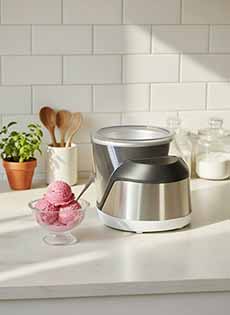
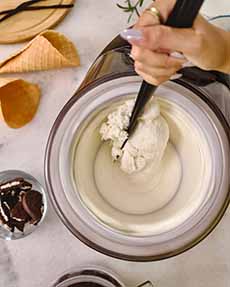
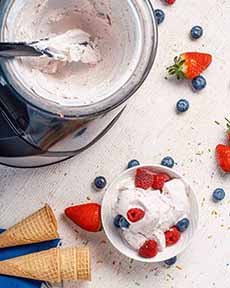
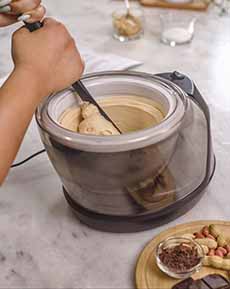
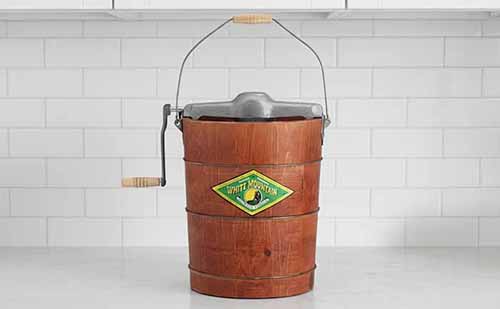
The best gift we received this past holiday season—by far—is the Tern Craft Ice Cream Maker. Luscious ice cream, frozen yogurt, or sorbet is ready in just five minutes (with the bowl kept in the freezer and the base mix previously chilled). It’s our Top Pick Of The Week (and perhaps every week forever!). Watch it making ice cream here: There’s more in a minute about this remarkable little machine, but we want to point out some goodies you can find elsewhere on The Nibble: > The year’s 50+ ice cream holidays > The different types of frozen desserts: a photo glossary. > The history of the ice cream maker. We’ve been making ice cream at home since childhood. Our mother had one of the hand-cranked White Mountain ice cream makers (photo #11), which set a quart-size cylinder of ice cream base into an old-fashioned wood bucket of rock salt. Adding water to the bucket created the slurry that froze the ice cream. But it required the upper arm strength to turn the crank for 30 to 45 minutes. (And we’re always surprised that despite creating electric versions decades ago, the hand-cranked versions are still sold!) In the 1970s, electric ice cream makers for home use appeared. No more upper arm workout, and it used regular ice cubes instead of the rock salt slurry (photo #12). Cuisinart introduced its first electric home ice cream maker in 1978. We got one as a birthday gift, and happily created flavors that could not be purchased in stores (banana chocolate chip [a decade before Chunky Monkey!], Grand Marnier, malted milk ball, vanilla double malt, and peach [a favorite flavor we could enjoy all year round, using frozen peaches]). But the real advance was the unit that didn’t require ice. In 1984, the Donvier ice cream maker was introduced to the U.S. from Japan. It was the first unit to use frozen gel in a double-walled canister to chill the ice cream, instead of ice and water. You’d freeze the metal cylinder overnight in your freezer, then pour in the ice cream mixture and manually turn the handle intermittently for 15–30 minutes. Yes, it was manual—but not painfully so. Then came a parade of small ice cream makers with pre-frozen cylinders that had electricity! We tried a few of them but never found the perfect one. Our complaint generally was that they didn’t freeze the ice cream firmly enough to enjoy it right out of the churn. We had to place the ice cream in the freezer to harden. So when we opened the box and pulled out the Tern, it was with both anticipation but also and concern. But Tern is a champion: firm ice cream in an amazingly swift five minutes. And at just 8″ x 10″ x 12″, it’s a space saver as well. That’s it in a nutshell. For “beyond the nutshell,” keep scrolling. And for the story of the weirdest ice cream maker we’ve ever tried, see the †footnote below. If you like to cook, then YES! If you’d like artisan alternatives beyond what you can buy at the grocer’s, then YES! If you want your ice cream ready in 5 minutes (with planning ahead to chill the mix and the bowl), then YES! If you don’t need to produce large quantities, then YES! The Tern Craft Ice Cream Maker succeeds brilliantly at what it sets out to do: produce small batches of genuinely premium ice cream quickly, using an artisan-style process. It makes a pint at a time, so it’s not for a crowd—but it’s perfect if you want ice cream for two. At just under one hundred twenty dollars, it’s an investment, but one that pays dividends of delight. While the company doesn’t make any “savings” claims, we’ve found that the cost of ingredients is far less than the $7-$10 that better pints of ice cream cost in our area. > Head to TernIceCream.com. It’s So Fast! In a world of automatic ice cream machines that churn away for 25 to 40 minutes, the Tern Craft Ice Cream Maker promises something different: ready-to-eat, artisan-quality ice cream in five minutes. And it delivers! The five-minute churning time is accurate for the actual ice cream making, but this doesn’t include preparation time for your base mixture or the overnight freezing requirement for the bowl. If you decide at eight in the evening that you want ice cream, the Tern won’t help you unless you’ve kept the bowl in the freezer. The company recommends leaving it there permanently, which is reasonable if you have a small amount of freezer space to spare. For simple, no-cook vanilla ice cream recipes, it takes less than 60 seconds to whisk together the cream, milk, sugar, and vanilla. If you’re making a custard base with egg yolks, it needs to be whisked for 5 minutes in a saucepan. Whatever the recipe, it needs two hours of chilling. However, this is true with any automatic ice cream maker. The only drawback is that it makes a pint at a time, not a quart (the same is true with other smaller machines). For two people, that’s enough; for a larger family, not. However, you can purchase an extra bowl and be ready to make the next pint as soon as the first bowl is done spinning. And if you work quickly, you can sometimes get a second batch out of the same bowl before it needs to return to the freezer. Either way, you have means to make a quart. The quality of its finished product is truly wonderful. Using only the recipes provided by the manufacturer, we enjoyed bowl after bowl of ice cream, custard (i.e., Philadelphia stye, with egg yolks), gelato, and sorbet. The ice cream comes out firm and scoopable immediately, ready for a bowl or cone—unlike other home machines where the mixture resembles soft-serve and requires additional freezing time. Non-dairy milks work equally well. In fact, if you’ve been less than thrilled with how your current machine makes plant-based ice cream, we can assure you the recipes we made with coconut cream and oat milk were just as impressive as cow-based. Because the rapid freezing technology creates a superior texture regardless of fat content, you can reduce the amount of cream and egg yolks in recipes. You can also use the sweetener of choice, including non-caloric options. Tern was created by mechanical engineer Josh Stuckey after years of disappointment with home ice cream makers. They took too long to freeze batches, resulting in larger ice crystals and less smooth, less creamy ice cream. After studying ice cream production books written for the industry, Stuckey realized that the difference was speed. Commercial artisan machines freeze ice cream rapidly, creating smaller ice crystals. After almost two decades of testing, dozens of design integrations, and many hundreds of hours of making ice cream, he found the solution. |
|
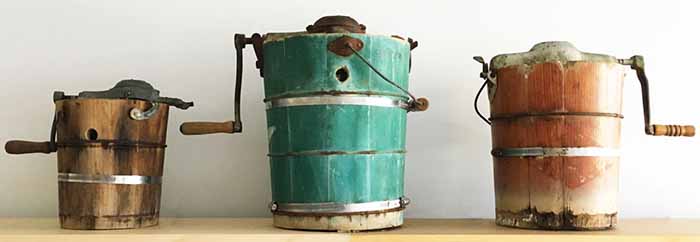 [12] Early White Mountain ice cream freezers, hand cranked. Here’s more about them. While hand-cranked models were the original, first produced in 1872, the company introduced electric motors in the 1950s. (photo © Triple Motion). ________________ *The meaning of Tern: The Arctic Tern has the longest migration of any animal on Earth, traveling from pole to pole each year: from the Arctic to the Antarctic and back. It’s a creature associated with endurance, precision, and remarkable journey*. These qualities that could metaphorically relate to the founder’s 17-year quest to create the perfect home ice cream maker. The tilted “e” in the logo symbolizes the spinning function of the machine. Out of curiosity, we looked up the the shortest migration journey—representing the shortest amount of time to make a batch of ice cream. That title belongs to North America’s blue grouse, which migrates just 300 meters (about 1,000 feet) vertically down the mountain to breed. And it doesn’t fly, it walks! It sounded too good to be true, but how could we resist a sample to try? You won’t be surprised to hear that it did not work. We ended up with the same cream mixture we had put in—and ended up drinking it like a milkshake. What we subsequently found out from an engineer friend is that it never could have worked. Basic thermodynamics says you need sustained cold temperatures to freeze ice cream, not the brief contact with a cold surface while being kicked around a yard. The mixture just sloshed, around getting warmer from all that motion and friction! There’s a sucker born every minute, and at least all it cost The Nibble was a few dollars’ worth of heavy cream. CHECK OUT WHAT’S HAPPENING ON OUR HOME PAGE, THENIBBLE.COM. |
||