The Great Hokusai Espresso Art For National Espresso Day
|
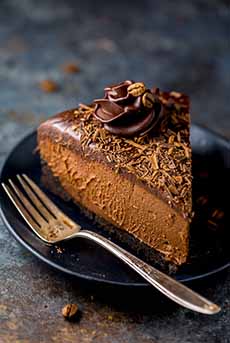
[6] We had a double espresso with a piece of this no-bake chocolate espresso cheesecake. Here’s the recipe (photo © Baker By Nature).
|
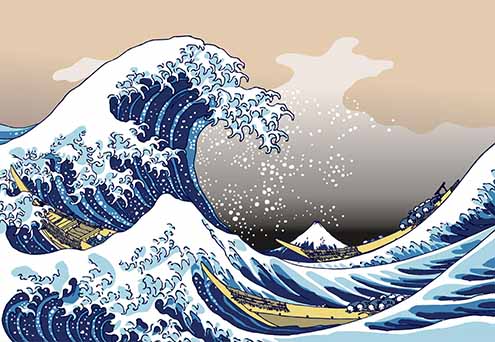
Here’s something special for National Espresso Day, November 23rd, below: It’s a coffee paean to “The Great Wave off Kanagawa,” a woodblock print that what has been called “possibly the most reproduced print or image* in the history of all art” (excluding stamps, in which case Arnold Machin’s etched profile of Queen Elizabeth II, created for British postage stamps, is the winner). “The Great Wave off Kanagawa,” is certainly a contender for the “most famous artwork in Japanese history” (photo #6, below). The print depicts three boats moving through a storm-tossed sea, with a large, cresting wave forming a spiral in the center over the boats, and Mount Fuji in the background. “The Great Wave off Kanagawa,” often called “The Great Wave” for short, was created in 1831 by Japanese ukiyo-e** artist Katsushika Hokusai. It’s a wood-block print, his most famous work, and is the first in his series, “Thirty-six Views of Mount Fuji.” It has influenced Western artists and musicians, including Claude Debussy, Claude Monet, and Vincent van Gogh, as well as inspiring wave-centric works by other Japanese artists.
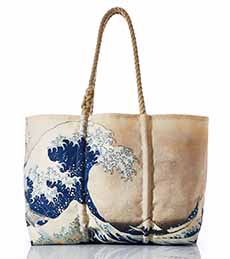
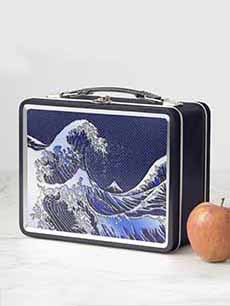
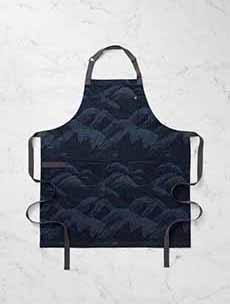
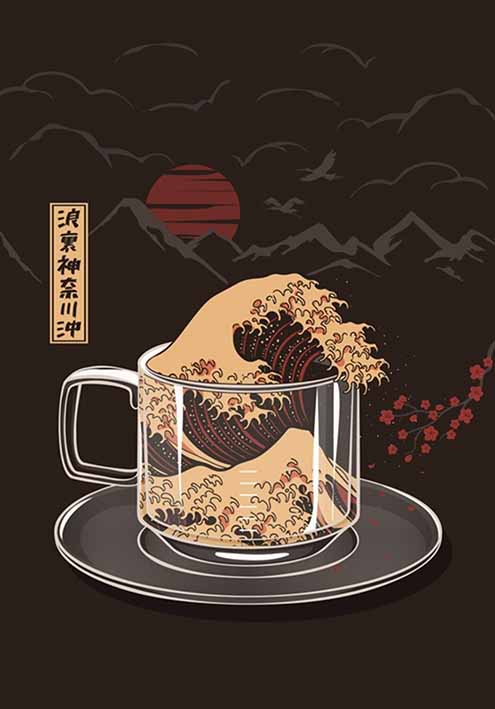
The Metropolitan Museum of Art owns one of the earliest original impressions of “The Great Wave,” a polychrome woodblock print, ca. 1830–32, off the original keyblock, with object number JP1847 and credit line “H. O. Havemeyer Collection, Bequest of Mrs. H. O. Havemeyer, 1929” Met collection entry. The Art Institute Of Chicago currently owns three later impressions—“all later impressions‡ than the first state of the design,” per the Art Institute. Scholars estimate that roughly 8,000 impressions that were printed in the 1830s, only about 100 early “original” impressions are thought to survive today. The iconic artwork has been reproduced on everything from espresso cups to home goods to clothing to…not a surprise…wall art. The image depicts a creative adaptation of Hokusai’s “Great Wave,” transforming the iconic wave into a frothy coffee wave inside a mug. This specific adaptation is credited to Faissal Thomas, available through various art print and merchandise platforms. > The different types of coffee: a photo glossary. > The different types of espresso-based beverages: a photo glossary. > The year’s 25 coffee and espresso holidays. **Ukiyo-e (pronounced oo-KEE-yoh-eh) is a genre of Japanese art that flourished from the 17th through the 19th centuries. It’s most famous for its woodblock prints, but it also includes paintings. “Ukiyo” literally translates to “floating world,” and “e” means picture or painting. Thus, ukiyo-e means “pictures of the floating world.” †The original Japanese title printed on the block is “Kanagawa oki nami ura,” which translates literally as “Under the Wave off Kanagawa.” “The Great Wave off Kanagawa” is just the widely used English nickname for that same print. ‡The 8,000 figure is an estimate, based on how long a keyblock could survive before wearing out and needing repair or replacement. The British Museum notes that “experts have estimated that this might represent around 8,000 prints” and that no exact production records survive. As the wood blocks wore down, the printer kept using them until they failed, so the same 1830s commercial run produced a spectrum from very early to very late states. Once new/replacement blocks were cut (e.g., for the light blue and yellow areas in very late prints), those impressions are still usually considered part of the original 19th‑century commercial production, but they’re visually distinct “late impressions” within that broad run. Thus, the estimated ~8,000 Edo‑period impressions encompass both ends of the spectrum—from early, high‑quality pulls like the Met’s to later, more worn or modified impressions such as those at the Art Institute of Chicago. The Edo Period (also known as the Tokugawa Period) was a significant era in Japanese history that lasted from 1603 to 1868. |
|
|
CHECK OUT WHAT’S HAPPENING ON OUR HOME PAGE, THENIBBLE.COM. |
||