Gift Of The Day: Minnie Beasley’s Almond Lace Tuiles
|
|
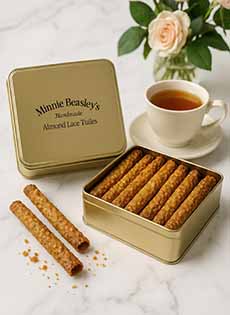
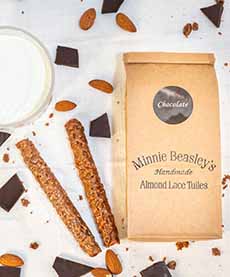
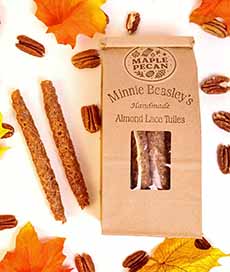
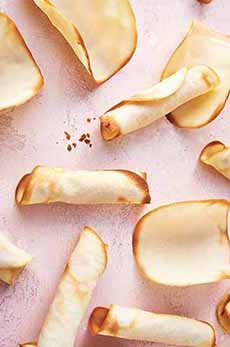
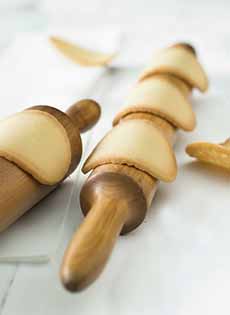
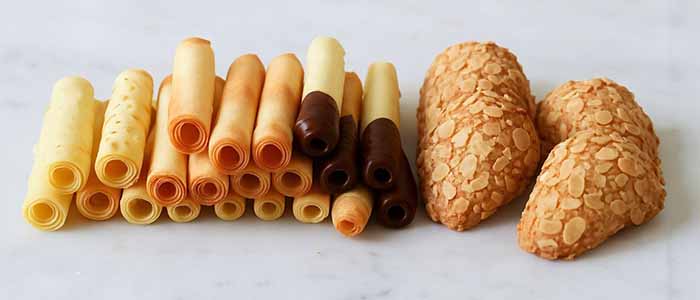
Way back in 2007, THE NIBBLE wrote enthusiastically about Minnie Beasley’s cookies: buttery, lacy almond toffee cookies. They won a gold medal as “best cookie” at the Fancy Food Show the following year and we have been pleased to watch them grow over the years—still a small, artisan brand making each cookie by hand. This means that you, too, can know the joy of Minnie Beasley’s Almond Lace Cookies*, thanks to her great-nephew Harmon Beasley Canon and his son Jackson, who has taken over the business. And keeping up with the times, Aunt Minnie’s original recipe is also available in: Lace cookies are a Southern specialty, named for the French tuile baked to create a lacy pattern. Lady Bird Johnson was known for her recipe. Different bakers made them in different ways, and the warm cookies can be molded into different shapes. But whatever the style, the cookies are a delicate gourmet confection, a special treat. Great Aunt Minnie, a Southern lady herself, lived with Harmon Canon’s family during his boyhood in Memphis and he grew up watching her make the cookies for family and friends. After she passed, Harmon took on the mantle, and was encouraged by friends and family to make them available to the public. A 6-person artisanal bakery was born, the cookies selling out as fast as the team could make them. They are now being produced by the fourth generation, Harmon’s son Jackson. Each individually handmade cookie requires a labor-intensive baking process, a commitment to craft that you can taste in every bite. When Minnie Beasley’s pliable cookies come out of the oven, they’re wrapped around dowel rods, creating crispy cylinders when cooled. And then, they’re packaged and sent to you. We’re as enthusiastic about these wonderful cookies as we were back in 2007. Each handmade batch sells out quickly, so head to the website and stake a claim to yours: Don’t forget yourself! Whether you’re enjoying one with a cup of coffee or serving them at an elegant gathering, these cookies elevate any moment into something special. We’ve got more to say below about the history of tuiles, but first, for your consideration: > The 10 basic types of cookies. > Cookie favorites: a photo glossary of hundreds of cookie varieties. > The year’s 44 cookie holidays. > The history of tuiles is below. > Up next: How do the cookies get “lacy?” Not all tuiles are lacy (see photos #4 and #5). The delicate “lace” effect is created through “baking chemistry.” Lace cookies get their name from their delicate and lace-like appearance when the sugar bubbles and creates tiny little gaps in the cookies. The magic is in the proportions: Lace cookies require a high ratio of butter to flour, with just a small amount of flour (or sometimes ground oats). The low flour content means there’s minimal structure to hold the dough together, so it spreads extremely thin during baking. The sugar caramelizes and bubbles vigorously in the oven, and as those bubbles form and pop, they create the characteristic openwork pattern. The result is an ultra-thin, crispy cookie with an intricate pattern of gaps throughout. The French word tuile (pronounced tweel) refers to the curved, terracotta roof tiles that are ubiquitous atop homes in Provence and the Mediterranean basin. The tuile cookie got its name from its curved shape, mimicking the curved roof tiles. It’s baked as a flat disc and then, while still hot and malleable, draped over a curved surface (traditionally a rolling pin or wine bottle) to set into an arch. When arranged in rows on a platter, these delicate cookies line up like a the tiled rooftop. While someone first draped warm dough over a rolling pin, there is no single known “inventor” of the cookie. It evolved in the 17th century or later, once refined sugar became more accessible to the French middle and upper classes. Because its shape is modeled after Provençal roof tiles (photo above), the tuile cookie is linked to the southn of France. These tuiles are typically the tuiles aux amandes (tweels-ohs-ah-mand), almond tuiles. Crisp, lacy, and golden, they’re made with slivered almonds to simulate the rough texture of the clay tiles. Because the hot-from-the-oven cookies can be molded into different shapes—cups, spirals, cones, etc.—the roof tile shape began to take on different forms in other regions. |
|
 [9] The famed roof tiles of Provence (Abacus Photo). The Tuiles Of Northern France Just as well-known are the tuiles of Northern France, particularly in the styles of the towns of Beauvais and Amiens in the Picardy* region. In French baking, the tuile falls under the category of petits fours secs, small dry oven cakes. Their evolution: Savory tuilles have long been made by fine chefs, filled with whipped goat cheese, truffle cream, and the like. Might they become commercialized as “wine wafers,” e.g. Parmesan/herb or a pesto cream? Perhaps some artisan brand will launch them to the broader public. Fusion flavors are already part of our everyday cuisine. We nominate Asian variants of the filled rolled wafer—not only popular flavors (black sesame, green tea, red bean…) but those that use coconut milk and rice flour, creating a harder, snappier roll than the buttery French version. Stay tuned. †A tuile is a cookie, made of batter and baked. A cannoli is a pastry, made of dough and fried in oil. CHECK OUT WHAT’S HAPPENING ON OUR HOME PAGE, THENIBBLE.COM. |
||