Pasta With Figs & Sofrito Recipe For National Fig Week - The Nibble Webzine Of Food Adventures Pasta With Figs & Sofrito Recipe For National Fig Week


THE NIBBLE BLOG: Products, Recipes & Trends In Specialty Foods


Also visit our main website, TheNibble.com.

Pasta With Figs & Sofrito Recipe For National Fig Week


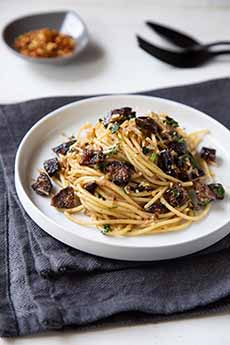
[1] Spaghetti with fig soffrito. The recipe is below (photo © California Figs).


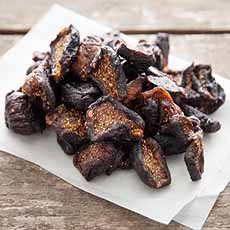
[2] Dried Black Mission figs (photos #2 and #4 © Good Eggs).


[3] Dried Golden figs.


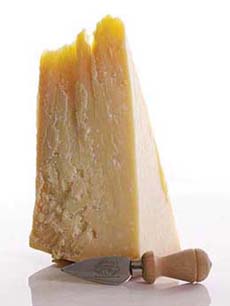
[4] Parmigiano-Reggiano cheese. Parmesan is the generic form, of more modest quality (photo © Murray’s Cheese).


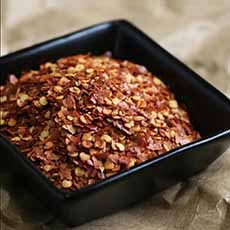
[5] Garnish with a pinch of crushed red chile flakes (photo © Silk Road Spices).


Editor’s Note: Soffritto is the Italian spelling, sofrito is the Spanish spelling. We’ll use the Italian spelling in the Italian-style recipe, and the Spanish cooking in the history of soffritto, where our sources provided the documentation.

National Fig Week is a good time to unveil an unusual-yet-delicious pasta dish: Pasta With Fig Sofrito & Parmesan, made with dried California figs. What’s sofrito, you may ask? It’s a staple in Mediterranean, Latin American, Spanish, Italian, and Portuguese cooking.

It’s different, but analogous to, the French mirepoix, which is blend of onion, carrots, and celery.

Sofrito, also called sofregit (Catalan), soffritto (Italian) and refogado (Brazilian Portuguese) is a basic preparation of aromatic ingredients cut into small pieces and sautéed or braised in cooking oil.

These typically include garlic, onion, bell pepper and tomato (some countries, such as Puerto Rico, don’t use tomatoes).

This recipe, from California Figs, is poetically named: garlic, onion, figs and basil or parsley make up the “sofrito.” And the ingredients are sautéed in butter, not olive oil.

But the results of both recipes are the same: deliciousness!

Below:

> The recipe for pasta with fig sofrito.

> The history of soffrito/sofrito.
 
 
Elsewhere on The Nibble:

> The year’s 20 pasta holidays.

> The history of pasta.

> The different types of pasta: a photo glossary.

> The history of figs and the year’s 2 fig holidays.

> More recipes with figs.
 
 
RECIPE: PASTA WITH CALIFORNIA FIG SOFRITO & PARMESAN

You can use whatever type of pasta you like. We prefer flat fettuccine to round spaghetti. You can also use shapes (farfalle/bowties, penne, etc.).

There are two types of dried California figs: Golden and Mission. The former is amber color, the latter is purple-black. You can use either; but for more eye appeal, how about a mixture of both?

The anchovy fillets add a delightful counterpoint to the figs.

Prep time is 10 minutes, cook time is 20 minutes.
 
 
Ingredients For 4-6 Servings

  • 3 quarts water
  • 1 tablespoon salt
  • 1 pound dried spaghetti or other pasta
  • 6 tablespoons unsalted butter
  • 4 ounces California dried figs, chopped or minced
  • 4 garlic cloves, minced
  • 1/4 large white onion, minced
  • Optional: 2 anchovy fillets, mashed or minced
  • 1/4 teaspoon fennel seed
  • 1 teaspoon ground black pepper
  • 1/4 cup chopped fresh basil or Italian parsley
  • 1 cup grated Parmesan cheese
  • Garnish: red chili flakes and extra grated Parmesan
  •  
    Preparation

    1. COMBINE the water and salt in a large pot and bring to a boil. Add the pasta and cook until just tender/al dente, about 10 minutes.

    2. MELT 2 tablespoons of the butter in a skillet. Add the figs, garlic, onion, optional anchovy fillets, fennel seed, and black pepper. Sauté until the onions are lightly cooked, about 3 minutes.

    3. ADD the basil or Italian parsley, briefly stir, and then remove the skillet from the heat. When the pasta is almost cooked…

    4. REMOVE ½ cup of the water from the pot and add it to the skillet with the fig sofrito. Return the skillet to the heat and bring the water to a simmer. Add the remaining 4 tablespoons of butter and stir until melted.

    5. DRAIN the pasta. Do not over drain the pasta; some water should still cling to the noodles. Immediately transfer the pasta to a bowl.

    6. ADD the warm fig sofrito and the grated Parmesan cheese to the bowl. Toss the pasta to coat. Serve immediately. Garnish with red chile flakes and additional grated Parmesan cheese.


    THE HISTORY OF SOFFRITTO/SOFRITO

    Soffritto, originating in Italy (the same is called sofrito in Spain) is one of the “big three” foundational cooking techniques in Western traditions, along with the Holy Trinity from Louisiana and Mirepoix from France. Its use is older than the modern dishes built on top of it.

    Soffritto (along with the other two) is less a “recipe” than a deeply embedded cooking logic: slowly cook aromatic vegetables in fat to build flavor and serve as a universal base.

    Its history is broad and spans the entire Mediterranean basin: Southern Europe, North Africa, and the Levant.

    Long before the word soffritto existed, cooks across the Mediterranean and Near East were gently sweating onions, leeks, and garlic in fat. Searching classical and medieval records we can see see:

  • Onions, leeks, and garlic cooked in olive oil, butter, or animal fat as a first step in stews and pulses.
  • In medieval Arabic, Jewish, and Latin cookbooks, the concept is already taken for granted.
     
    The technique predates Italy, although the Italian word comes from soffriggere, to fry gently, a combination of sotto (under/low) and friggere (to fry).
  • Thus, soffritto literally means lightly fried or under‑fried (with “under” meaning gently, e.g. under low-ish heat).

    The word shows appears in Italian by the late Renaissance/early modern period.

    As Italian cuisine was codified in the 19th century, soffritto became ubiquitous in “serious” cuisine. Twentieth‑century regional cookbooks and restaurant manuals indicate soffritto as the first step: something done almost automatically to build depth of flavor.

    As with any recipe, other varieties evolve over time. Today you’ll find:

  • Ingredient ratios: some recipes/cooks prefer more onion‑heavy, some boost the carrot ratio for more sweetness.
  • No carrot at all: “White” soffritto—onion, leek, and celery, without carrot—can be used for delicate, pale dishes.
  • Olive oil as the fat of choice, largely replacing butter or lard for health or cost reasons.
  •  
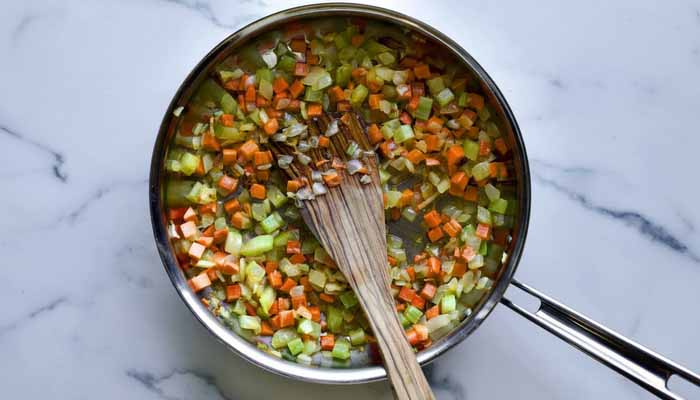
    A Pan Of Soffritto / Soffrito
    [6] Cooking Italian soffritto. Here’s the recipe (photo © Cucina By Elena).
     
    How It’s Done

    While there are region variations, as with anything, the classic soffritto common in central/northern Italy— and the version with which Americans are familiar—is the three-aromatic base:

  • Onion (or sometimes shallot or leek), carrot, and celery, finely chopped.
  • Cooked slowly in olive oil or butter until sweet and soft (not browned).
  • Used as the base for minestrone and other vegetable soups, ragù alla bolognese and other meat sauces, risottos, stews, and braises.
  •  
    Related European Versions

  • French mirepoix: onion, carrot, and celery in fat. The term appeared in the 18th century.
  • Spanish sofrito: onion, garlic, sometimes tomato and peppers, cooked in olive oil (name appeared by the late Middle Ages).
  • Portuguese refogado: Unlike Italian soffritto (onion, carrot, and celery), Portuguese refogado often skips the celery and carrot in favor of bay leaf and sometimes tomato or bell pepper, depending on the dish. See the *footnote.
  •  
    All Have The Same Purpose

  • To concentrates sweetness: Slow cooking converts the vegetal sharpness into sugar and umami.
  • To dissolves aromas in fat: Fat captures and transports fat‑soluble flavor compounds, which then permeate the dish.
  • To build structure for acidity and protein: Tomato, wine, and meats are added on top of the soffritto, a base that already tastes round and complete.
  •  
    There’s another “soffritto.” In southern Italy (particularly Abruzzo, Calabria, Campania, Puglia), soffritto can also refer to a spicy stew of pork offal (heart, lung, etc.) cooked with chiles and tomato. This use of “soffritto” came later, and is often called soffritto napoletano.
     
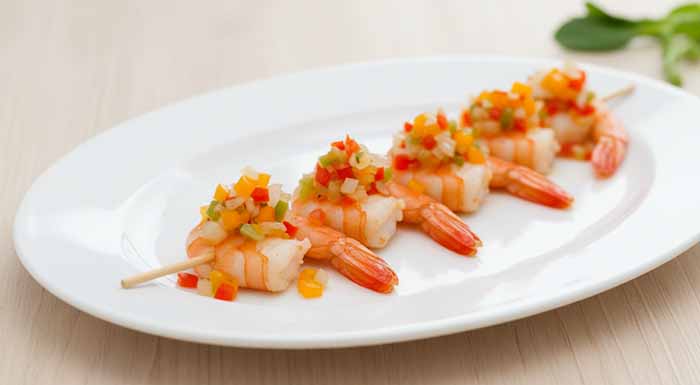
    TIP: Soffritto as a garnish. Beyond the traditional, we use soffritto as a savory topping on everything from pasta and proteins (photo below) to grain bowls and oatmeal.

    Shrimp With Soffritto Garnish
    [7] Here’s an unusual use for soffritto: as a garnish! (Abacus Photo)
     
    ________________
     
    *The term “refogado” comes from the verb refogar, which means to braise or sauté aromatics in fat. A Portuguese/Brazilian recipe will almost always begin with the instruction to “fazer um refogado” (make a refogado). While onion and garlic are always included, classic Portuguese refogado often skips the celery and carrot in favor of bay leaf and sometimes tomato or bell pepper, depending on the dish. Olive oil is standard, although in some traditional rural recipes, lard (banha) might be used. It is used in all rice recipes, cod recipes, and the various meat and fish stews that define the national diet.
     

    CHECK OUT WHAT’S HAPPENING ON OUR HOME PAGE, THENIBBLE.COM.


    Please follow and like us:
    Pin Share


    Comments are closed.

    The Nibble Webzine Of Food Adventures
    RSS
    Follow by Email


    © Copyright 2005-2026 Lifestyle Direct, Inc. All rights reserved. All images are copyrighted to their respective owners.