Make Blueberry Ice Pops For National Blueberry Popsicle Day
|
|
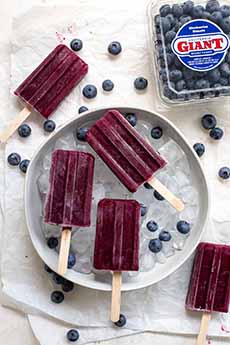
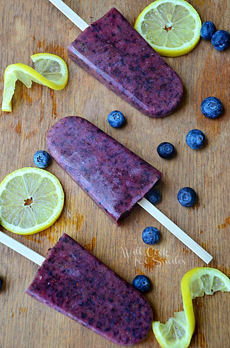
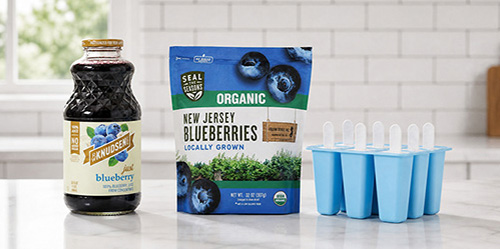
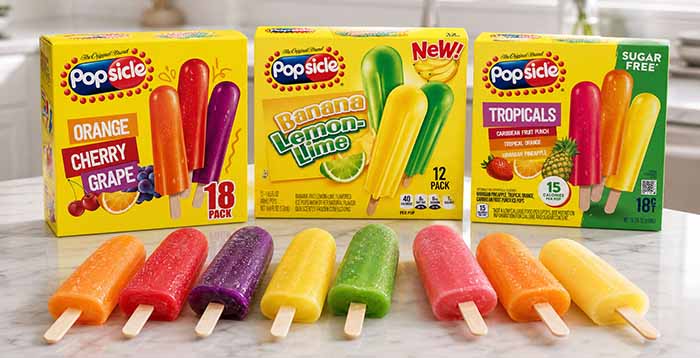
Updated September 2026 September 2nd is National Blueberry Popsicle Day, following close on the heels of National Cherry Popsicle Day, August 24th. But the name of the holiday needs to be changed, to Blueberry Ice Pop Day. Why? “Popsicle” is a registered trademark of Unilever used for a brand of frozen treats. It is not a synonym for “ice pop.” The should not be used as a generic synonym for every frozen treat on a stick. As far as we could veryify, there has never been a single-flavor blueberry Popsicle (the flavor is used in some berry blends—here are the current Popsicle flavors). So it’s not possible to celebrate a product that has never existed! But that doesn’t stop the celebrating: We proclaim this day, September 2nd, as National Blueberry Ice Pop Day. Celebrate by making your own blueberry ice pop. We guarantee that to an adult palate, they’ll be tastier than a Popsicle. Even if you don’t have ice pop molds, we’ve got you covered. Below: > Recipe: easy blueberry ice pops. > Recipe: blueberry-yogurt ice pops. > Blueberry measurement conversions. > How to make ice pops without an ice pop mold. > Are you guilty of genericide? Elsewhere on The Nibble: > The history of Popsicles (a happy accident). > 30 more blueberry recipes: beverages, breakfasts desserts, mains, and sides. > The year’s 50+ ice cream and frozen dessert holidays. > The year’s 35+ berry holidays. The easiest way to make blueberry ice pops is to freeze blueberry juice or a purée of frozen blueberries. This recipe uses both. Ingredients First, choose what kind of blueberry you’ll use: blueberry juice, fresh, or frozen blueberries. See the conversion table below.
Next, choose your sweetener. These are pretty low-caloric pops if you use non-caloric sweetener or agave (you need only half the amount of agave, as it’s twice as sweet as sugar). The blueberry juice may be sweet enough that you don’t need to add anything.
Plus
1. BRING the sugar (or other sweetener) and the water to a boil in a small saucepan over high heat, stirring until the sugar (or other sweetener) dissolves. If using blueberry juice, it may be sweet enough to avoid this step. Taste and decide. 2. TRANSFER to a large measuring cup or other container and refrigerate for 30 minutes, until cool. 3. COMBINE the blueberry juice or puréed blueberries with the lemon or lime juice. Add the sweetener/water mix to taste. 4. STIR thoroughly and pour into ice pop molds. Freeze for 4-6 hours, with the mold tops on. If you’re not using ice pop molds with built-in handles, insert a stick into each mold after 1 or 2 hours when it can stand up straight. If you won’t be eating the pops in short order, you might want to put some foil or plastic wrap around the open top, and insert the stick through to elminate potential freezer odors. When ready to eat: 5. RUN the molds under warm water to release the pops for serving.
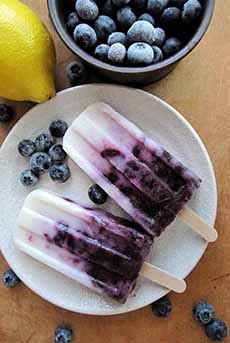
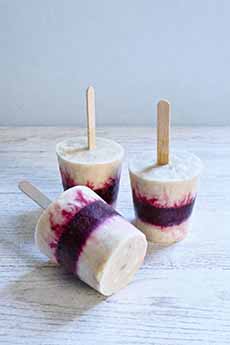
1. PURÉE the blueberries and sweetener together. Pour into a large bowl. 2. FOLD in the yogurt gently. For a swirled effect, use a spatula to make swirls in the bowl. You can also add the yogurt first, then the blueberries, to get a half-and-half effect in photo #2, above. Otherwise, combine thoroughly for a lighter purple pop. 3. TASTE and adjust sweetener if desired, then pour into the molds or cups. Freeze for 4-6 hours, with the mold tops on. If you’re not using ice pop molds with built-in handles, insert a stick into each mold after 1 or 2 hours, when it can stand up straight. 4. RUN the molds under warm water to remove the pops. |
|||||
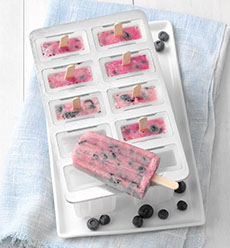
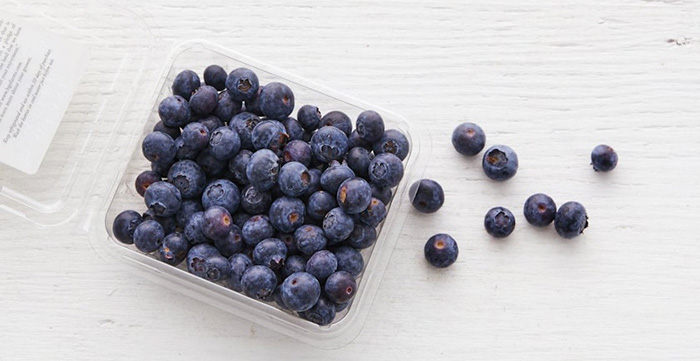 [8] Even when fresh blueberries are in season, it’s more economical to use frozen berries; and for ice pops, any difference in texture or sweetness won’t matter (photo © Good Eggs). 3. BLUEBERRY CONVERSION MEASUREMENTS These measurements are from CooksInfo.com. Volume equivalents will vary based on size of the berries. Depending on how many pops you’re making and how many ounces are in each mold, determine how much fruit you need:
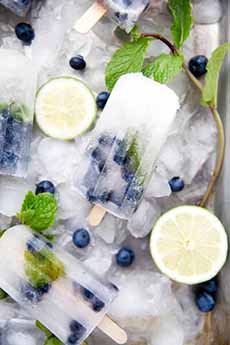
Ice pop molds are inexpensive, and if you like the idea of making your own, get one. In a pinch, these options aren’t elegant, but they work. Leave room for expansion, which will happen when the mixture freezes, and be ready to insert sticks when the mixture is firm enough to hold them.
We even saw a recommendation for an uncoated paperboard strip! Pretty much everyone we know would use “Popsicle” when meaning an ice pop. In fact, it’s hard to find any reference to an ice pop that doesn’t call it a Popsicle or popsicle. This phenomenon is known in trademark law as genericization or genericide: a brand name becomes so successful that the public uses it to refer to the entire category of product. Popsicle® and similar brands actively fight this usage in their marketing to avoid losing their trademark protection entirely—a fate that befell former trademarks like aspirin, escalator, granola, thermos, tv dinner, and heroin (yes, Heroin® (diacetylmorphine) was trademarked by Bayer in 1898 as a non-addictive cough suppressant and a substitute for morphine). Yet even the New York Times published a recipe called Blueberry Cream Popsicles. Probably not, but only because no one has the money to take on the lawsuit. Our finding in researching recipes for this story is that virtually everyone used popsicle as a generic term for their recipes, i.e., never “pineapple ice pops,” always “pineapple popsicles.” This highlights the sharp divide in trademark law between legal status and cultural reality. On paper, Popsicle® is a protected trademark; in actual human language, it has already gone generic. Widespread generic use could be relevant to a trademark dispute, but determining whether a mark has become generic is a fact-specific legal question (an area in which we claim no expertise). If a judge sees that a preponderance of published recipes—from major media to food bloggers—use “popsicle” as a common word for “frozen juice on a stick,” that’s strong legal evidence that the word has lost its trademark significance in the public consciousness. Who would undertake such an expensive legal action? Stripping a massive brand of its trademark requires an expensive, multi-year federal lawsuit. Most food companies find it far cheaper to simply label their products “ice pops,” “pop ice,” “pop sticks,” “frozen fruit bars,” or something else, rather than fund a massive legal war against Unilever, a global powerhouse with $57 billion in revenue in 2025. If someone did want to mount the case, would they win? Possibly. When courts determine whether a trademark has become generic, they rely heavily on the “Primary Significance Test,” a look at how the purchasing public uses and understands the word. Courts examine:
It’s not too difficult to look at the evidence that popsicle is a generic, common use. These trademarked food and beverage brand names are routinely used as generic terms. How many of these trademarked names do you use generically?
|
||||||
|
CHECK OUT WHAT’S HAPPENING ON OUR HOME PAGE, THENIBBLE.COM. |
||||||