
[1] No cream? No problem! Make it from milk and butter (photo © Wisconsin Milk Marketing Board).
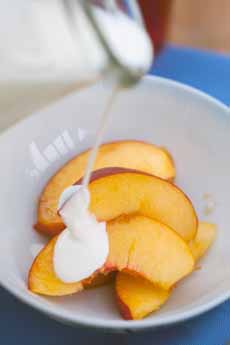
[2] How about some dessert? Just pour cream over any sliced fruit or berries—or on cooked fruit like baked apples and compote (photo © Spache The Spatula).
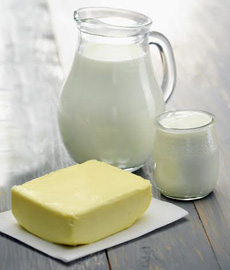
[3] Butter + Milk = Heavy Cream (photo © Siberkorn | Dreamstime).
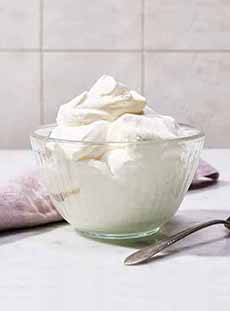
[4] Whip it into a dessert topping (photo © King Arthur Baking).

[5] Salted caramel hot chocolate with lots of whipped cream (photo © Starbucks).
|
|
Here’s a fun kitchen trick. Say you need some heavy cream for a recipe (or even a cup of coffee), but have none.
If you have whole milk and unsalted butter, you can combine them to make cream. The difference between milk and cream is the amount of butterfat. The butter, which is at least butterfat, supplies what the milk lacks.
This recipe makes heavy cream, approximately 36% butterfat.
> The butterfat content of all dairy products is below.
> The history of cream and the different types of cream: a photo glossary.
> The year’s 16+ milk and cream holidays.
HOW TO MAKE HEAVY CREAM AT HOME
Ingredients For 1 Cup
1/3 cup unsalted butter
3/4 cup whole milk
Preparation
1. MELT the butter in the microwave or on the stove top.
2. PLACE in a mixing bowl with the milk.
3. BLEND with electric beaters or an immersion blender.
It’s that simple!
BUTTERFAT CONTENT
Butterfat, also called milkfat, is the fatty portion of milk. The components of milk include:
Carbohydrate, 4.9% (this is lactose, or milk sugar)
Fat, 3.4% (approximately 65% saturated fat, 29% monounsaturated fat and 6% polyunsaturated fat)
Protein, 3.3% (82% casein and 18% whey)
Water, 87%
Vitamins (cobalamin [vitamin B12], folate, niacin [vitamin B3], pantothenic acid [vitamin B5], pyridoxine [vitamin B6], thiamin [vitamin B1], riboflavin [vitamin B2, vitamins C, D, E and K)
Minerals (calcium, copper, iron, magnesium, manganese, phosphorus, potassium, selenium, sodium, zinc)
Minor biological proteins and enzymes (lactoferrin, lactoperoxidase, lipases, lactase) [Source]
The USDA imposes federal standards for the minimum butterfat content of commercial dairy products. Here are the standards:
BUTTERFAT CONTENT OF BUTTER
Butter, including whipped butter, must contain at least 80% butterfat.
BUTTERFAT CONTENT OF CREAM
Half and half contains 10.5%–18% butterfat (average 12%).
Light cream and sour cream contain 18%–30% butterfat (average 20%).
Light whipping cream* (often called simply “whipping cream”) contains 30%–36% butterfat (average 35%).
Heavy cream* contains a minimum of 36% butterfat, up to 38%.
BUTTERFAT CONTENT OF MILK
Skim milk contains less than 0.5% butterfat, typically 0.1%.
Lowfat milk (1% and 2% varieties) contain between .5% and 2% butterfat.
Whole milk contains at least 3.25% butterfat.
BUTTERFAT CONTENT OF CHEESE
Dry curd and nonfat cottage cheese contain less than 0.5% butterfat.
Lowfat cottage cheese contains .5%–2% butterfat.
Cottage cheese contains at least 4% butterfat.
Swiss cheese contains at least 43% butterfat relative to the total solids.
Cheddar cheese contains at least 50% butterfat relative to the total solids.
BUTTERFAT CONTENT OF FROZEN DESSERTS
Sherbet contains 1%–2% butterfat.
Lowfat ice cream, also called ice milk, contains no more than 2.6% butterfat.
Ice cream contains at least 10% butterfat.
Frozen custard contains at least 10% butterfat, but it also must contain at least 1.4% egg yolk solids.
________________
*For whipped cream, the higher the fat content, the thicker the cream is, and the easier it is to whip into stiff peaks. Higher fat cream is also more resistant to curdling, and thus a better choice for soups and sauces.
|



