We don’t use corn syrup in our cooking or baking, so on National Caramel Corn Day, April 6th, we make a recipe that requires none. Instead, the corn is made with real caramel sauce.
If you feel like popping along with us, below you’ll find:
> The caramel corn recipe without corn syrup.
> Why do most recipes include corn syrup?
> The difference between popping corn and sweet (table) corn.
Elsewhere on The Nibble, dig into:
> The history of caramel corn.
> The history of popcorn.
> The history of corn.
> The year’s 13 popcorn holidays.
> More popcorn recipes.
There are two types of caramel corn:
While “caramel” is often used as a catch-all term, the richness and depth of the real caramel sauce used in this recipe come from the emulsion of fats and sugars. Commercial “caramel corn” is typically made with a simple sugar-and-oil glaze.
Homemade caramel corn recipes often use real, butter-based caramel, as does the recipe below. It produces a thick, opaque coating. The fat in the butter prevents the sugar from forming a perfectly clear, hard “glass” shell that is familiar in commercial products.
Store-bought caramel corn typically uses a sugar glaze rather than a buttery, rich coating. With store-bought, the sugar is added directly to the popping vessel or during a high-heat glazing process to create a thin, glass-like layer of caramelized sugar from corn syrup and soy lecithin, that is crisp and brittle. Commercial “glazed” popcorns often use.
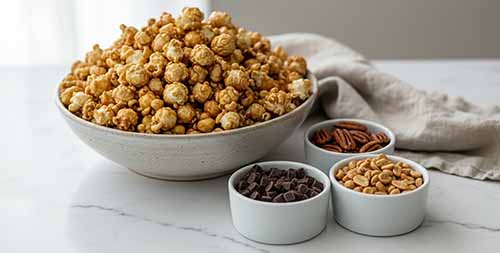
[7] We like to serve a bowl of plain caramel corn with separate mix-ins, so people can customize their own. The photo shows chocolate chunks, peanuts, and pecans, but you can offer anything from bacon or dried cherries or cranberries to M&Ms and toffee bits (Abacus Photo).
RECIPE: CARAMEL CORN WITHOUT CORN SYRUP
For a salted caramel version, increase the salt to 1 teaspoon and add a light sprinkle of flaky sea salt over the top just before baking.
Ingredients For 8 Servings
1 cup unsalted butter, softened
1 cup brown sugar, firmly packed
1/2 teaspoon salt
8 cups popped popcorn
Optional: 1 cups pecan halves, salted/honey roasted peanuts, or a mix (photo #7, above)
Preparation
1. PREHEAT the oven to 250°F. Lightly grease a large roasting pan or oven-safe bowl.
2. MAKE the caramel: Beat the softened butter, brown sugar, and salt until light and fluffy, about 3 minutes. The mixture should be smooth and creamy.
3. COMBINE the popcorn and caramel: Remove any unpopped kernels before coating. Place the popped popcorn and optional 1 cups pecan halves in the pan. Drop spoonfuls of the caramel mixture over the popcorn and toss gently but thoroughly, to coat as evenly as possible. Tip: We grease our hands with butter to hand-toss.)
4. BAKE AND STIR. Bake at 250°F for 55 minutes, removing the pan every 15 minutes to stir and redistribute the caramel coating. This low-and-slow method ensures even coating and proper crisping without burning.
5. COOL. Spread the finished caramel corn onto a sheet of parchment paper in a single layer and allow to cool completely, about 25 minutes. The caramel will crisp up as it cools.
6. BREAK into clusters and serve. You can serve the optional mix-ins (photo #7) and let people customize their corn. Store in an airtight container for up to one week.
Tip
Use freshly popped popcorn for the best texture. Old popcorn will turn out chewy rather than crispy, and when popcorn has a lot of unpopped kernels, it’s often because the kernels have dried out too much.
WHY DO MOST CARAMEL CORN RECIPES USE CORN SYRUP?
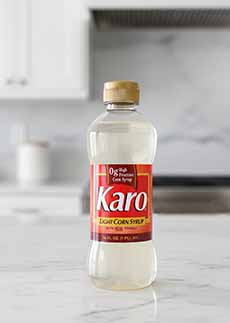
Corn syrup (photo #6) is a functional ingredient that prevents crystallization.
When sugar is cooked at high temperatures, it has a tendency to recrystallize—i.e., the dissolved sugar molecules can suddenly bond back together and turn grainy or sandy.
Corn syrup, being a different type of sugar (glucose rather than sucrose), interferes with that crystallization process and keeps the caramel smooth and glossy.
When making caramel corn, specifically, it enables a:
Smoother, more even coating, enabling the caramel to adhere to the popcorn more uniformly.
Crispier texture, helping the caramel set to a harder, glassier finish.
Longer shelf life, keeping the caramel corn crisper longer by resisting moisture absorption.
But it doesn’t impact the flavor, so we’re more than happy to use only brown sugar and butter in our recipe instead of brown sugar and corn syrup.
Brown sugar contains molasses in it, which has some natural resistance to recrystallization. Combined with butter and a low-and-slow baking method, we achieve a very satisfying result.
It may be slightly softer and less glassy than a corn syrup version, but we don’t notice.
|
|

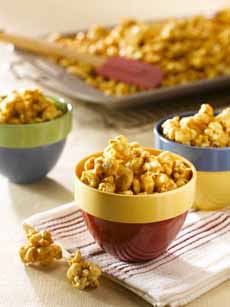
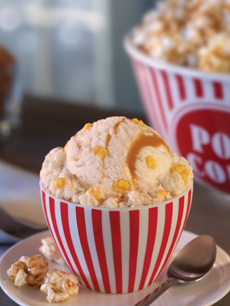
[1] Treat yourself to some homemade caramel corn made with real caramel (photos #1 and #2 © National Popcorn Board).
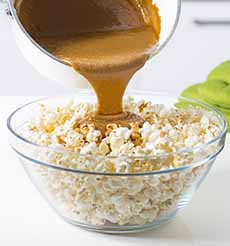
[2] It’s as easy as pouring caramel sauce over popcorn.
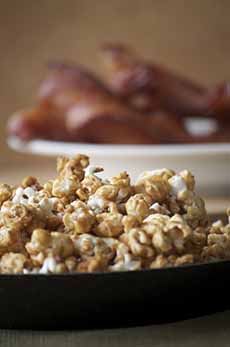
[3] How about mixing in chopped bacon (photo © Evan Dempsey | THE NIBBLE)?
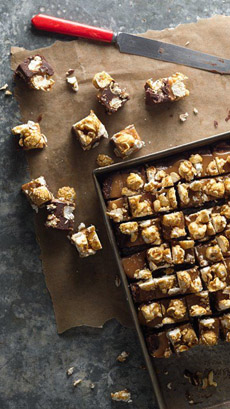
[4] Here’s a fun recipe: triple caramel fudge with dulce de leche, caramel candies, and caramel corn (photo © Betty Crocker).
[5] In January 2014, Baskin Robbins’ Flavor of the Month was Movie Theater Popcorn: popcorn-flavored ice cream, butter popcorn crisp pieces, and a salty caramel ribbon. Make your own version with your ice cream flavor of choice topped with caramel sauce and garnished with caramel popcorn (photo © Baskin-Robbins).
[6] Nice for popcorn balls, but not for our caramel corn (Abacus Photo)!
|
THE DIFFERENCE BETWEEN POPCORN AND SWEET CORN
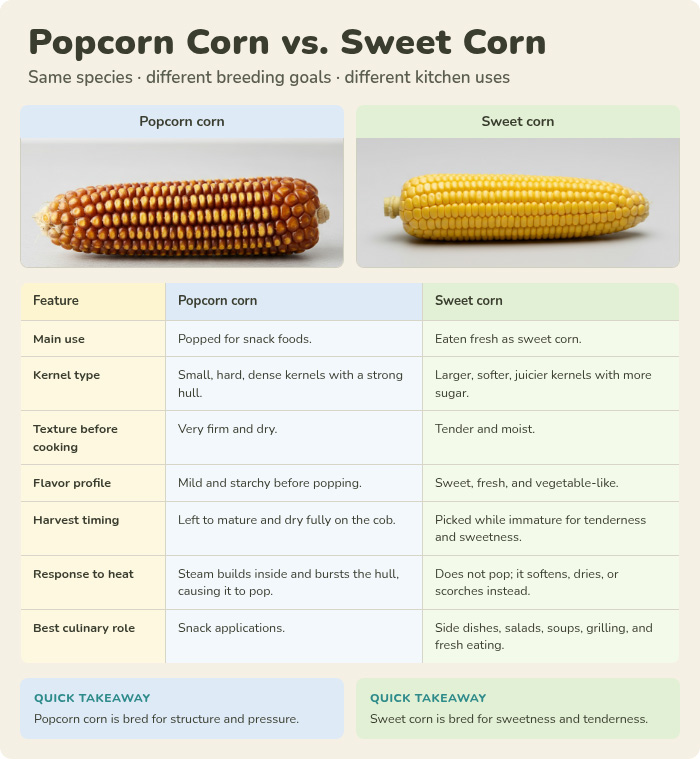
What’s the difference between the corn kernels we eat (sweet corn, a.k.a. table corn), and the kernels we pop?
They are actually quite different varieties of corn:
Corn (Zea mays) has several distinct varieties:
Dent Corn/Field Corn (Zea mays var. indentata): Harvested mature and dry, and used for livestock feed, ethanol, and processed foods like corn chips, hominy, masa (for tortillas), and corn oil.
Flint Corn/Calico Corn (Zea mays var. indurata): Hard-kernel corn used for foods like polenta and as decorative Indian corn, livestock feed, and industrial applications.
Flour Corn (Zea mays var. amylacea): A soft, starchy corn used to make cornmeal.
Popcorn (Zea mays var. everta): A type of flint corn with a hard shell and high moisture content.
Sweet corn (Zea mays var. saccharata or rugosa): Table corn, i.e. the corn we eat (kernels, on the cob, corn syrup), as well as non-food uses (see *footnote).
[8] Popcorn and sweet corn are quite different subspecies (Abacus Chart).
________________
*Sweet corn’s high sugar content makes it primarily a human food crop compared to starchy field corn. Beyond human consumption, it’s used for livestock fodder (corn cobs, stalks, and leftover kernels), cosmetics (corn syrup is used in toothpaste and mouthwash), medicine (husks and corn silk are sometimes used in traditional medicine to treat issues such as bladder irritation), industrial applications (the starch is used in adhesives and bio-plastic), and in some cases, biofuels (while field corn is the primary source, the sugars in sweet corn can be used for ethanol production).
CHECK OUT WHAT’S HAPPENING ON OUR HOME PAGE, THENIBBLE.COM.
|