|

[1] Chocolate baked custard. Here’s the recipe (photo © Healthy Recipes Blogs.

[2] Chocolate pudding (photo © Bonchan | iStock Photo).
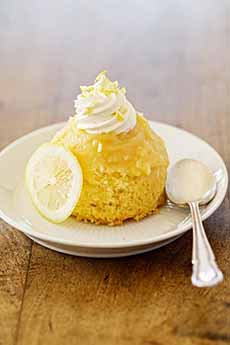
[3] Americans would call this lemon steamed pudding a cake. Brits call it pudding (photo © Sticky Toffee Pudding Company).
|
|
May 3rd is National Chocolate Custard Day, and June 26th is National Chocolate Pudding Day. Which got us to thinking: What’s the difference between custard and pudding?
Eggs, for starters.
Custard is a broad category of dairy-based desserts that can include both stirred and baked varieties. Many custards rely on eggs for thickening, while others use different methods.
Pudding (in the U.S.) is a general term for a variety of desserts with a creamy texture. Pudding can be thickened with eggs, starch, or other ingredients.
American pudding is a different product from a British pudding.
In the U.S., pudding is sweetened milk mixture thickened with cornstarch, then cooked (instant pudding is chilled in the fridge).
American pudding contains no eggs.
American pudding is a creamy pudding available in numerous flavors (butterscotch, chocolate, lemon, pistachio, vanilla, etc.).
These puddings can do double duty as pie filling.
When a recipe filling is exceptionally smooth and light, it is often called silk pie.
Both custard and pudding can be baked or cooked on the stove top.
There are custard-pudding hybrids, such as pastry cream (the filling of cream puffs and éclairs).
In the U.K. and Europe, American pudding is also known as blancmange, although classic blancmange is neither pudding nor custard (see footnote*).
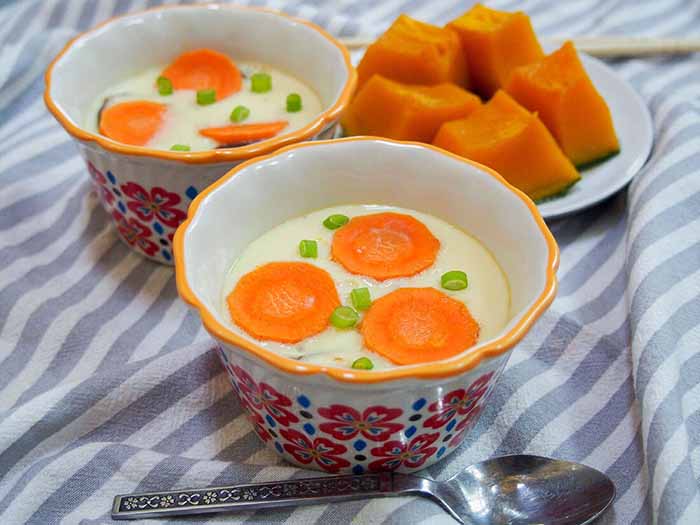
There are also savory custards—asparagus, corn, onion, Parmesan, etc. One of our favorites is chawanmushi, a.k.a. Japanese savory egg custard (photo #4, below).
But “pudding” is any dessert in the U.K. that’s steamed or boiled and served hot.
It especially refers to sweet, cake-like baked, steamed and boiled puddings, usually made in a mold.
Other puddings include bread puddings, crumbles, and sponge puddings. They are often served with hot custard sauce.
The steaming/boiling creates a texture of a cake (think Christmas/Plum Pudding, Spotted Dick, Sticky Toffee Pudding).
British cuisine also includes savory puddings and other foods that are called pudding: black pudding or blood pudding (sausage), Yorkshire pudding (baked batter, served as a side), bread pudding (stale bread baked in a custard sauce) and steamed pudding (cake).
________________
*Other custard thickeners besides eggs and lemon juice: The choice of thickener affects not only the consistency but also the flavor, appearance, and stability of the finished custard. Professional pastry chefs often select specific thickeners based on the desired characteristics of the final product. Options include:
Starch-based: arrowroot, cornstarch, flour, potato starch, rice flour, tapioca starch.
Gelling agents: agar-agar, carrageenan, gelatin, pectin, seaweed extract.
agar-agar: Plant-based alternative to gelatin; creates a firmer set than gelatin.
Other thickeners: coconut cream, guar gum, ground chia or flax seeds, xanthan gum.
|