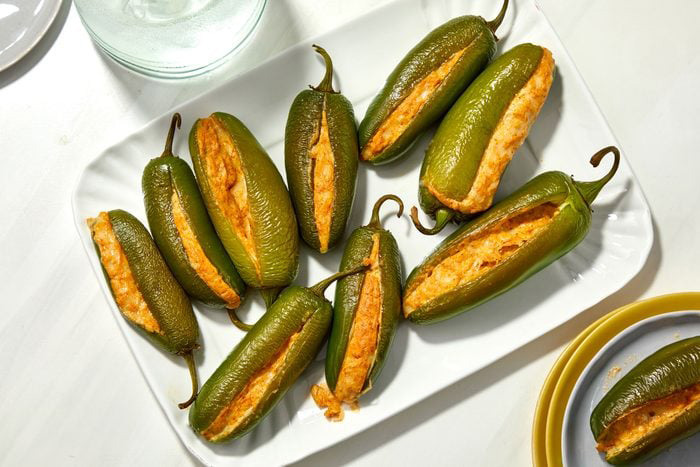
Jalapeño Poppers: Recipes For Jalapeño Holidays & Beyond
|
|
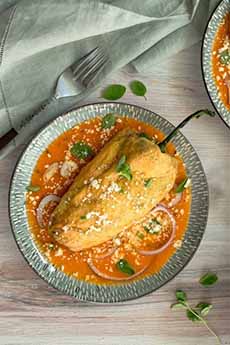
Updated September 2026 Once a year, on September 5th, we make jalapeño poppers to celebrate National Jalapeño Popper Day. We don’t frequent the types of restaurants and bars that have them on the menu, so homemade is our big chance—and also produces a popper with better ingredients. They are quite delicious with a cold beer. Are you ready to celebrate? Below: > The history of jalapeño poppers. > The history of jalapeño chile peppers. Elsewhere on The Nibble: > An oven rack for jalapeno poppers. > The history of chile peppers. > The different types of chiles: a photo glossary. > The year’s 25+ Mexican and Tex-Mex food holidays. > The year’s 12 hot and spicy holidays. Stuffed and breaded chile peppers existed in various forms in Southwestern and Mexican-American cooking long before they were commercialized as “poppers.” Stuffed jalapeños emerged in a Tex-Mex setting, drawing on the older Mexican tradition of chiles rellenos, which are stuffed poblano chile peppers (photo #6). Snack-sized stuffed chiles began to appear in Texas in the 1950s, when import stores began to advertise a canned Mexican product consisting of “jalapeños stuffed with cheese, sardines, red snapper and shrimp.” Recipes for stuffed jalapeños appeared in print by 1960. Throughout the 1970s and early 1980s, recipes for what we now call jalapeño poppers appeared in newspapers and restaurant ads, occasionally under the name “armadillo eggs.” By the time Dallas-based syndicated food columnist Dotty Griffith wrote an appreciation of them in 1989, she termed jalapeño poppers “standard fare.” Jalapeño poppers were not invented by a corporation. Cheese-stuffed jalapeños had appeared in Texas and Mexican-American foodways for decades, evolving from an older Tex-Mex-style stuffed-pepper snack. The First Commercial Brand The first company to sell breaded, stuffed, ready-to-fry chiles commercially was Leon’s Texas Cuisine of Dallas, a commercial supplier of corn dogs and other breaded, fried products.
By the early 1990s, a standardized breaded-and-fried snack was appearing under the name “jalapeño poppers” on bar menus in parts of Middle America, as far east as Kentucky. The Anchor Drops The available record does not show where that name came from or how the snack traveled from Texas to the Midwest, but someone at Anchor Foods in Appleton, Wisconsin saw the opportunity to mass-market them.
By early 1995, both Applebee’s and TGI Friday’s had added Jalapeño Poppers to their menus, firmly fixing the dish in America’s culinary history. Happy Hour had new excitement on the menu. Since both Leon’s and Anchor were major suppliers to restaurants, that’s where most consumers discovered jalapeño poppers (or Jalitos, Leon’s product). Customers had a new reason to head over for a drink. Restaurants and bars rejoiced. Alas, the record is mute on which chef, restaurant, or customer bestowed it. While Anchor Foods filed a trademark for the term in 1992, it had been appearing on bar menus for a while. This strongly suggests that before any corporation got involved, the name “popper” emerged organically from bar and restaurant culture, most likely from bartenders, cooks, or customers describing the way the hot cheese literally “pops” in your mouth when you bite into one. Our own vision is different. We see a customer, having had a few beers with his first plate of the stuffed chile peppers, saying, “Bartender, get me another plate of those chile poppers.” Poppers Today You can find Anchor Poppers in the frozen foods section of grocery stores nationwide. Anchor’s expanded line includes seven flavors, the most popular of which are Original, Cream Cheese & Cheddar Cheese Jalapeño Poppers, and Fire-Roasted Poblano & Jalapeño Popper Bites. Anchor Foods was split and sold in 2001.
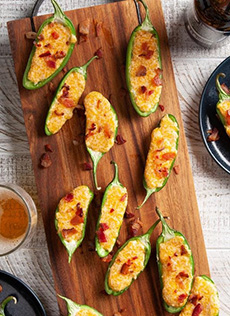
Numerous other companies in the foodservice business manufacture the product for restaurants, schools, caterers, and so on. The original poppers were jalapeño chiles stuffed with cream cheese or Cheddar, battered and deep-fried—a spicy Tex-Mex snack. A jalapeño chile pepper is sliced lengthwise or cored, with the seeds and membranes removed. |
|
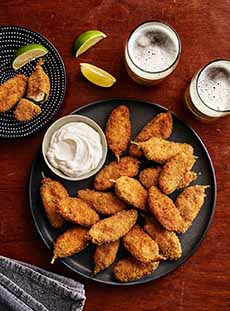
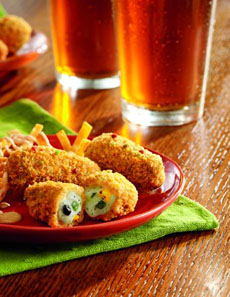
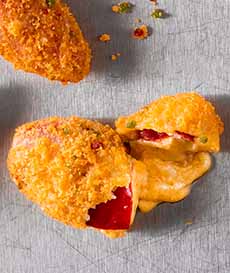
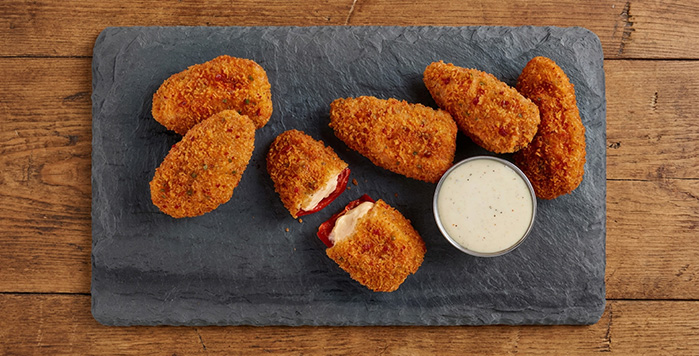 [8] These poppers are made with red jalapeños, which we prefer for both their sweeter flavor and bright color. They’re stuffed with seasoned cream cheese and shown here with ranch dressing as the dip (photo © Fry Foods). It’s then stuffed with cheese and spices and breaded and deep-fried, or wrapped in bacon and baked. The stuffing is typically made with a rich, soft base like cream cheese, often mixed with sharp Cheddar or other cheeses, plus seasonings.
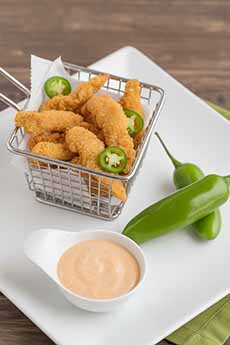
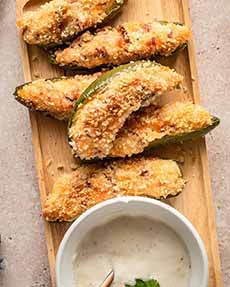
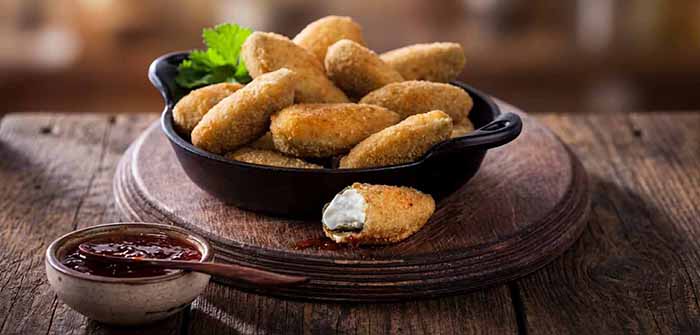
Poppers are delicious with a beer and can be served with a dip or sauce: marinara sauce, pepper jelly, ranch dressing, salsa, or other favorite. We combine pepper jelly with fat-free Greek yogurt to add a bit of sweetness without the cholesterol; plus a breading of Japanese-style panko breadcrumbs. One of our favorite dips provides a “fusion” touch: Thai sweet chili sauce. Look for reduced-sugar versions.
The jalapeño is one of the world’s most recognizable chile peppers, but its story begins long before it acquired that familiar name—or became an ingredient in salsa, a topping for nachos, or the centerpiece of a cheese-filled bar snack. Like other cultivated chile peppers, the jalapeño belongs to Capsicum annuum, a species domesticated in the Americas thousands of years ago. Chiles were a foundational seasoning and food crop in Mesoamerica long before the arrival of Europeans. They were eaten fresh, dried, ground into sauces, and preserved by smoking. The specific jalapeño variety, however, did not come down to us unchanged from the distant past: It is a cultivated variety shaped over generations of selection. The name provides its strongest geographic association. Jalapeño—also spelled xalapeño in Spanish—means “from Xalapa,” the capital of Veracruz in eastern Mexico. Xalapa’s older spelling was Jalapa, and the city gave the chile pepper its eventual commercial name.
After the Spanish invasion of the Americas, chiles joined maize, tomatoes, cacao, potatoes, and other American foods in the Columbian Exchange (the massive transfer of plants, animals, culture, human populations, and diseases between the Americas [the New World] and Europe [the Old World, also including Africa and Asia] that began after Christopher Columbus reached the Americas in 1492). Chiles spread rapidly through Europe, Africa, and Asia, in part because they could thrive in many warm climates and supplied the pungency that other cuisines had obtained from expensive imported spices. While the worldwide spread included numerous varieties of Capsicums, the jalapeño remained especially identified with Mexico and Mexican cooking. Survival Of The Perishable The world embrace of jalapeños today owes much to preservation techniques. Fresh jalapeños are seasonal and perishable; pickling and canning turned them into a durable condiment that could travel widely. Around 1910, Veracruz native Narciso Jiménez Guerra began experimenting with preserving the local cuaresmeño chile. In 1921, he registered the name La Jalapeña for his pickled-chile business, and in 1928 the company opened a canning factory in Xalapa. Its products helped establish canned jalapeños as a recognizable regional specialty. By the mid-20th century, larger manufacturers elsewhere in Mexico had expanded the market far beyond Veracruz. In Mexico, chiles en escabeche—preserved in a seasoned vinegar brine—became a standard way to serve jalapeños. The jars are often packed with carrots, onions, garlic, herbs, and spices, producing a tart, spicy garnish offered alongside tacos, tortas, and many other dishes. In the U.S., the jalapeño became increasingly familiar through Mexican and Mexican American foodways, especially in Texas and the Southwest. It appeared fresh in salsas and cooked dishes, pickled as a table condiment, and later as a standardized ingredient in processed foods. Canned slices became closely associated with Tex-Mex dishes such as nachos and chili-cheese foods, while smoked red jalapeños—chipotles—eventually became widely used in adobo sauces, marinades, barbecue, and packaged seasonings. A Versatile Heat Level The chile’s moderate heat helped make it unusually adaptable. Jalapeños are hotter than ancho, Anaheim, cascabel, and poblano but are generally less fierce than birdseye, habanero, red chile flakes, and other varieties. > Check out the Scoville scale for comparative heat levels. Their heat varies according to cultivar, growing conditions, ripeness, and individual fruit, but they are commonly described as a medium-hot chile. Their thick walls and relatively broad shape also make them practical for stuffing, pickling, grilling, roasting, and processing. Commercial breeding has further changed the jalapeño’s story. Growers and seed companies have selected varieties for uniform size, thick flesh, disease resistance, higher yields, reduced heat, or greater heat. This helps explain why a supermarket jalapeño can look and taste quite different from a locally grown cuaresmeño in Mexico. As discussed earlier, the late-20th-century rise of the jalapeño popper gave the pepper another distinct cultural identity in the United States. The nationwide availability of Anchor’s frozen Jalapeño Poppers made the jalapeño a familiar food, even for people whose experience with Mexican food was otherwise limited. As we wind down National Jalapeño Popper Day, this overview relates a history of Indigenous Mesoamerican chile cultivation, regional Mexican preservation traditions, Veracruz trade and canning, and the global movement of American crops. Whether fresh and green, red and ripe, pickled in escabeche, or dried and smoked into chipotle, the jalapeño remains one chile pepper with several culinary lives. ________________ The strategy paid off. “Jalapeño Poppers” became the universal term for the product, which helped propel the dish into mainstream popularity. CHECK OUT WHAT’S HAPPENING ON OUR HOME PAGE, THENIBBLE.COM.
|
||