THE NIBBLE BLOG: Products, Recipes & Trends In Specialty Foods


Also visit our main website, TheNibble.com.

Pairing Champagne & Barbecue Plus A Free Champagne Course

Pairing Champagne & Barbecue
[1] Brut Champagne, the most popular style in Champagne and among sparkling wines in general, is a dry style, but not as dry as Extra Brut (photos #1, #2, and #4 © Champagne Bureau | Facebook).
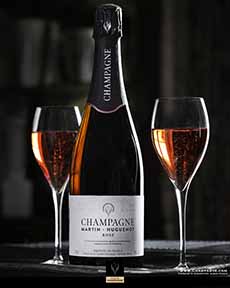
Pairing Champagne & Barbecue
[2] Rosé Champagne is a delight with any course, and pairs well with fruit-based desserts.
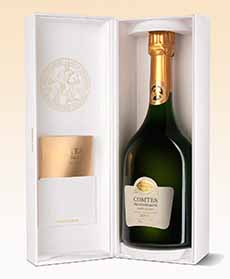
Pairing Champagne & Barbecue
[3] Blanc de Blancs Champagne, is a perfect pairing with seafood. The crème de la crème of Blanc de Blancs is Taittinger Comptes de Champagne (photos #3 and #5 © Champagne Taittinger).
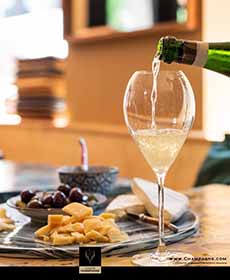
Champagne & Hors d'Oeuvre
[4] Salty snacks, cheeses, charcuterie, and other nibbles are delicious with an Extra Brut Champagne, the driest style.
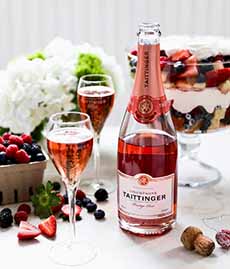
Rose Champagne With Fruit
[5] Rose Champagne is delicious with fruit desserts.


Have you ever considered serving Champagne with barbecue? Neither did we, until the Champagne Bureau U.S. sent us the following pairing suggestions for a Memorial Day celebration.

Your crowd may prefer beer or a hearty red wine with barbecue (Barolo, Bordeaux, Cabernet Sauvignon, Malbec Shiraz, Zinfandel).

But if you’d like to try something different, take a look below.

Champagne pairs perfectly with grilling, says the Champagne Bureau, which is the official site of the Comité Champagne—officially the Comité Interprofessionnel du Vin de Champagne, or CIVC for short.

This trade association represents all the grape growers and houses (producers) in the Champagne region of France.

both the growers and the producers (houses) of the Champagne region in France. This trade association represents

We must note that while Champagne is the crème de la crème of sparkling wines, you can easily use less pricy bubbly. Check out our list of affordable sparkling wines.

> May 16th is National Barbecue Day.

Below:

Champagne and barbecue pairings.

Elsewhere on The Nibble:
> The different types of ribs.

> The 6 styles of champagne: Blanc de Blancs, Blanc de Noirs, Non-Vintage, Prestige Cuvée, Rosé, Vintage.

> The 7 levels of Champagne sweetness: Brut Nature, Extra Brut, Brut, Extra Dry, Dry, Demi-Sec, Doux.

> The year’s 10+ Champagne and other bubbly holidays.

> The year’s 24 pork holidays.

> The history of barbecue


THE DIFFERENT TYPES OF BARBECUE
Beyond the classic ribs and brisket, American barbecue is a vast landscape of different cuts, meats, and even entirely different animals depending on the region. The variety often comes from local livestock traditions and specific cultural influences.
Regional Meat Specialties

Pulled Pork (The Carolinas and Memphis): This is the backbone of Southeastern BBQ. Pork shoulder or the “whole hog” is smoked for up to 24 hours until it can be Shredded. In Eastern North Carolina, they typically cook the whole hog, mixing the crispy skin with various parts of the pig to create a unique texture Truth BBQ.

Burnt Ends (Kansas City): These are the deeply caramelized, fatty cubes cut from the “point” end of a smoked brisket. Once considered scraps, they are now the “crown jewel” of KC BBQ, often re-sauced and smoked a second time to become meat candy BBQHOUSE.

Mutton (Western Kentucky): A distinct departure from beef and pork, Western Kentucky is famous for slow-smoked mutton (mature sheep). It is typically served with a thin, Worcestershire-based “black dip” that cuts through the rich, gamey flavor of the meat WebstaurantStore.

Tri-Tip (Santa Maria, California): A specific triangular cut of beef from the bottom sirloin. Unlike Southern BBQ, which uses indirect smoke, Santa Maria style involves grilling the tri-tip over an open pit of red oak coals, resulting in a flavor more akin to a smoky roast BBQHOUSE.

Smoked Chicken with White Sauce (Alabama): While many regions smoke chicken, Alabama is unique for its “White Sauce”—a tangy, creamy mixture of mayonnaise, vinegar, and pepper that is used as a finishing dunk for halved chickens Truth BBQ.

Barbecue Sausages and Stews

Texas Hot Links: Influenced by German and Czech immigrants, these are spicy, snap-casing beef or beef-pork sausages smoked alongside the brisket. In East Texas, they are sometimes called “Hot Guts” due to the traditional natural casings used WebstaurantStore.

Barbacoa (South Texas): Deeply rooted in Mexican tradition, authentic South Texas barbacoa involves slow-cooking cow heads (particularly the cheek meat) in an underground pit or smoker until the meat is incredibly tender and rich BBQHOUSE.

Barbecue Spaghetti (Memphis): A unique regional fusion where spaghetti noodles are tossed in a blend of marinara and BBQ sauce, then loaded with smoked pulled pork WebstaurantStore.

Burgoo (Kentucky): A thick, hearty “hunter’s stew” made from a variety of smoked meats (often mutton and pork) and vegetables, simmered until it becomes a dense, flavorful meal WebstaurantStore.


CHAMPAGNE & BARBECUE PAIRINGS

Certainly it’s a highbrow/lowbrow pairing, but Champagne and other sparklers offer a diversity of styles that can be paired with a barbecue menu.

And why not: Sparkling wine has that same palate-refreshing __ as beer, a popular barbecue beverage.

  • For pre-barbecue snacking, potato chips are an unusual yet perfect pairing with an Extra Brut Champagne. Extra Brut is the driest style, and pairs well with other salty foods as well—from charcuterie to olives and popcorn.
  • For the main course, barbecue ribs, brisket, and other smoked and grilled meats pair wonderfully with a vintage or nonvintage Brut Champagne. Brut is the most common type of sparkling wine in the world. Brut can have up to 12 g/L of residual sugar but will taste completely dry to most palates. The sugar gives the wine a bit of weight rather than sweetness. While Brut can go with just about anything, it is great with salty foods. Try it with fried chicken as well as barbecue chicken. A Brut Champagne can be made from all white grapes, all black [red‡] grapes, or a combination of both.
  • With grilled seafood—fish, scallops, shrimp—pair a Blanc de Blancs Champagne. Meaning “white from white” (i.e., white wine from white grapes), a typical Blanc de Blancs is made entirely from Chardonnay grapes. The style tends to be lighter and drier than Blanc de Noirs, “white from black” (i.e., white wine from black [red] grapes†, which in Champagne are typically Pinot Noir and Pinot Meunier).
  • For dessert, a Rosé† Champagne goes nicely with fruit salad or fruit pie. A sweeter style of Champagne, such as demi-sec* or sec, is also delicious. Of course, Rosé Champagne is delicious with just about everything.
  •  
     
    FREE ONLINE CHAMPAGNE COURSE

    If you’d like to learn more about Champagne, you can take the Champagne Massive Open Online Course (MOOC) at your convenience.

    The Level 1 course is free.

    Study at your own pace, 24/7. The classic version is free and is packed with almost 5 hours of pairing tips and other fascinating facts about the Champagne region and its wines.

    How long is it? The total course runs for less than 5 hours and covers:

  • The Champagne-making process
  • The Champagne terroir
  • History and economy of Champagne
  • Diversity and tasting
  •  
    Each of these four modules includes videos, texts, and illustrative content to make learning easier.

    Thanks to the 16,200 growers and 360 houses in Champagne that produce such wonderful wines, beloved the world over.
     
     
    GREAT ARTICLES FROM THE NIBBLE

    ________________

    *Although “demi-sec” translates to “half dry” in French, it actually means that it is half as dry as doux, the French word for sweet.

    †By pressing these red grapes very gently, and removing the skins quickly after pressing, the wine retains its white color. The grape juice is naturally white. Red wine is created by allowing the skins to remain in contact with the juice, imparting their red color. To make a rosé wine, the skins are left for a much shorter time.

    ‡While the wine they produce is red in color, most of the grape varieties’ skins are black with red or blue hues. Thus, the industry refers to them as black grapes. It is also proper to refer to them as red wine grapes, because they make red wine!
     
     
    CHECK OUT WHAT’S HAPPENING

    ON OUR HOME PAGE,

    THENIBBLE.COM.


    Comments off

    Carrot Hummus Recipe For National Hummus Day

    Carrot Hummus Recipe
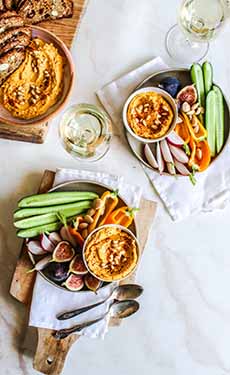
    [1] Carrot hummus, served with crunchy crudités (photo © Wine Institute).

    Whole Cumin Seeds
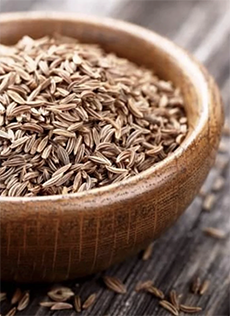
    [2] Whole cumim seeds. Toast them for great flavor (photo © Planet Spices | Etsy).

    Pine Nuts & Garlic Cloves
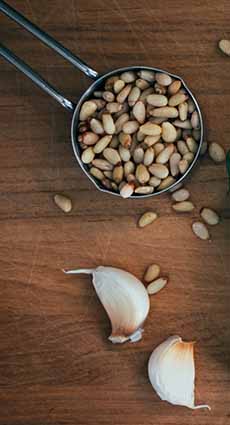
    [3] Pine nuts and garlic cloves. Did you know that pine nuts come from pine cones† (photo © C.J. Dayrit | Unsplash)?

    Aleppo Pepper Crushed
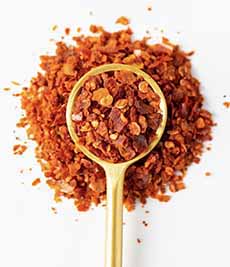
    [4] Aleppo pepper, a crushed hot chile (photo © Savory Spice Shop).


    While we missed celebrating International Carrot Day on April 4th, we’re making up for it today, May 13th, National Hummus Day. We just finished making this carrot hummus recipe, and it is delicious.

    The hummus with a platter of crunchy crudités—in this case, spring vegetables—for dipping.

    > The history of hummus and more hummus recipes.

    > The history of carrots.
     
     
    RECIPE: CARROT HUMMUS

    The carrots are first cooked to heighten their sweetness. Whole cumin seed, freshly toasted and ground by you, will be so much more flavorful than store-bought ground cumin.

    But, you can default to the pre-ground, untoasted variety.

    Thanks to the Wine Institute, which recommends serving a California Chardonnay or California Sauvignon Blanc with the hummus and crudités plate.

    (Crudités is the French word for sliced raw vegetables, typically served as an appetizer or a snack with wine.)

    You can find many more delicious recipes and wine pairings at DiscoverCaliforniaWines.com.
     
    Ingredients 2 to 2-1/2 Cups

  • 1 tablespoon plus 2 teaspoons extra virgin olive oil
  • ½ pound (225 g) carrots, peeled and coarsely grated
  • Sea salt
  • ½ teaspoon whole cumin seeds or ½ teaspoon ground cumin
  • 1 can (15.5 oz/439 g) chickpeas, drained, or 2 cups cooked chickpeas
  • 2 large cloves garlic
  • ¼ cup (60 ml) fresh lemon juice, or more to taste
  • ½ cup tahini
  • 1 tablespoon pine nuts
  • Aleppo pepper, hot red pepper flakes, or paprika
  • Spring vegetables‡ for dipping, such as radishes, baby carrots, roasted beets, sugar snap peas*, asparagus*, Persian cucumbers, hearts of romaine, scallions
  • Optional: plain or toasted pita wedges
  •  
    Preparation

    1. HEAT a 10-inch (25-cm) skillet over high heat. Add 1 tablespoon olive oil. When the oil is almost smoking, add the carrots and a generous pinch of salt. Cook, stirring constantly with a wooden spoon until the carrots have wilted slightly and lost their crunch, about 3 minutes. Set the skillet aside.

    2. PLACE the cumin seeds in a small dry skillet over medium heat. Cook, shaking the skillet often until the cumin seeds darken and begin to smell fragrant, about 2 minutes. Let cool, then pound fine in a mortar.

    3. PLACE the carrots, cumin, chickpeas, garlic, and lemon juice in a food processor and process until very finely chopped. Add the tahini and process until well blended. With the machine running, add enough water through the feed tube to make a smooth purée, about 1/3 cup. Add salt to taste and more lemon if desired.

    Process for 5 minutes to make a smooth, light hummus. Transfer to a serving bowl, spreading it with a rubber spatula and making some “valleys” where oil can pool.

    4. HEAT the remaining 2 teaspoons of olive oil in a small skillet over medium heat. Add the pine nuts and cook, shaking the skillet constantly, until they are golden brown, about 2 minutes.

    5. IMMEDIATELY POUR the hot oil and pine nuts over the hummus. Sprinkle with Aleppo pepper, pepper flakes, or paprika, and serve with the crudités for dipping.
     
    ________________

    *The Wine Institute recommends briefly blanching the sugar snap peas and asparagus to brighten their color.

    †Only 20 varieties of pine trees worldwide produce cones with pine nuts that are large enough for harvesting. Pinyon pines, Pinus edulis which only grow between 6,000- and 9,000-foot altitudes, provide the finest pine nuts in North America [source].

    ‡Or vegetables of whatever season you’re in.


    CHECK OUT WHAT’S HAPPENING ON OUR HOME PAGE, THENIBBLE.COM.


    Comments off

    Food Fun: Creative Toast Toppings

    At our house, toast comes to the table with butter, cream cheese, and jam. But this weekend, we’ll adapt this idea for creative toast toppings from Woodstock Foods.

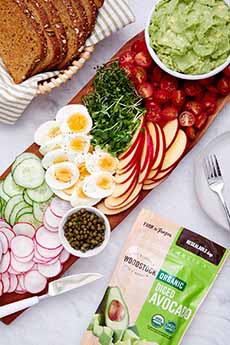
    Whole grain toast (so much more flavorful than packaged white bread!) is served with guacamole as the bread spread, and a DIY assortment of healthful toppings:

  • Capers
  • Cherry tomatoes
  • Cucumbers
  • Hard-boiled eggs
  • Microgreens (substitute watercress)
  • Sliced apple (substitute blueberries)
  • Radishes
  •  
    We’d add:

  • Something from the onion group for tang: sweet onion, scallions or chives.
  • Almonds, pistachios, or other nuts for more protein.
  •  
    Instead of guacamole, substitute hummus or plain Greek yogurt.


    Platter Of Creative Toast Toppings
    A healthy platter of creative toast toppings (photo © Woodstock Foods).

     
    Woodstock Foods, a leader in the non-GMO category, sells wholesome, organic, low-sodium/sugar products. Check out the company website.

    For this toast toppings platter, the brand’s frozen diced avocado (shown in the photo) means you’ll always have ripe avocado at hand, ready to mash into guacamole or avocado toast.
     
     
    > The history of bread.

    > The different types of bread.


    CHECK OUT WHAT’S HAPPENING ON OUR HOME PAGE, THENIBBLE.COM.


    Comments off

    Different Wine & Food Pairings–Cocktails & Spirits, Too

    Foie gras with Sauternes…

    Oysters and Champagne or Chablis…

    Pasta with red sauce and Chianti…

    Steak with Cabernet Sauvignon…

    Thai food and Riesling…

    These are classic food and wine pairings.

    But what if you’d like to try something different?

    Matthieu Yamoum, beverage director of the Baccarat Hotel in New York City, has suggestions that we’d never have thought of—seemingly unusual pairings of wines, spirits, and even cocktails.

    Yet his unexpected matches are just as tasty…maybe even better!

    Here are his recommendations.
     
     
    DIFFERENT FOOD PAIRINGS

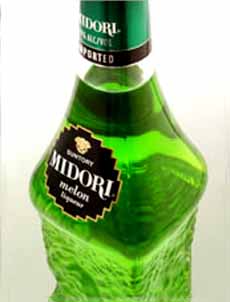
  • Cured Ham/Italian Salume: Midori Melon Liqueur
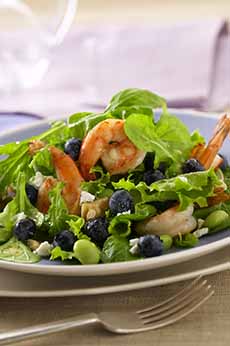
  • Green Salads: Blanco Tequila
  • Hamburger: Mezcal
  • Ice Cream: Single Malt Scotch
  • Indian Food: Gin & Tonic
  • Mac & Cheese: Dessert Wine
  • Middle Eastern Mezze: Negroni
  • Tacos: Vodka Martini
  • Thai Food: Champagne
  •  
    For details, check out the full story on CNN Travel.
     
     
    MORE UNUSUAL FOOD & WINE PAIRINGS

    Here are some of our own favorites:

  • Barbecue & Malbec
  • BLT & Chardonnay
  • Charcuterie & Zinfandel (pâtés, mousses, and terrines, etc.)
  • Chocolate Ice Cream & Pinot Noir
  • Green Salad Vinaigrette & Madiera
  • Hamburgers & Beaujolais
  • Indian Food & Syrah
  • Peanut Butter Jelly Sandwich With Gewürtztraminer
  • Salmon or Swordfish & Pinot Noir
  • Sushi and Riesling or Gewürtztraminer
  • Spicy Tacos & Reisling
  •  
     
    A final note: There are no “rights” and “wrongs,” there’s just what you like.


    Wine & Food Pairings
    [1] Can you imagine pairing fruit liqueur with food? Well…Midori melon liqueur pairs with prosciutto and other cured meats, in the time-honored pairing of melon and prosciutto (photo © Midori Melon Liqueur).

    Food & Wine Pairing Shrimp & Green Salad
    [2] With a green salad—plain or topped with your favorite proteins and/or fruits—have a glass of blanco (silver) tequila Here’s the recipe (photo © Blueberry Council).

    Martini & Olives Wine & Food Pairings
    [3] Try a Vodka Martini with tacos (photo © Sable & Rosenfeld).


    CHECK OUT WHAT’S HAPPENING ON OUR HOME PAGE, THENIBBLE.COM.


    Comments off

    Neft Vodka, An Ultra-Premium Vodka That’s A Great Gift

    Neft Ultra Premium Vodka
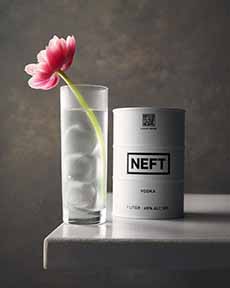
    [1] Neft is a winner in a dry Martini, any vodka cocktail, or neat (all photo © Neft Vodka).

    Neft Ultra Premium Vodka
    [2] Neft vodka on the rocks. The vodka is packaged in oil drum-shaped cans, available in black or white.

    Neft Ultra Premium Vodka
    [3] Neft is also made in a single-portion, 100 ml size.

    Neft Vodka Pride Barrel
    [4] The Pride barrel.

    Field Of Rye
    [5] Austrian fields growing ancient varieties of rye.

    Rhaetian Alps In Austria
    [6] The Rhaetian Alps in Austria, source of the water used to distill Neft Vodka.

      NEFT ultra-premium vodka‡‡ is produced in Austria with spring water from the Rätikon Massif mountain range, part of the the Rhaetian Alps.

    There, rain and snowmelt water is filtered for 50 years through the layers of limestone and slate beneath.

    That accounts for part of the special flavor, but a bigger part is the blend of four gluten-free, non-GMO, ancient rye grains* grown in lower Saxony, that are distilled into the vodka.

    Neft is crafted at Destillerie Freihof, a 130-year-old family-run distillery in Lustenau, Austria.

    The packaging is an unbreakable metal barrel that stays cold for hours.

    For gifting, Neft Vodka is a great combination of presentation and taste.

    If you’re wondering why the vodka is packaged in a barrel shape, it’s because Neft means “oil” in Russian, and the brand was created to honor oil workers. (There is Cyrillic lettering on one side of the can.)

    Neft Vodka was created by a petroleum engineer from Western Siberia, who observed the endurance and sacrifice displayed by the Siberian oil pioneers† in the 1970s. When she decided to create a vodka brand, she fashioned it to pay tribute to them.

    One source says that the unbreakable barrel allowed the workers to carry a container of vodka that wouldn’t break. There’s more about the barrel below.

    In 2012, Ekaterina Kuzmina wanted to create a vodka that paid homage to her family’s roots in the Siberian oil workforce [source 1, source 2].

    She was determined to make a vodka of outstanding quality for which those original workers would be proud.

    Kuzmina, sought the best organic ingredients and settled on the mountainous Vorarlberg region in the westernmost part of Austria, where pristine Alpine spring water and distillation methods produce some of the best spirits in the world.

    Critics agree.

  • Neft Vodka received two Double Gold Medals from the San Francisco World Spirits Competition and a “Best in Show” in the vodka category in 2018††.
  • More recently, The Tasting Panel Magazine recently awarded Neft an impressive 98-point score. A 92 point rating and Gold Medal came from the Beverage Tasting Institute.
  • Neft also got a Double Gold at the 2020 Best Tasting Spirits competition.
  • Neft was named one of the “Top 20 Vodka Brands of 2020” by VinePair.
  •  
    Neft donates 50 cents from every barrel sold to one of six charities they support.

    Are you ready for a taste?
     
     
    THE FLAVOR

    The great Alpine water, multiple-distillation process, and proprietary carbon-layer filtration produce a vodka of exceptional purity. Neft is elegant, creamy, smooth, and viscous, and can be joyfully sipped neat.

    It truly is a luscious, ultra-premium vodka.

    Get a group of tasting professionals in a room and you’ll hear a multitude of descriptors:

  • A nose of almond and vanilla, which opens up to tangerine and butterscotch.
  • Minerality on the palate, based on the limestone and slate through which the water filters.
  • A sweet vanilla, caramel, and cream entry on the palate, with a soft mouthfeel. A return of the mineral, almond, and tangerine notes in the nose arrive on the palate, evolving to butterscotch.
  • The finish is smooth and long, with almond, caramel, cream, minerality, tangerine, vanilla, and the actual rye itself.
  •  
    If that sounds like a lot, clear your palate, taste, re-taste, and see what you come up with.
     
     
    UNIQUE OIL BARREL PACKAGING

    The tin-and-aluminum cans are made in black and white, plus a multicolor Pride design and a seasonal holiday barrel. The vodka inside is the same.

    Why an oil barrel?

    The barrels aren’t just to stand out: They’re insulated and will stay cold for up to 6 hours, according to the company. They’re also suitable for outdoor use since they can’t shatter if dropped.

    And yes, you can refill the empty barrels with whatever you like.

    The metal barrels are more sustainable packaging. According to the company:

  • The tin and aluminum packaging is lighter than glass and thus carries a smaller carbon footprint when transported.
  • Tin is also easier to recycle. Aluminum contains, on average, 70% recycled content (more than 3 times the amount in glass or plastic).
  •  
    Although the 750ml can is listed at the MSRP‡ of $36.99 on the Neft website, we’ve seen a 750ml bottle for $29.95.

    There’s also a 1-liter barrel for $44.99; and a 100ml barrel for $9.99.

    Some people are stymied by the rubber stopper at the top of the barrel. If you need it, see the video below.
     
     
    > The history of vodka.


    ________________

    *The ancient rye grains—Amato, Askari, Rasant, and Pollino—are thousands of years old and contribute to the unique flavor of Neft. They were selected for their soft and mild flavor profiles.

    †The vodka is produced in Austria. It’s unfortunate that the Russian oil issue was brought on by the current Ukraine invasion, but the brand was founded in 2011 and is made in Austria.

    ‡MSRP is an abbreviation of Manufacturer’s Suggested Retail Price.

    ††The company was founded in 2011. The vodka first arrived in the U.S. in 2017.

    ‡‡The industry only recognizes “premium” vodka as the highest level. Brands in vodka and other categories have marketed themselves as super-premium and ultra-premium, based on the quality of ingredients and, in vodka’s case, the number of distillations and other features.


    CHECK OUT WHAT’S HAPPENING ON OUR HOME PAGE, THENIBBLE.COM.


    Comments off

    The Nibble Webzine Of Food Adventures


    © Copyright 2005-2026 Lifestyle Direct, Inc. All rights reserved. All images are copyrighted to their respective owners.