THE NIBBLE BLOG: Products, Recipes & Trends In Specialty Foods


Also visit our main website, TheNibble.com.

Not Fried Chicken Ice Cream: A Father’s Day Gift?

A Father’s Day gift that will never be forgotten: a bucket of fried chicken ice cream! (Wait! It only looks like fried chicken!)

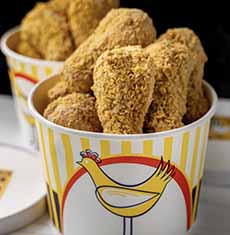
It’s a bucket of nine pieces of “Not Fried Chicken” Ice Cream.

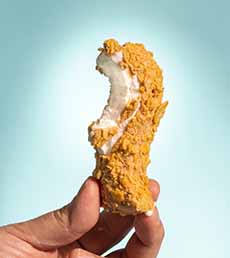
What looks just like a fried chicken drumstick is actually an intricate ice cream creation, complete with waffle ice cream, a chocolate-covered cookie “bone” and a coating of white chocolate and crushed corn flakes—and absolutely NO chicken.

It’s crispy, crunchy, creamy, salty, sweet, and as fun to eat as it is delicious.

Not Fried Chicken is the brainchild of pastry chef Cynthia Wong, owner of Life Raft Treats.

She writes on her website: “We are devoted to sparking joy and surprise through our unique, passionately crafted ice cream and sweets.”

She has a winner with Not Fried Chicken. It will bring a big smile, a happy palate, and a memory that will last.

All of her ice creams are made with high-quality locally-farmed dairy and eggs, and while she’s located in South Carolina, you can order Not Fried Chicken on Goldbelly.

Order your Not Fried Chicken here.

Of course, it’s not just for Father’s Day: You can send it to anybody, anytime.
 
 
> The history of ice cream.
 
> The different types of ice cream and other frozen treats.


Not Fried Chicken Bucket
[1] Yes, it’s really ice cream (photos © Life Raft Treats).

Not Fried Chicken Drumstick
[2] Bite into a “drumstick.” Each drumstick is three ounces.


CHECK OUT WHAT’S HAPPENING ON OUR HOME PAGE, THENIBBLE.COM.


Comments off

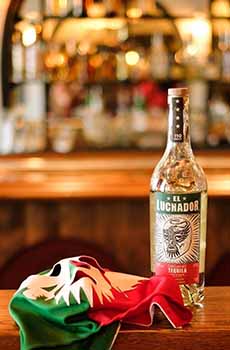
El Luchador Tequila For A Father’s Day Gift

El Luchador Tequila
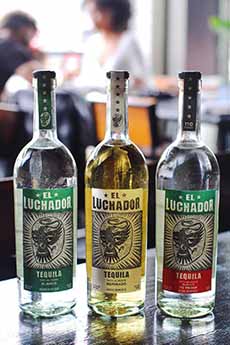
[1] El Luchador tequila, featuring a graphic of the famed Mexican Lucha Libre wrestlers (all photos © El Luchador Tequila).

El Luchador Tequila
[2] El Luchador Blanco, shown with a Lucha Libre wrestler mask.

El Luchador Tequila
[3] A Lucha Libre wrestler. They keep their identities a secret.


When we first saw El Luchador tequila, we thought: Great gift! We purchased several bottles as Father’s Day gifts. Because while any artisanal tequila is welcome to a tequila lover, a bottle with memorable branding is that much better.

The El Luchador portfolio of tequilas was inspired by the instantly recognizable-masks of Mexico’s colorful Lucha Libre wrestlers, whose acrobatic showmanship is a national cultural institution.

So is Mexico’s tequila, so connecting the two is a natural.

The use of the mascara or Lucha Libre mask that adorns the bottles was popularized by Santo, El Enmascarado de Plata (Saint, the Silver Masked Man).

A cultural icon, Santo is considered the greatest Luchador of all time. Here’s more about him.

Santo made his wrestling debut in the summer of 1942 and quickly captured the public’s fascination with his fighting ability and mysterious secret identity. He lied most of his entire life never showing his face.


THE EL LUCHADOR TEQUILA PORTFOLIO

Made from 100% blue agave with centuries-old artisan techniques, even the unaged Blanco expression is a delightful sipping tequila. The aging of the other expressions adds layers of complexity and sipping satisfaction.

The brand’s portfolio of outstanding tequila expressions includes:

  • El Luchador Blanco, unaged, delivers fresh agave and bright citrus notes ($39.99 SRP).
  • El Luchador Still Strength Blanco, the Blanco distilled to 110 proof, adds notes of nougat and coconut (55% ABV ).
  • El Luchador Reposado, aged for four to six months in French white oak barrels*, delivers flavors of roasted agave, citrus, and vanilla (40% ABV; $44.99 SRP).(/li>
  • El Luchador Añejo, aged 14 to 16 months in French white oak barrels*, has more finesse. That additional time in oak adds increasing layers of complexity with notes of deeply roasted agave, caramelized citrus, and vanilla.
  •  
    A release of an El Luchador Extra Añejo, aged for more than three years, is in the works.
     
     
    WHERE TO FIND EL LUCHADOR TEQUILA

    Check with your local liquor store, or order online.
     
     
    > The history of tequila.

    > The different types of tequila.

     
    ________________

    *The Reposado and Anejo aged expressions rest in French white oak barrels that once held the great white Burgundy wines of Puligny Montrachet.


    CHECK OUT WHAT’S HAPPENING ON OUR HOME PAGE, THENIBBLE.COM.


    Read article: http://elluchadortequila.blogspot.com/

    Comments off

    Savory Olive Oil Loaf Cake Recipe For National Olive Day

    June 1st is National Olive Day, celebrating what is likely the second-earliest-cultivated fruit (figs were first). The history of olives is below.

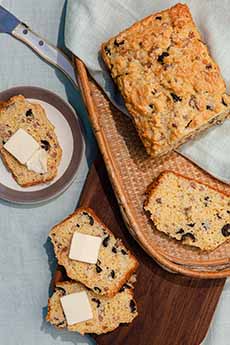
    Our featured recipe, created by Colavita Olive Oil, is called a “savory loaf cake.”

    It’s made with a combination of AP flour and cornmeal, plus olives and olive oil. As a bonus: cheese!

    The baked product is called a cake because, while savory, its crumb (the interior—i.e., everything under the crust) resembles a sweet loaf cake, also called a bread (zucchini bread, pumpkin bread, e.g.).

    If it were called olive bread—even an olive-semolina bread—you’d be expecting something very different (see photos #3, #4, #5, and #6).

    Call it what you like: It is so delicious, that one loaf isn’t enough. Next time, we’ll make four loaves: One for Day 1, one for Day 2, and two for the freezer.

    We ate it plain, with breakfast eggs, with soup and salad at lunch, and with grilled chicken and seafood at dinner (it goes with everything).

    We ate it buttered or slathered with cream cheese or other fresh cheese as a snack. We even added fig spread, and it was a nice counterpoint to the slight saltiness of the olives.

    And if we hadn’t finished the loaf, we’d have tried it with Greek/Mediterranean mezze.

    > The history of olives is below.
     
     
    RECIPE: SAVORY OLIVE OIL LOAF CAKE

    One question to decide up-front is what type of olive to use. Our preference is for full-on Mediterranean black olive flavors, such as Gaeta, Kalamata, and Niçoise varieties. If you prefer a green olive, use Castelvetrano or Picholine.
     
    Ingredients

    Prep time is 10 minutes, and cook time is 45 minutes.

  • 1½ cups unbleached all-purpose flour
  • ½ cup cornmeal
  • 2 tsp baking powder
  • 1 tsp salt
  • ¼ tsp black pepper
  • 3 large eggs
  • ⅓ cup milk
  • ⅓ cup extra virgin olive oil, plus more for greasing the pan
  • 1½ cups Fontina* cheese, coarsely grated
  • ½ cup Colavita Country Style olives, coarsely chopped
  • ________________

    *Substitute Emmental, Gouda, Gruyère, or Provolone
    ________________

    Preparation

    1. PREHEAT the oven to 350°F. Oil a 5″x9″ loaf pan.

    2. WHISK together the flour, baking powder, salt, and pepper in a large bowl.

    3. LIGHTLY WHISK the eggs in a medium bowl, then whisk in the milk and olive oil.

    4. FOLD the wet ingredients into the dry with a rubber spatula, just until barely mixed. Fold in prosciutto, olives, and cheese. Scrape the batter into the pan and smooth the top.

    5. BAKE the loaf until the top is golden and a toothpick inserted into the center comes out with just a few crumbs attached, 45 minutes.

    6. COOL the loaf in the pan for 5 minutes. Run a knife around the edges to release. Allow loaf to cool on a rack for about 30 minutes before slicing.
     
     
    THE HISTORY OF OLIVES

    The olive was first domesticated in the Eastern Mediterranean between 8,000 and 6,000 years ago, according to new research, which indicates that they were probably first cultivated from wild olive trees in Asia Minor, at the frontier between what is now Turkey and Syria [source].

    From there it spread to Iran, Palestine, and the rest of the Mediterranean. As mentioned earlier, among the world’s cultivated trees, it is second only to the fig. It was grown before the written language was invented. That’s perspective!

  • Olives were grown on Crete by 3,000 B.C.E. and may have been the source of the wealth of the Minoan kingdom there.
  • Olives have been found in Egyptian tombs dating from 2,000 years B.C.E.
  • The Phoenicians spread the olive to the Mediterranean shores of Africa and Southern Europe.
  • The olive culture was spread to the early Greeks and then the Romans. As the Romans extended their domain they brought the olive with them.
  •  
     
    Olives Come To The New World

    The Spaniards took olive cuttings to the New World in the mid-sixteenth century, first to Peru. From there, Franciscan Monks moved northward establishing missions and taking olives to Central America.

    In 1769, they planted the first olive cuttings in California at the San Diego Mission (hence, the name Mission olive). Olives thrived in California’s climate.

    Over the past several hundred years the olive has spread to North and South America, Japan, Australia, and New Zealand [source].

    In the U.S., Franciscan monks establishing missions in California also planted olive groves. Southern California saw the first olive trees.

    But all of the California olives were pressed into oil, which was used for food, fuel, grooming, medicine, and religious rites.

    Thousands of acres of olive trees were planted in response to the high demand for olive oil in the 1800s. When the market became saturated (ironically, with monounsaturated oil), prices dropped, and farmers were tasked with finding an alternative use for their olive trees.
     
     
    Olives Become Food, Not Just Oil

    A grower named Freda Ehmann came up with a resourceful solution to the industry’s problem. After consulting with a U.C. Berkeley professor about processing methods, she began experimenting with pickling methods and discovered a formula that resulted in table olives (i.e., those eaten directly or used in creating recipes), that could be sold loose from containers or prepackaged. product. Thanks to her initiative, the condiment* olive industry was born [source].

    The olive, Olea europaea, is a member of Oleaceae, known as the olive family, with 27 extant genera. Botany geeks can go up one level, to the order, Lamiales, one of the largest orders of flowering plants, which includes the ash tree, basil, garden sage, jasmine, lavender, lilac, mint, olive, rosemary, sesame, snapdragon, and teak.

    > Here’s the history of olive oil.


    Savory Olive Oil Loaf Cake
    [1] This savory olive loaf cake is delicious for a bread basket, for snacking, and anything in-between (photo © Colavita).
    Savory Olive Oil Loaf Cake
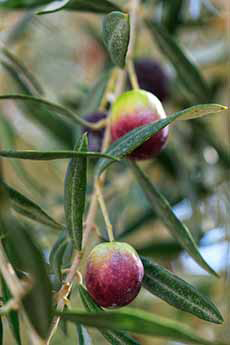
    [2] We used black olives in this recipe, shown here, ripening on the branch. Beautiful, aren’t they (photo © Sule Bas | Pexels)?
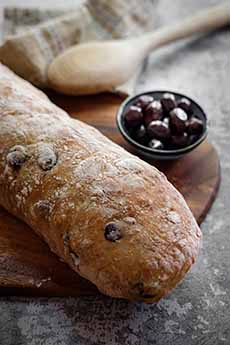
    Olive Oil Loaf Cake
    [3] A loaf of Italian-style olive bread (photo © Vincent Ghillione | Unsplash).
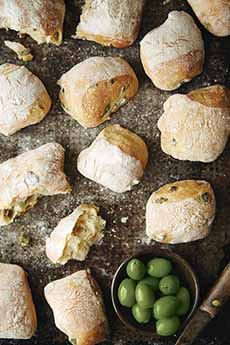
    Olive Oil Loaf Cake
    [4] Olive sourdough rolls. Here’s the recipe (photos #4 and #5 © King Arthur Baking).
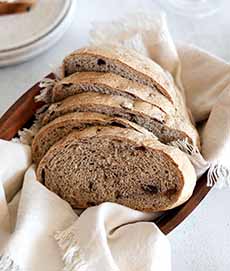
    Savory Olive Oil Loaf Cake
    [5] Greek olive and onion bread. Here’s the recipe.
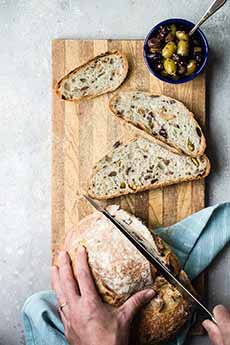
    Savory Olive Oil Loaf Cake
    [6] Another traditional loaf of olive bread. Here’s the recipe (photo © Foodness Gracious).


    ________________

    *What is a condiment? A condiment is an auxiliary food product that adds flavor to another food. While we normally think of capers, chutney, gravy, hot sauce, mayonnaise, mustard, oil, tartar sauce, soy sauce, vinegar, and Worcestershire sauce as condiments, the category includes “standalone” products such as olives and pickles, as well. The definition in Merriam-Webster is, “something used to enhance the flavor of food, especially a pungent seasoning.” They pinpoint the first use of the word in the 15th century. The term condiment comes from the Latin condimentum, meaning “spice, seasoning, sauce,” and from the Latin condire, meaning “preserve, pickle, season.” The term originally described pickled or preserved foods, but its meaning has changed over time.


    CHECK OUT WHAT’S HAPPENING ON OUR HOME PAGE, THENIBBLE.COM.


    Comments off

    FOOD FUN: Pound Cake Sundae Recipe & The History Of Hot Fudge

    Pound Cake Sundae Recipe
    [1] Just buy four ingredients and assemble (photo © Sticky Walnut).

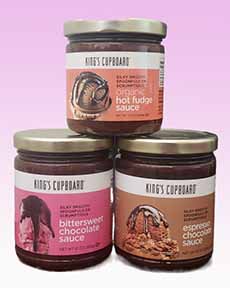
    King's Cupboard Chocolate Sauce
    [2] Use a good chocolate sauce for this recipe, or it can get cloying. King’s Cupboard, one of our favorite brands, has Bittersweet, Organic, Espresso, Sea Salt, and Sugar-Free hot fudge sauces. You can buy them online (photo © King’s Cupboard).

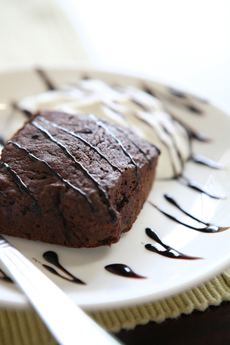
    Pound Cake Sundae Recipe
    [3] How to make a brownie into a more special dessert? Garnish with a bit of fudge sauce and whipped cream (photo © Dreamstime).

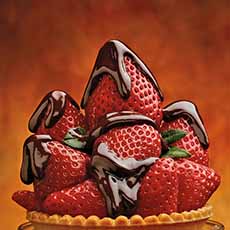
    Strawberry Tart With Chocolate Sauce
    [4] Add a chocolate garnish to tarts and other desserts (photo © King’s Cupboard | Facebook).

    Hot Fudge Sundae
    [5] The most popular use for hot fudge: a hot fudge sundae (photo © Lauri Patterson | iStock Photo).


    When we came across this photo in our Twitter feed, we were reminded of a favorite dessert of our young adulthood: a toasted pound cake sundae with hot fudge or caramel.

    After our neighborhood Rocking Horse Café closed, our source of an immediate fix was gone. And for some reason, nobody else was selling them then, and even now, to the best of our knowledge.

    Why not?

    It’s the easiest “fancy” dessert to make at home—that is, if you buy the ingredients instead of making them all from scratch, as is done by Sticky Walnut restaurant in Chester, England.

    So there’s no need to get out the cake pans, the ice cream machine, and the double boiler.

    Sticky Walnut’s dessert, which they call “a lovely little indulgent way to finish off your meal,” reminds us that it doesn’t have to be a big portion.

    They topped the square of cake with mint chocolate ice cream and dark chocolate sauce.

    So here’s your shopping list:

  • Pound cake or other cake of choice, as long as you can slice it into a square or rectangle
  • Chocolate chip mint ice cream, or flavor of choice
  • Chocolate sauce, plain or flavored (espresso, mint, orange, etc.)
  • Garnish: tuile or other small cookie (a macaron works)
  •  
    If you choose to toast the pound cake, it will not get soggy as quickly.

    However, is there something worse than a piece of pound cake drenched with chocolate sauce and melting ice cream?

    The big question is:

    Is this cake à la mode, or a pound cake ice cream sundae?

    Whichever, it’s delicious.
     
     
    THE HISTORY OF HOT FUDGE SAUCE

    Simple chocolate sauces likely existed shortly after cacao came to the Old World in the 16th century. The ground beans were first made into hot chocolate, following the beverage usage for cacao by the Aztecs, Mayas, and other Central Americans.

    But cooks in Spain and Italy who experimented with the cacao beans no doubt ported the ground beans they used for beverages into sauces, both sweet and savory. We know that in 1674 there were chocolate puddings and pastilles* [source].

    Pharmacists first created chocolate syrups with cocoa powder and sugar in the 19th century. In 1828 that a chemist in the Netherlands, Coenrad J. Van Houten, took out a patent for a process to manufacture a type of chocolate with a much-reduced fat content. This chocolate, which was made in block or cake form, could be easily reduced to a fine powder—i.e., cocoa powder.

    Cocoa powder was one step away from chocolate syrup: Just mix the powder with sugar and water. The popularity of pharmacist-made chocolate syrup exploded in the late 19th century [source].

    Chocolate sauce vs. chocolate syrup: A syrup is a flavored sugar solution.

  • Chocolate syrup is chocolate-flavored sugar syrup.
  • Chocolate sauce is a sauce is thicker, with a greater concentration of the flavor. It has a higher percentage of cocoa powder than chocolate syrup, and a lower percentage of sugar.
  •  
     
    Finally, Hot Fudge Sauce

    Real hot fudge sauce came in the late-19th century. The first hot fudge sauces likely resulted from early fudge-making failures, when the ingredients that wouldn’t solidify into fudge were eaten up with a spoon (the history of fudge).

    By the 20th century, people began deliberately undercooking fudge so they could serve it warm over ice cream, creating banana splits, hot fudge sundaes, and other soda fountain treats.

    The hot fudge sundae was one of many ice cream sodas, floats, and sundaes that were created during Prohibition, when the bars were closed and many people hung out at the soda shop (often the soda counter of the local drugstore).

    Fudge sauce is different from ordinary chocolate sauce, which is made from cocoa powder, sugar, salt, and vanilla.

    Fudge sauce adds cream and butter. It’s made like those early fudge failures: It’s fudge that never sets.

    Cream or milk, sugar, and butter are slowly boiled down until slightly thickened and light caramel-colored. The boiling-down process not only gives the sauce a thicker texture, but also contributes to the “fudgy” taste of the sauce.

    Today, hot fudge sauce recipes almost always include corn syrup, which contains anti-setting properties that prevent fudge from turning into thick fudge candy regardless of the cooking time [source].
     
     
    > The history of the sundae.

    > The history of pound cake.

    > The history of ice cream.

     
    ________________

    *There are different definitions for “pastille.” Today, in the U.K., they refer to chewy gel candies (like Rountree’s). On the Continent, they are small hard candies used for lozenges, flavored with fruit or herbs. Still other companies, like Droste, sell tubes of small, flat, round chocolate pieces they call pastilles. The original pastilles were the latter, hard chocolate.


    CHECK OUT WHAT’S HAPPENING ON OUR HOME PAGE, THENIBBLE.COM.


    Comments off

    Biscuits With Appetizers For National Biscuit Day

    May 29th is National Biscuit Day. How about biscuits with appetizers?

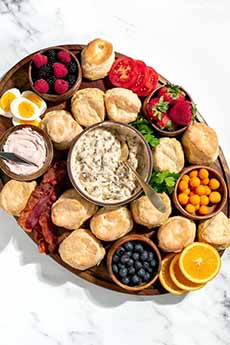
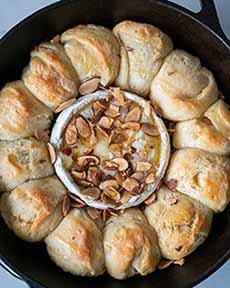
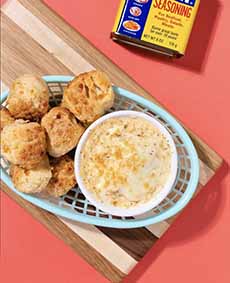
    Serve biscuits instead of other breads or crackers with appetizer plates, cheese boards, dips, spreads, and specialties like Baked Brie (photos #1, #2, and #3).

    Whether warm from the oven or room temperature, they’re that much more of a treat.
     
     
    WHAT IS A BISCUIT?

    In the U.K., ask for a “biscuit” and you may be surprised.

    • In the U.K., a biscuit is a cookie or a cracker, not a bread product.
    • What Americans think of as a roll or biscuit is a scone in the U.K.
    • An American roll is a British cob.
    • An American English muffin is a British muffin (the history of the English muffin—invented by a British immigrant to the U.S.).
    • A bun in the U.K. may look like a kind of American roll, but it is sweet, what Americans call a sweet roll or sweet bun.
    • A burger bun is called a bap. And so on, and so forth.

    > Here’s a longer discussion of the different American and British terms.

    > The history of biscuits.

    > The history of bread.

    > The different types of bread.

    Check out the yummy biscuit recipes below.
     
     
    TYPES OF BISCUITS

    • Angel Biscuits. These lighter, fluffier biscuits are made with yeast. They rise before being baked.
    • Drop Biscuits. A wet dough is dropped from a spoon onto a baking sheet. They’re not shapely like cut-out rounds, but just as delicious.
    • Dumplings. The dumplings in the chicken and dumplings recipe are actually smaller drop biscuits. The biscuits are steamed in a pot rather than baked, and are served atop a hearty chicken stew.
    • Rolled Biscuits. Also called baking powder biscuits, the dough is rolled out, then cut into rounds, and baked.
    • Scones. Yes, scones are biscuits, even the versions that add cream and butter.
    • Shortcake. The same biscuits used for shortcake—sliced in half and topped with whipped cream and berries added—are also popular in the bread basket. Scones can be used as well.
    • Southern Buttermilk Biscuits. Loaded with butter and buttermilk, the result is rich and flaky. Baking soda is also often added to make the biscuit fluffier.

    There are numerous variations on the above. Some of them:

    • Self-rising biscuits are made with self-rising flour.
    • Cream biscuits are made with heavy cream.
    • Sourdough biscuits are made with sourdough starter.


    MORE BISCUIT RECIPES

    Biscuits & Appetizers For National Biscuit Day
    [1] An appetizer board with biscuits instead of crackers and baguette slices (all photos © Mason Dixie Foods).

    Baked Brie & Biscuits For National Biscuit Day
    [2] Baked Brie with biscuits instead of crackers and party breads. Here’s a recipe.

    Maryland Crab Dip & Biscuits For National Biscuit Day
    [3] Scoop up Maryland crab dip with biscuits. Here’s the recipe.


    CHECK OUT WHAT’S HAPPENING ON OUR HOME PAGE, THENIBBLE.COM.


    Comments off

    The Nibble Webzine Of Food Adventures


    © Copyright 2005-2026 Lifestyle Direct, Inc. All rights reserved. All images are copyrighted to their respective owners.